
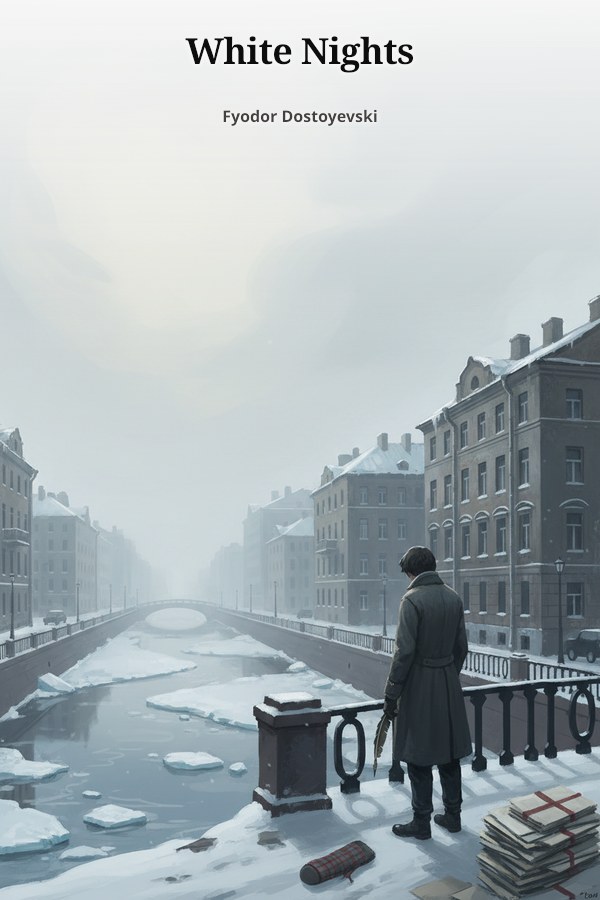
Fyodor Dostoyevski
Dostoevsky's famous 1848 work White Nights is a melancholic story set during the summer nights in St. Petersburg where the sun does not set and twilight prevails, built upon themes of loneliness, dreams, and impossible love. It concerns the four-night friendship and love between an unnamed, dreamy narrator and a young girl named Nastenka.
The conflict between an individual's inner desires and innocence, and the freezing, isolated real world (as well as their own weak will). Dreamers, jealous husbands, and weak-willed clerks strive to protect their minds, honor, or hearts against the rigid rules of the outside world.
St. Petersburg, Russia. Streets, canals (banks of the Fontanka), unpretentious attic apartments, cold squares, and the theater boxes of the Bolshoi.
Mid-19th century (approximately the 1840s).
A foggy, cold, gloomy, and isolated atmosphere of St. Petersburg. The crushing weight of bureaucracy and reality prevails during the day, while the melancholy yet magical silence of dreams and reveries dominates at night.
Mostly first-person narrative told by the main character experiencing the events (the Dreamer, Astafiy Ivanovich), interspersed with a third-person perspective that closely follows the inner worlds of the characters.
In the nineteenth-century Tsarist Russian city of St. Petersburg, status, rank, and material wealth are paramount. People are valued by the titles they hold. Desperate, statusless clerks or ordinary people are ostracized by society; consequently, they suffer from loneliness and become trapped within their own dream worlds or obsessive feelings of gratitude and jealousy.
It is an era where society is governed by a deep hierarchy, bureaucratic obedience, and material expectations. Low-ranking clerks live hand-to-mouth while harboring an almost pathological submission toward their superiors. Marriages are generally shaped not around love, but around dowries and social status.
Characters are arranged at equal intervals on a circle; you can read the relationship type and dynamics by clicking on the lines.
Bir çizgiye tıklayarak ilişki detayını açın.
The Dreamer becomes attached to Nastenka with all his being and self-sacrifice, dedicating himself to her happiness. While Nastenka feels sincere friendship and gratitude toward him, she is truly bound in heart to her fiancé; the balance of power lies entirely in Nastenka's hands.
Nastenka giving him hope by saying, 'I love you because you are not like those cynical people,' but then immediately throwing herself into her fiancé's arms when he arrives.
A relationship based on waiting and one-sided hope. The lodger is rational enough to refuse marriage before securing financial independence, while Nastenka is passionate enough to wait for him faithfully for a year.
Before leaving for Moscow, the lodger binds Nastenka with a promise, saying, 'If we don't love each other when I return in a year, we are free.'
While the husband follows his wife with constant bouts of suspicion and jealousy, the wife is the party who can lie easily and holds control. Ivan Andreyevich loses his authority by repeatedly making a fool of himself.
The moment Ivan Andreyevich emerges from under someone's bed to confront his wife, Glafira immediately reverses the situation and blames him.
The absurd rivalry of two men who encounter each other in front of the same woman's apartment and keep watch on one another. Even though they are partners in misfortune under the bed inside the house, they hold each other in contempt.
When they meet under the bed in the dark, the young man threatens to bite Ivan Andreyevich's nose or hand to keep him silent.
Out of pity, Astafiy takes Yemelya into his home and teaches him morals. Yemelya acts like a submissive, obedient dog, but due to his lack of willpower, he lies and steals; Astafiy holds the moral high ground.
Astafiy scolding Yemelya by saying, 'They dismissed you from your job because you are a drunk,' and Yemelya remaining silent while shedding tears.
Arkadiy approaches Vasya with deep affection and a protective instinct. Vasya also loves him dearly, but due to his own hysterical feelings of gratitude and his personal weaknesses, he does not allow Arkadiy to save him.
Arkady’s frantic attempts to save Vasya while Vasya suffers a breakdown for failing to complete his work, insisting, 'I will save you, I will explain the situation to Mastakovich myself.'
Julian Mastakovich is a god-like figure in Vasya’s eyes. Vasya, who considers even being given extra work by him a great favor, descends into madness out of fear of disappointing him.
Vasya weeping and saying, 'Today Julian Mastakovich gave me fifty silver rubles,' and losing his mind under the burden of thinking he had betrayed his trust.