
Namık Kemal
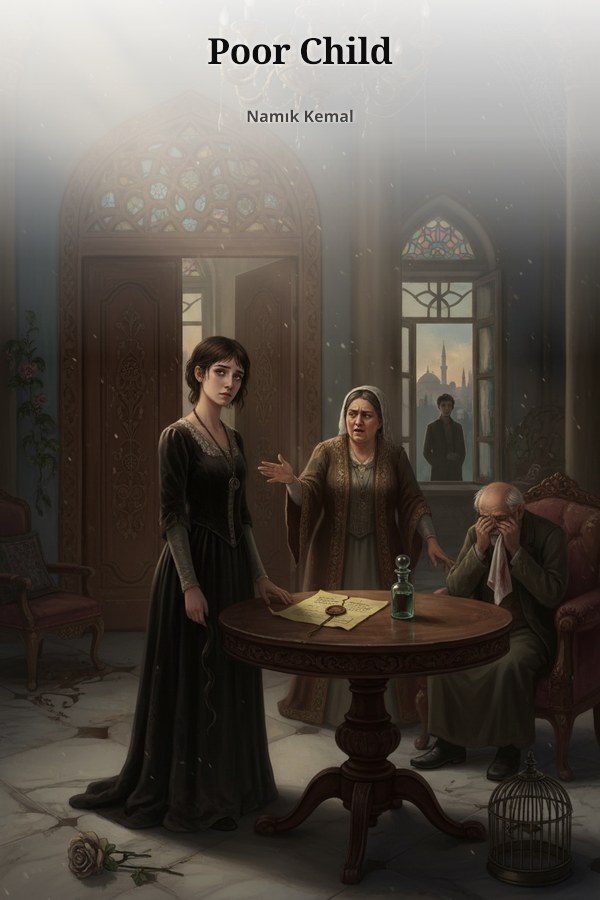
Zavallı Çocuk is a famous three-act play written by Namık Kemal while in exile in Famagusta, dealing with the tragedies caused by arranged marriages and family pressure.
The tragic dilemma between Sefika’s feelings for Ata, whom she has loved passionately since childhood, and her being forced to marry a 38-year-old pasha to save her father, who is facing bankruptcy and imprisonment. Traditional and material pressures destroy individual freedom and love.
The interiors of a mansion in Istanbul belonging to Halil Bey and Tahire Hanım, once wealthy but now in deep debt.
19th Century (Ottoman Empire period, likely the Tanzimat era, the 1870s).
Heavy, dramatic, bleak, and intensely melancholic. The hopeful atmosphere of love at the beginning of the work rapidly gives way to despair born of financial deadlock, followed by a tragedy filled with illness, death, and pain.
As it is a theatrical work (play), the author's voice is directly felt in the stage directions within parentheses (which are somewhat directive and emotional in tone). The story is presented from an objective external perspective through the characters' internal dramatic conflicts, dialogues, and long monologues.
Social norms and the survival of the family take precedence over the individual's personal happiness and desires. Families in financial collapse seek salvation by marrying their daughters to wealthy, elderly men (a social reality of the Tanzimat era). In a world where medical means are insufficient, mental anguish and trauma manifest directly as terminal illnesses (such as tuberculosis), exerting a ruthless rule over the body.
It is a classic Ottoman family structure where, despite the appearance of a patriarchal system, the mother figure (specifically Tahire Hanim) is extremely dominant in the management of marriage and domestic crises, and unconditional obedience to parents is expected. The marriage of young girls at a tender age to much older, influential men solely for wealth and status (arranged marriage) is a festering wound within the social context.
Characters are arranged at equal intervals on a circle; you can read the relationship type and dynamics by clicking on the lines.
Bir çizgiye tıklayarak ilişki detayını açın.
The pure, innocent, and mortally intense romantic love felt by two young people who grew up together. The dynamics are shaped by unshakable loyalty, prioritizing each other above everything, and an extreme devotion that leads them to choose to die together once their destinies are parted.
"If I am to perish with love for Ata, shall I not see his face even once in my final breath?" / Ata drinking poison as Sefika dies.
An authoritarian, manipulative, and pragmatic mother and an obedient, heartbroken daughter. The mother ignores her daughter's feelings with the motivation of saving the family; she enslaves her daughter by creating emotional manipulation and a sense of guilt.
"Do you want your dear father to rot in prison, me to die of grief, and your delicate sister to be thrown onto the streets?"
An affectionate but helpless and guilt-ridden father-daughter attitude. The father senses his daughter's unhappiness, and while he wants to protect her, he cannot show willpower due to his financial exhaustion; the daughter sacrifices herself because she cannot bear to see her father suffer.
"Sacrifice... let it be a sacrifice. Let my heart be sacrificed, let my life be sacrificed. I will do it. From now on, I will do whatever you order."
A parental dynamic where Tahire Hanim dominates decision-making processes, while Halil Bey is marginalized. The woman takes on the role of the family's 'savior' and is ruthless, while the man remains a spectator filled with remorse.
"Do whatever you want, mother and daughter! I don't understand your business. I won't interfere."
Although Tahire Hanim views Ata as one of the family and an 'orphan' raised in the house, she completely devalues him as a suitor for her daughter due to class and financial expectations.
"Has anyone who married their relative ever found peace? And how will they make a living? Won't Ata graduate from school as a captain? What is a captain's salary worth? Will you give your daughter away to be a servant?"
Tabende is the servant of the house. She represents a practical mind, and far from the romanticism of the period, she dismisses Sefika's love in a shallow manner because she is too young.
Tabende belittling Sefika's feelings by saying, "What would a child your age know about loving?"
Halil respects Ata's talent, has sent him to medical school, and may internally find him a suitable suitor, but he cannot support Ata against his wife's dominant interests.
"Ata says the same as I do, my daughter!... Have you not heard of the earnings of physicians? Do you not know how capable Ata is?"
Asymmetric respect in the form of a professional master-apprentice relationship. Ata is a medical student; he knows how to diagnose, and in the final act, he makes his own diagnosis where the physician's intervention proves insufficient, thereby preparing for death.
Ata acting like a physician and writing a mock prescription for Sefika, saying, "Sir! Would you send this to the pharmacist next to the door?" while secretly having poison brought.