

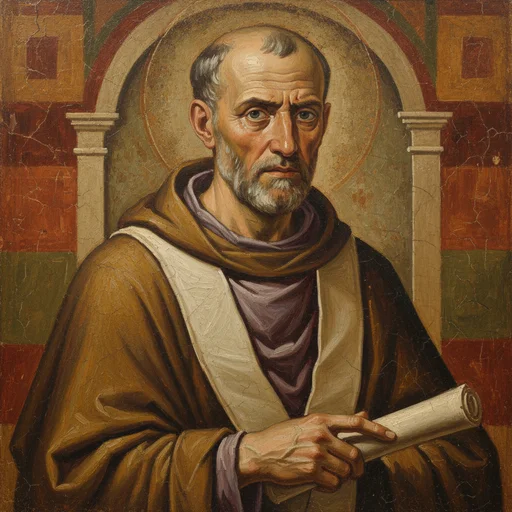
He was born on 13 November 354 in Thagaste, a town in Numidia, Rome's North African province. His father, Patricius, was a minor local official who gave up his pagan faith only near the end of his life; his mother, Monica, was a Christian whose hold on her son never loosened. He studied grammar and rhetoric at Madauros and then at Carthage; in the great city the provincial boy discovered both his ambition and his waywardness. At eighteen he read Cicero's Hortensius, and it turned him towards philosophy. For some nine years he belonged to the circle of Manichaean "hearers", teaching rhetoric at Thagaste and Carthage. In Carthage the woman he lived with bore him a son, Adeodatus. In 383 he moved to Rome and from there to Milan, seat of the imperial court, where he became the city's salaried professor of rhetoric. In Milan the sermons of Bishop Ambrose and the writings of the Neoplatonists broke his ties with Manichaeism. In the summer of 386, in a garden, he heard a voice saying "take up and read" and opened Paul's letter: this was the turning point of his life. The following Easter, Ambrose baptised him. On the journey back to Africa he lost his mother at Ostia. At Thagaste he founded a quasi-monastic community; in 391 he was ordained priest at Hippo Regius and around 395 became its bishop. He wrote the Confessions between 397 and 400: addressed to God and probing his own past, the book changed how the inner life was written about in the West. After the sack of Rome in 410 he began The City of God, which took him years to finish. His way of interrogating memory, desire and time turned theological writing into a language of confession and self-examination. He died on 28 August 430 in Hippo, while the Vandals were besieging it.
Born in Tagaste to a devout mother and a pagan father. In his youth, he struggled with the study of classical languages; though he disliked learning, he studied out of fear of corporal punishment. In his adolescence, he devoted himself to sensual pleasures, theft (the pear-stealing incident), and spectacles. He became a teacher of rhetoric to become a wealthy and respected man. For many years, he lived with a woman out of wedlock, and they had a son named Adeodatus. For years, he served the dark beliefs of the Manichaean sect.
Although the author's inner state (swollen eyes, groaning chest, weary body, etc.) is conveyed throughout the text, a standard physical description remains obscured behind depictions of scripture and confession. However, one can perceive an observant gaze carrying intellectual weight and a weary yet resilient posture.
Monika
Kendisini dünyevi uçurumlardan kurtarmak için ömrü boyunca gözyaşı döken ve dua eden vefakar annesi.
Tanrı
Ruhunun her saniyesini ithaf ettiği yaratıcısı, mutlak aşkı ve merhamet dilediği Rabbi.
Alypius
Günahı ve aydınlanmayı birlikte deneyimlediği en güvendiği ahlaki yoldaşı.
Ambrosius
İlahi gerçekleri kelimelerin ötesinde anlamasını sağlayan ruhani mentoru.