

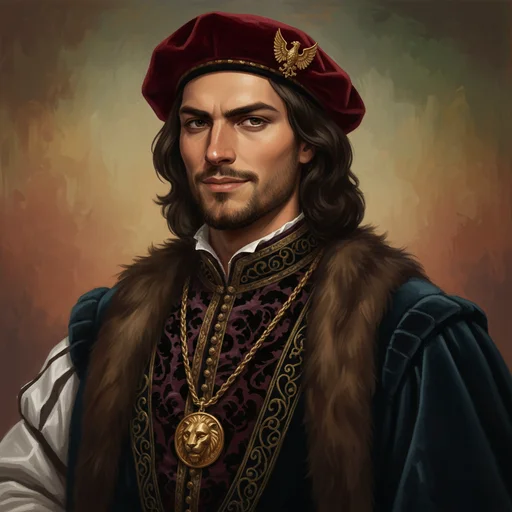
Cesare Borgia, son of Pope Alexander VI, is the most competent historical example of Machiavelli's 'Prince' model. By skillfully using his father's Papal office and French military support, he created a state out of nothing in the Romagna region. He personally displayed all kinds of ruthlessness, cunning, and strategic skill required to hold on to his state on the field. He made it a priority to build his own army and wisely liquidated unreliable mercenaries. By shifting the burden of oppression and violence onto people like his sub-administrator Remirro de Orco, he positioned himself in the eyes of the public as a clean ruler who is both feared and respected. Only due to misfortunes completely outside human control, such as the sudden death of his father and his own being critically ill at the same time, was he unable to maintain his empire. Despite this, he is shown by Machiavelli as a perfect object of imitation for every leader who establishes a state from scratch.
As the illegitimate child of Pope Alexander VI, he rose to the cardinalate within the Church with the opportunities provided by his father, but rejected religious life and jumped into the political and military arena. With the help of the King of France, he received the title of 'Duke of Valentino', took advantage of the political corruption in Italy, seized small principalities one by one, and attempted to sow the seeds of a centralized state in Italy.
Although there is no direct physical description in the work, he paints a picture of a dark, magnificent duke who is charismatic, constantly calculating, and has a noble knightly posture with the self-confidence provided by his military power.
Papa II. Julius
His fierce enemy who supported his rise to power but ultimately caused his downfall.
Remirro de Orco
The pawn to whom he had his bloody work done for the sake of state order and whom he later sacrificed.
Papa VI. Alexander
His great supporter and the origin of his political power.