

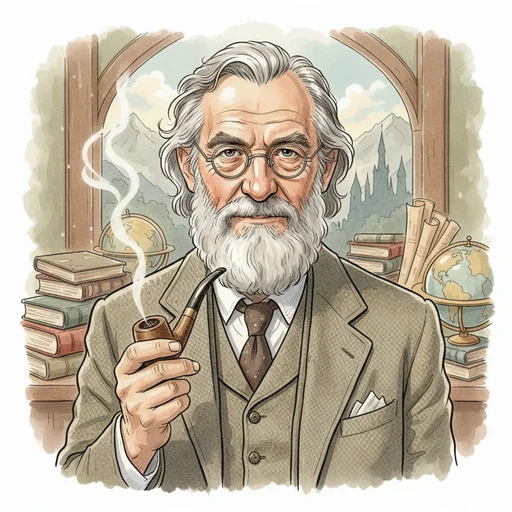
John Ronald Reuel Tolkien was born on 3 January 1892 in Bloemfontein, South Africa. When his mother returned to England with her two sons in 1895, his father Arthur, a bank manager who had stayed behind, died there the following year. His childhood was spent in the countryside near Birmingham. His mother Mabel converted to Catholicism in 1900; when she died of diabetes in 1904, the two brothers passed into the guardianship of Father Francis Morgan. In his school years, old languages and the alphabets he invented himself became his real occupation. At Exeter College, Oxford, he moved from classical philology to English language and graduated with first-class honours in 1915. In 1916 he married Edith Bratt and was sent that same year as an officer to the Somme. The fever he caught in the trenches brought him back to England; during the months of his convalescence he began The Book of Lost Tales, which would later grow into The Silmarillion. After the war he worked on the Oxford English Dictionary, taught at Leeds, and returned to Oxford in 1925 as Professor of Anglo-Saxon. His 1936 lecture on Beowulf opened the way for the poem to be read as literature. The Hobbit, born from a tale he told his children, appeared in 1937; when a sequel was asked for, a labour of more than ten years began, and The Lord of the Rings was published in three volumes in 1954-1955. Tolkien built the languages first and then the peoples who would speak them; the world he described had its own map, its own calendar, its own poetry. His grave manner, leaning on the language of epic, kept critics at a distance for a long time, while readers passed the book from hand to hand. Edith died in 1971; Tolkien died on 2 September 1973 in Bournemouth and was buried in Oxford beside his wife. The unfinished Silmarillion was compiled by his son Christopher and published in 1977.
Mid-20th century, England, academic attire or tweed suit, elderly man with a pipe, scholarly surroundings.