

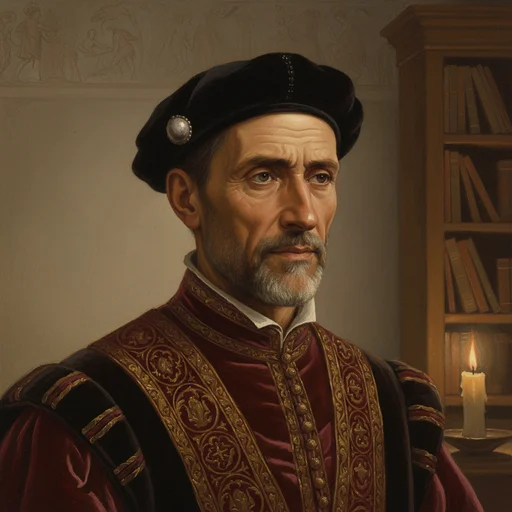
Niccolò Machiavelli was born in Florence on 3 May 1469. His father, Bernardo, had studied law but his debts kept him from practising it freely; his mother was Bartolomea de' Nelli. The family still carried an old name, but no money. Niccolò began Latin at seven, though his real school was his father's library, full of Roman authors. After Savonarola's fall, in 1498, at twenty-nine, he was elected secretary of the Second Chancery of the Florentine Republic. For fourteen years he was on the road on diplomatic missions: in 1502 he waited for months at Cesare Borgia's camp, in 1510 he went to the court of Louis XII. His writing was born in those dispatches; there he learned to describe states, armies and men with a cool eye. When the Medici returned to Florence in 1512 he lost his post; the following year he was jailed and tortured on suspicion of conspiracy. He withdrew to his farm at Sant'Andrea in Percussina. In a letter of December 1513 to Francesco Vettori he described his days among peasants and his evenings spent before the ancient writers, composing a small book: The Prince. Then came the Discourses on Livy, The Art of War, The Mandrake and the Florentine Histories. His style is short, hard and unadorned; instead of passing moral judgement it claims to see things as they are. He took politics out of theology and out of the language of virtue and made it a subject of study in its own right, and he gave Italian prose a living voice close to ordinary speech. When the Medici were driven out again in 1527 he hoped to recover his old office, but his past ties told against him. He died in Florence on 21 June 1527 and was buried in Santa Croce.
He served as the 'Second Secretary' of Florence for fourteen years, sat at negotiation tables directly with the King of France, Cesare Borgia, and many Roman popes. Having seen his country dragged from disaster to disaster by the betrayal of mercenary soldiers, he harbored a deep anger regarding this subject. Subjecting him to unjust torture proved to him the ungrateful nature of life and power.
An impoverished intellectual who possesses a resilient spirit that survived torture; as he notes in his dusty letters, he spends his days in taverns wearing coarse, mud-stained daily clothes, but at night, he dons noble attire fit for converse with historical sages when entering his study.
İtalyan Halkı
Untrained masses who do not understand reality, but who will show loyalty when governed by a strong prince.
Lorenzo de Medici
The potential authority figure to whom he dedicated his work with the hope that he would save a divided Italy.