
Paulo Coelho
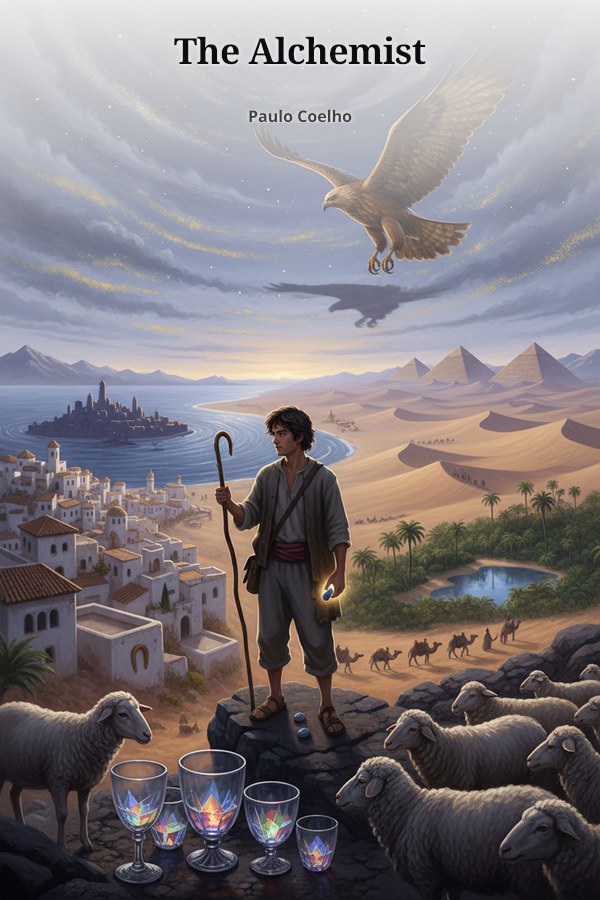
Paulo Coelho’s cult novel The Alchemist recounts the fabled and philosophical journey of an Andalusian shepherd named Santiago as he sets out to find treasure. Based primarily on the concept of the "Personal Legend," the work advocates for following one's dreams, listening to one's heart, and living in harmony with the soul of the world.
The relentless struggle on Santiago's path to achieve his Personal Legend; the conflict between his own fears, the desire to give up, his attachment to temporary comfort zones (sheep, the merchant's shop, love), and his soul's thirst for universal truth.
The Andalusia region of Spain (Tarifa), Tangier (Morocco), a city on the Strait of Gibraltar, the Sahara Desert, the Al-Fayoum Oasis in Egypt, and finally the Pyramids of Giza.
Although a specific date is never mentioned, it is a nostalgic and legendary pre-modern period dominated by swords, camels, desert Bedouins, and ancient Andalusian-Arab cultural motifs.
A mystical, philosophical, spiritual, poetic, and adventurous atmosphere. A magical realist texture prevails, where world wonders, deserts, stars, and oases are intertwined, evoking a feeling of a fairytale yet profound reality.
Third-person omniscient narrator who, however, remains entirely focused on the experiences, inner struggles, and visions of the protagonist, Santiago.
Everything in the universe (minerals, animals, humans, stars) is part of a single whole called the 'Soul of the World.' There is a 'Universal Language' shared by the entire world, hidden in silence and natural phenomena. When a person wishes to realize their 'Personal Legend' (their deepest dream), the whole universe conspires to help them. Life sends 'omens' that one must follow; to see these omens, one must listen to the heart and overcome fear.
A setting where the mysticism of Islamic and Arab culture is blended with Christian and Spanish shepherding culture, and ancient alchemical traditions meet universal philosophy. It emphasizes the 'Divine Unity' at the essence of faith rather than religious rituals.
Characters are arranged at equal intervals on a circle; you can read the relationship type and dynamics by clicking on the lines.
Bir çizgiye tıklayarak ilişki detayını açın.
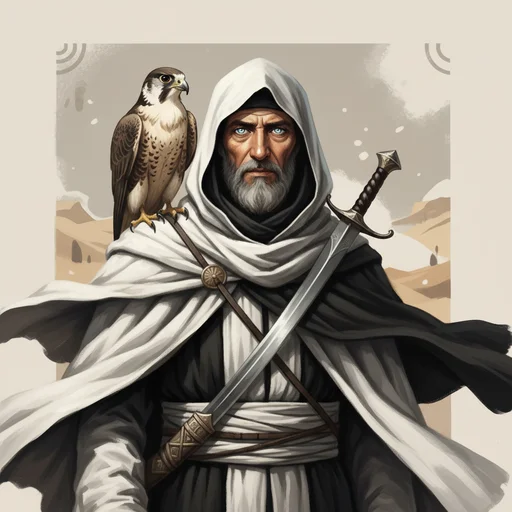
While the Alchemist is the wise figure who knows everything and guides, Santiago is the student learning through tests. The Alchemist ensures Santiago uncovers the wisdom he already possesses and compels him to face his fears.
The Alchemist tested Santiago's life by ordering him to transform into the wind in the desert, forcing him to discover his own inner power.
Built on respect, infinite support, and trust. Fatima, a woman of the desert, knows the virtue of waiting, while Santiago has a sanctuary to which he is certain he will return once his goal is achieved. Their love is not an obstacle to his Personal Legend, but a support.
Fatima encourages Santiago to continue his journey in the desert and seek his treasure, even at the risk of losing him.
Melchizedek is an old and wise figure who sparks a fire in Santiago's mind to see and desire more. He exists briefly but establishes the foundational philosophy of Santiago's entire journey.
He is the first to tell him about a person's Personal Legend and gives him the stones Urim and Thummim to help him make decisions along the way.
While the merchant represents the status quo and fear, Santiago represents innovation and progress. While Santiago revitalizes the shop and enriches the merchant, the merchant inadvertently provides Santiago with the patience needed to return to his journey.
The merchant first resisted then accepted Santiago's ideas for cleaning the display and selling tea, and a compassionate bond formed between them.
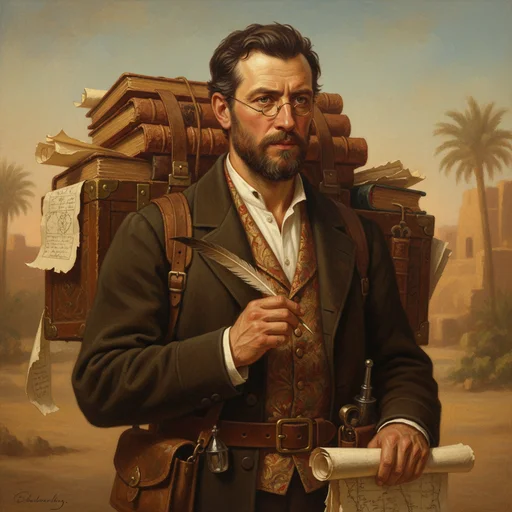
Both are chasing the same treasure or knowledge, but their methods differ. The Englishman relies entirely on books and theoretical knowledge, while Santiago trusts the practical language of life, nature, and the desert. They draw inspiration from one another.
Along the way, they offered each other advice on testing the power of books through observation.
For the Englishman, the Alchemist is like an idol to be reached; however, the Alchemist finds the Englishman's years of reading incomplete and pushes him toward practice, sending him off to melt lead on his own.
Instead of asking about his theories, the Alchemist shook the Englishman by saying, 'Go and try it in your furnace.'
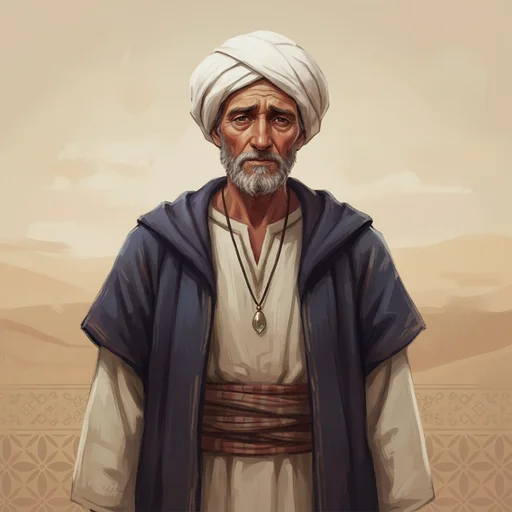
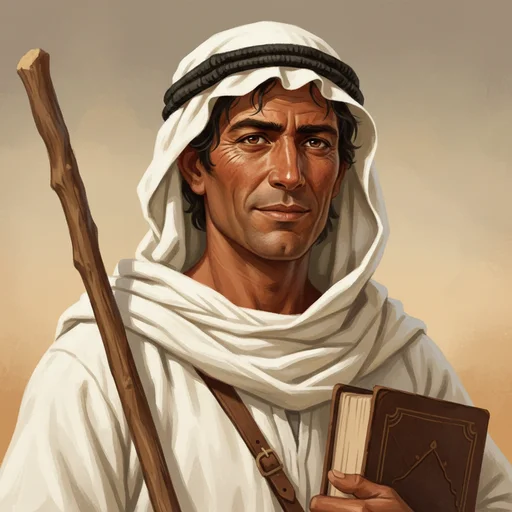
The camel driver is an ordinary but wise guide who teaches Santiago to live in the moment (focusing on the present) by learning from past disasters (his field being flooded) and introducing him to the East.
Even when faced with the risk of death in the desert, the camel driver taught Santiago not to be afraid by saying, 'I am only in the present.'
The Gypsy woman is the initial driving force that directs Santiago to Egypt by giving concrete form to his dream, but Santiago approaches her with caution, sensing her untrustworthy and self-serving nature.
Santiago's disappointment stems from her making him swear to give her one-tenth of the treasure if he finds it.