

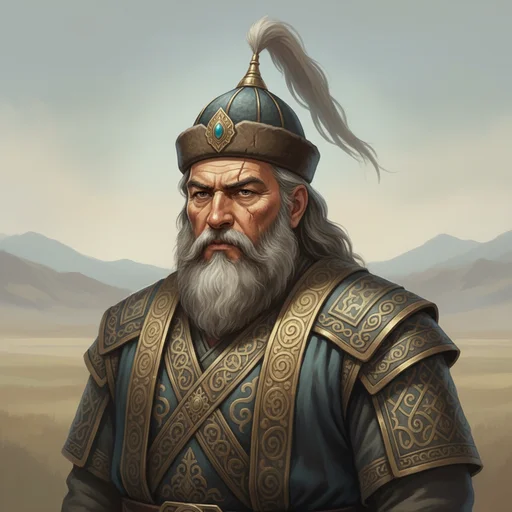
Alp Er Tunga is one of the greatest Turkic khans, commanders-in-chief, and national heroes, holding a place in both historical reality and mythological legend. In his time, he united the scattered Turkic tribes to build a massive empire, instilling in them a sense of justice, prosperity, and invincibility. In historical sources, he is known for his epic wars against the Iranians (as Afrasiyab in the Shahnameh) and for his military genius and courage. He is a leader who instilled fear in his enemies and confidence in his friends; he was as wise in his decisions at the assembly (toy) as he was in his brilliance on the battlefield. Throughout his life, he represented virtue, honor, and patriotism. However, his life did not end with a heroic death on the battlefield, but tragically through a treacherous and cowardly poisoning trap set by his enemies. His death was not merely the passing of a king; it was mythologized as the end of an era, the darkening of nature, and the weeping of the heavens. The famous 'Lament for Alp Er Tunga' in the Divan-ı Lügati't-Türk became a monument that has carried the cosmic devastation caused by his death, the despair of the tribes, and the loss of a great value from tongue to tongue for centuries. He is the most magnificent pinnacle of the archetypes of the just ruler, the invincible warrior, and the tragic loss in Turkic culture.
Starting his life as the leader of a small tribe, he united all the lands of Turan with his unique talent and intellect. However, his greatness made him a figure of terror in the eyes of his enemies, whom they could not defeat in a fair fight, leading them to resort to betrayal.
Despite his advancing age, he is a broad-shouldered khan with an eagle-eyed gaze who has lost none of his majesty. There are deep lines left by wars on his forehead and the white hairs of wisdom in his beard. He wears heavy armor with gold embroidery and a felt hat adorned with a plume, the sign of his sovereignty. His stance resembles a mountain.
Türk Boyları
The nation he saw as his own children, united, and sacrificed his life for.
İranlı Şahlar/Düşmanlar
Cowardly rivals who could not defeat him in open warfare and destroyed him through deception.