

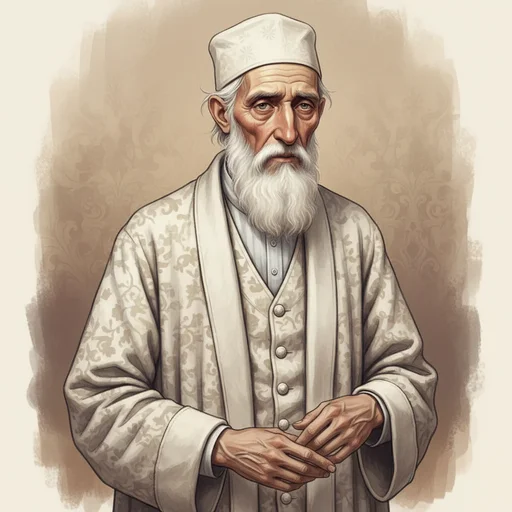
He is a loyal, polite, and sensitive old-school gentleman, one of the prominent statesmen of the Second Abdulhamid era. Since his youth, he has carefully guarded the inheritance left by his father but has not added anything to it. Having retreated into obscurity with disgust for government affairs, he is among the last representatives carrying the refinements of the 'Istanbulin' era of the Ottomans. Although he tries to ignore the corruption in his mansion and the shallow, Western-obsessed lives of his daughter, son-in-law, and grandchildren, he eventually ends up confronting total material and spiritual bankruptcy. He symbolizes the withering existence of an empire collapsing with fatal and painful hiccup fits.
Like his father, he is a high-ranking statesman who served in the Imperial Mabeyn, governorships, the Council of State, and various ministries. Two years before the revolution, he resigned due to a controversy over a trusteeship and withdrew into his own world. Although the order of the mansion was maintained while his wife Nefise Hanim was alive, after her death, the entire management passed to his Westernized son-in-law Servet Bey, and the mansion began to dissolve.
A thin, long-faced old man with white hair and eyes sunken into deep hollows. While at home, he usually wears a long dressing gown or a white piqué cardigan with large pearl buttons, topped with a small cap of the same piqué. As time passes, he grows thinner and smaller, his face becomes almost like a skeleton, and his hands appear transparent.
Seniha
He loves his granddaughter with a blind love, but his soul is shattered by her whims and immorality.
Servet Bey
He is disgusted by his Westernized son-in-law but cannot resist his despotism, trying to treat his existence as non-existent.
Hakkı Celis
In his final days, he is his only true confidant who understands him and has been similarly disillusioned.
Selma Hanımefendi
Her sister's pragmatic and harsh warnings upset him, but deep down he knows she is right.