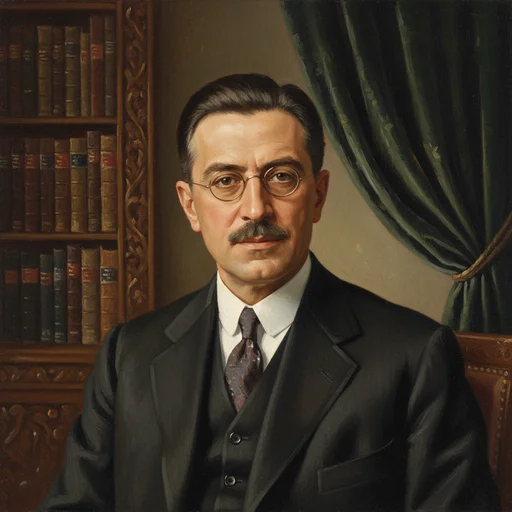


Yakup Kadri Karaosmanoğlu
Kiralık Konak is a realist novel by Yakup Kadri Karaosmanoğlu that depicts the collapse of the Ottoman Empire and the Westernization process of Turkish society. The work symbolically fuses the cultural conflicts between three generations and the decline of a family with the general state of the Ottoman Empire.
The destructive cultural and moral gap between Naim Efendi, who represents traditional morality, patience, and civility, and his daughter, son-in-law, and grandchildren, who pursue a superficial and selfish Westernization that recognizes no spiritual values.
Istanbul (the mansion in Cihangir, Büyükada, modern apartments in Şişli, Beyoğlu, and waterfront mansions in Kanlıca).
The final years of the Ottoman Empire; the Constitutional Era, the Balkan Wars, and the beginning of the First World War (Gallipoli front).
Melancholic, gloomy, tense, and filled with a sense of collapse. A mood prevails that evokes the death of an old way of life and the coldness of the corrupt, rootless, and noisy new life that has replaced it.
An omniscient third-person narrator who delves deeply into the inner worlds and weaknesses of the characters, appearing at times critical, judgmental, and melancholic.
Status in society is based not on old nobility and morality, but on adapting to European-style living, knowledge of superficial etiquette, and wealth. While the older generation is doomed to melt away and perish in the corners of the mansion, the new generation rushes toward its own disaster with a selfish, hedonistic, and lawless speed. Family ties and spiritual values have given way to self-interest and fleeting whims.
A period of painful transition that began with the Tanzimat and accelerated with the Constitutional Era, during which society was trapped between traditional Ottoman-Islamic culture and Western (particularly French) culture, experiencing a moral crisis.
Characters are arranged at equal intervals on a circle; you can read the relationship type and dynamics by clicking on the lines.
Bir çizgiye tıklayarak ilişki detayını açın.
Naim Efendi initially loves Seniha with great tenderness and weakness, even fearing her. Seniha, however, rejects her grandfather's world entirely and is ashamed of him. Over time, Seniha's crossing of moral boundaries destroys Naim Efendi, and the bond between them is completely severed.
When Naim Efendi learns of Seniha's letter regarding her flight to Europe, he sheds tears, saying, 'She has broken my heart badly. I never expected this.'
They are a complete cultural contradiction. Naim Efendi represents Ottoman breeding, while Servet Bey represents a superficial, rootless, and anti-Turkish Western affectation. They despise each other, and eventually their life together ends when Servet Bey leaves the house.
Following the discovery of secret love letters addressed to Naim Efendi, Servet Bey walks toward the old man, shouting and demeaning him before fleeing to the apartment in Şişli.
Initially, Faik Bey is the experienced and indifferent party, while Seniha is attached to him with a burning passion and suffering. However, over time, Seniha takes control, seizes the reins, and turns Faik Bey into a humiliated lover for the sake of her own whims.
While dragging Faik Bey along the seaside, Seniha dominates him by saying, 'I don't know either, don't ask me anything, you will comply with all my whims.'
Hakkı Celis is attached to Seniha with an idealized, poetic, and sickly love. Seniha views him as a 'child' and mocks him. Over time, Hakkı Celis notices Seniha's emptiness and corruption, breaks free from this love, and turns toward his love for the motherland (Gallipoli).
Seniha explicitly mocks his sensitivity, saying, 'You will never be a man of the world, poor Hakkı!'
Sekine Hanım loves her father but is under the hegemony and pressure of her husband, Servet Bey. Being passive and indecisive, she cannot protect her father and only manages to shed tears.
While Naim Efendi suffers from bouts of sobbing, Sekine Hanım merely cries and says, 'How grumpy Father has become!', failing to defend her father against her husband.
Because Hakkı Celis loves Seniha, he harbors a great grudge against Faik Bey. However, once Faik is also crushed by Seniha, a strange solidarity and mutual confession of defeated men emerges between them.
Faik Bey complains to Hakkı Celis at the bar, 'Love is a matter of self-esteem... That red-haired girl dragged me through the mud.'
Madame Kronski is a pragmatic woman who inflames Seniha's dreams of Europe and corrupts her mind with stories of wealth and nobility. However, when Seniha spirals out of control, the Madame herself is left bewildered.
As Madame Kronski talks about the casino life in Europe, Seniha asks with a feverish intensity, 'Madame, tell me, what does it take to join this life?'
Selma Hanımefendi is the authoritarian and traditionalist face of the family, relentlessly throwing the harsh realities in their faces. Naim Efendi tries to escape these realities and pretend not to understand, but Selma constantly reminds him of his grandchildren's immorality.
Selma Hanımefendi screams the truth at him: 'Brother, they are feeding you all these scandals by claiming they are requirements of Westernization.'
Both are selfish characters with no other concerns than going to Europe and pursuing pleasure. They know each other's secrets and exhibit a shared indifference toward the family.
Cemil offers to sell his diamonds for Seniha's escape plan to Europe and sees no harm in assisting his sister in this immoral scheme.
Initially distant relatives, one old and one young, they both become wounded by Seniha in the face of the family's corruption and take refuge in each other's loneliness. Both are 'victims' of the new world.
During the days when Naim Efendi feels most lonely, Hakkı Celis is always by his side, and the old man pours his heart out to him, saying, 'Who else but you understands my trouble?'