

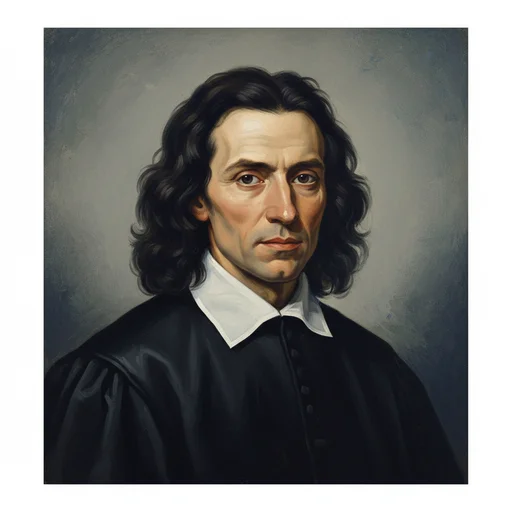
Author · 1 works
He was born in Amsterdam on 24 November 1632. His family were Portuguese Jews who had fled the Inquisition and taken refuge in the Netherlands; his father, Michael, was a merchant. His mother, Hanna Debora, died before he turned six. At the congregation's Talmud Torah school he studied Hebrew and the religious texts, and as a boy he worked in his father's trading house.
After his father's death in 1654 he gave up commerce; at the Latin school of Franciscus van den Enden, a former Jesuit, he came to know Descartes, the new natural science and the dissenting circles of Amsterdam. His views unsettled the congregation: on 27 July 1656, aged only twenty-three, he was cast out with the harshest ban the Portuguese community of Amsterdam had ever pronounced. He took the name Benedictus; the Principles of Descartes' Philosophy, published in 1663, remained the only book to appear in his lifetime under his own name.
He settled in Rijnsburg near Leiden, then in Voorburg, and finally in The Hague. He earned his living grinding lenses for microscopes and telescopes, and corresponded about that craft with the opticians of the day, Christiaan Huygens among them. In 1670 he published the Theological-Political Treatise without his name on it; the book was banned in 1674. In 1673 he declined the chair offered him from Heidelberg, on the grounds that it would restrict his freedom of thought.
He built the Ethics out of definitions, axioms and propositions, in the order of a book of geometry, and treated the passions not with moral reproach but with the composure granted to natural events. He never risked publishing it while he lived. He died in The Hague on 21 February 1677, at forty-four, of a lung disease aggravated by years of breathing glass dust. His friends printed his manuscripts in secret that same year; his books reached readers only after he was gone.
He wrote in the years when the Dutch Republic was growing rich on trade and counted as the most tolerant country in Europe, while Calvinist preachers kept narrowing the limits of that tolerance. Descartes's rationalism had divided the universities, and Amsterdam's Portuguese Jewish community was guarding its own boundaries. The rivalry between the republican rule of the De Witt brothers and the Orangists ended in blood in 1672. In that setting Spinoza argued for reading scripture as a historical text and for freedom of thought.