
Author · 1 works
Yaşar Kemal was born in 1923 in the village of Hemite, near Osmaniye in southern Turkey, and was named Kemal Sadık Gökçeli. His Kurdish family had been driven from the Van region during the First World War and had settled on the Çukurova plain. An accident cost him his right eye at about three; at five he watched his father stabbed to death in the village mosque, and the shock left him with a stammer until he was twelve.
His schooling broke off early. He hired himself out in the cotton fields and then set up in Kadirli writing petitions for those who could not write. While still young he began collecting laments in the Taurus mountains, and that collection became a book in 1943. Arrested in 1950 on a charge of communist propaganda, he moved to Istanbul the next year and wrote reportage for the daily Cumhuriyet, travelling Anatolia village by village and winning a wide readership.
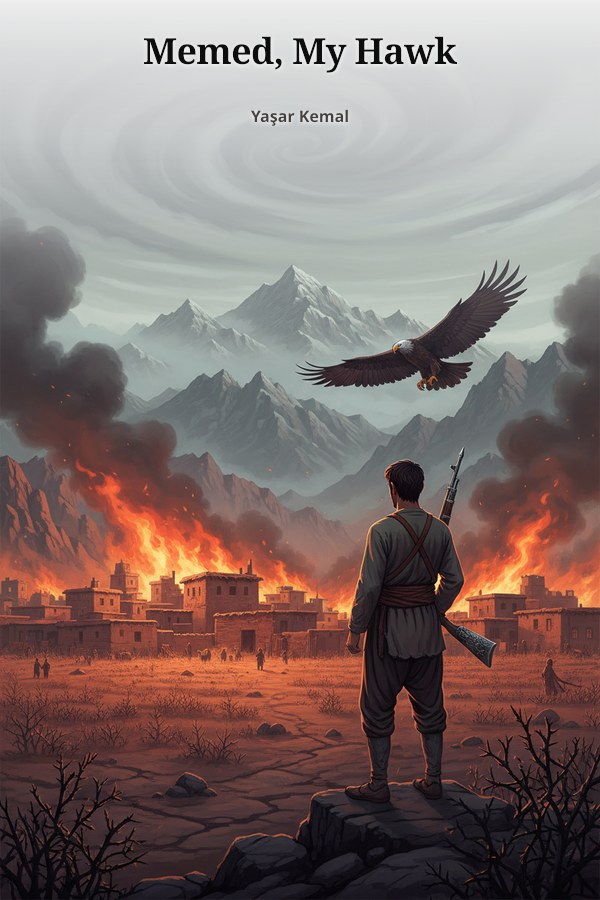
His first book of stories appeared in 1952 and Memed, My Hawk in 1955. The story of a peasant who takes to the mountains to escape a landlord's cruelty has been translated into nearly forty languages. In the Çukurova novels that followed, and in the later volumes of Memed, he wrote the same soil and the same people as a widening epic. He held office in the Workers' Party of Turkey, was tried again and again for what he published, and in the 1990s received a suspended sentence for an article on the Kurdish question.
He joined the epic, the folk tale and the lament of oral tradition to social realism, and made the nature of the Taurus and Çukurova inseparable from human fate. He was nominated for the Nobel Prize and received the Prix mondial Cino Del Duca and the Peace Prize of the German Book Trade. He died in Istanbul on 28 February 2015.
Kemal wrote among the socially engaged realists who moved village life to the centre of Turkish literature. His country was unsettled by multi-party politics, the mechanisation of farming and the drift of landless peasants towards the cities, and the 'village literature' debate opened by writers from the Village Institutes was under way. Cold War censorship, military coups and the prosecution of the left shaped his generation; the Kurdish question marked his later years.