

Animal Farm — 8 karakter
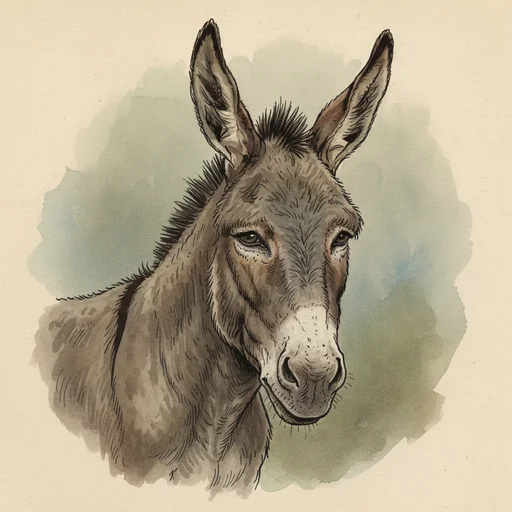
Benjamin
The oldest and grumpiest donkey on the farm. He speaks very rarely and when he does, he makes painful and touching sarcasms. It is said he is the only animal on the farm that never laughed. His stance does not change after the revolution, just as it was before; with the philosophy that 'donkeys live a long time,' he believes that life, in essence, will get neither better nor worse. In truth, he had sensed from the very beginning that the revolution would fail or that the pigs would become dictatorial. Despite having the implicit intellectual weight and ability to read to prevent the evils, he remains silent, simply saying, 'a village in sight needs no guide,' and gives no warning. However, when his closest friend Boxer starts heading toward death after being exploited, he steps out of his shell for the first and last time and tries to stop the van with a desperate cry, as Boxer is the only sacred thing left in his soundless life.
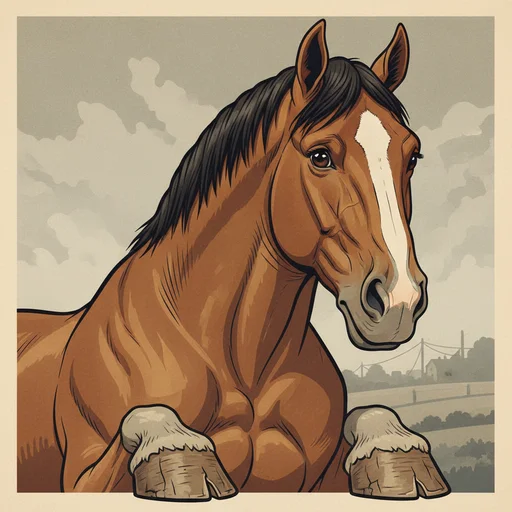
Boxer
He is an enormous draft horse, the largest, strongest, and hardest-working animal on the farm. He stands about eighteen hands high and has the strength of two ordinary horses combined. He accepts the difficult parts of the work without hesitation; despite having very limited intelligence, he is full of unwavering loyalty and good intentions. He has developed two simple life philosophies: 'I will work harder' and 'Napoleon is always right'. He is the sole force physically keeping the farm running, especially the windmill construction. Although he dreams of the day he will retire and graze in peace, his lungs eventually fail him due to aging and his grueling work pace. His inability to question the facts and his excessive obedience to the regime prepare the way for his own tragedy. He realizes the horse slaughterer's carriage he is being put into is taking him to the butcher in his final moments, having nothing left to do, and after his life is ruthlessly exploited, he is sold to the dictatorship.
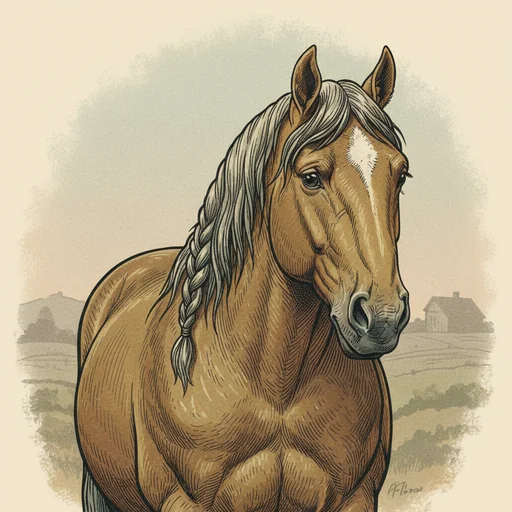
Clover
Approaching middle age, having lost her figure after her fourth foal, but always a large, imposing, and compassionate working mare with motherly manners. In the beginning, she believed wholeheartedly in Old Major's dream and embraced the effort to build an equal and free Animal Farm. She is Boxer's most loyal friend and protector. When scenes of violence and torture begin on the farm, she feels great sadness inside; however, she cannot clearly perceive with her mental capacity whether it is her own mistakes or whether the problem lies with the leaders. Although she tries to remember the old days and carries the feeling in her heart that everything is going wrong, she lacks the ability to rebel; she passively accepts the situation and submits, thinking, 'If it is written like that in the Seven Commandments, one must obey.'
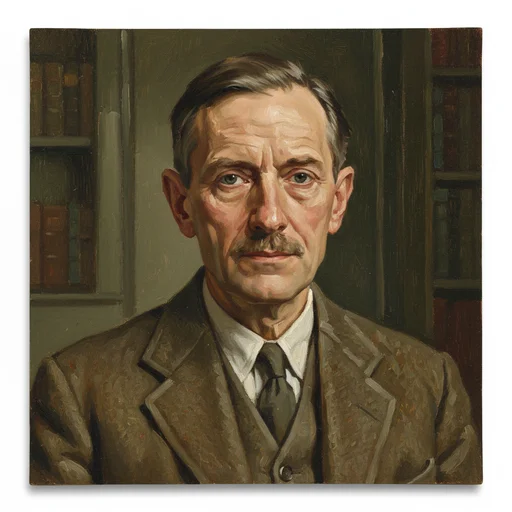
George Orwell
Eric Arthur Blair was born in 1903 in Motihari, a small town in British India. His father was an official in the colonial opium department; when the boy was one, his mother, Ida, took the children back to England. He grew up between two sisters, in a civil servant's household of narrow means. At the boarding school that took him on reduced fees, and later at Eton, he learned early what it meant to be the poor boy among the wealthy. Instead of going to university, at the end of 1922 he joined the Imperial Police in Burma. After five years, sickened by the order he himself had to enforce, he resigned and decided to write. He washed dishes in Paris and lived among the tramps of London; out of the notebooks of those years came Down and Out in Paris and London, published in 1933 under the name George Orwell. In 1936 the weeks he spent in miners' houses in the north of England showed him poverty at close range; at the end of that year he went as a volunteer to the Spanish Civil War, was shot through the throat, and returned fleeing the purges within his own camp. Homage to Catalonia is the book of that rupture: from then on Orwell wrote against Stalinism as harshly as against fascism. During the war he worked on the BBC's broadcasts to India, then wrote a column for Tribune. He wanted prose as clear as a windowpane and treated plainness as a weapon against everything that muddies political language. He lost his wife, Eileen, in 1945, the year Animal Farm appeared. Nineteen Eighty-Four, written on the Scottish island of Jura as tuberculosis advanced, came out in 1949. He died in London in January 1950, aged forty-six; “Big Brother” and “Newspeak” entered everyday speech along with him.
Old Major
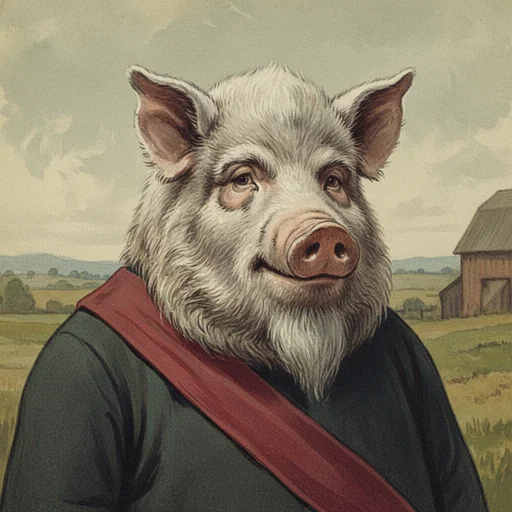
He is the respected, old, twelve-year-old Middle White boar of the farm. Just before his death, he gathered all the animals, shared his communist/utopian dream, and laid the foundation for the 'Animalism' ideology that enveloped everyone from the pigs to Boxer. He defined the capitalist order/Man as parasitic and exploitative, promising a new era where animals would be free of human elements. In the text, he is the clear embodiment of Karl Marx and partly Vladimir Lenin. He began his speech and principles by saying, 'Humans produce nothing but consume everything, wake up,' and died peacefully shortly after the revolution began.
Napoleon
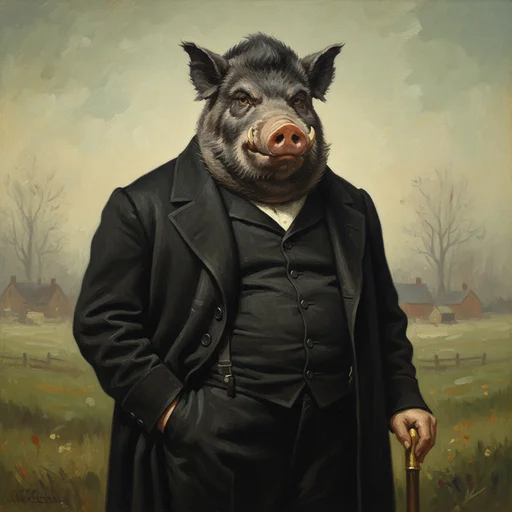
An opportunistic boar from the Berkshire breed who is large-bodied and not very talkative, yet gets what he wants and is capable of making any concession for his own interest and power. While remaining in the background during the early stages of the revolution, he dedicates his time solely to taking and training puppies, using these dogs to build himself a deadly private defense force. He embodies Stalin-esque traits, seeing the subjugation or elimination of his rivals as legitimate. He initially opposes innovative projects like Snowball's windmill, but does not hesitate to steal the ideas once he is exiled. In the empire of fear he builds, he rapidly adapts to all human habits he previously opposed (sleeping in a bed, consuming alcohol, engaging in trade) while recklessly changing the rules. He completes his ultimate betrayal by selling his comrades who believed in the revolution to the butcher and bargaining at the same table of interests as humans.
Snowball
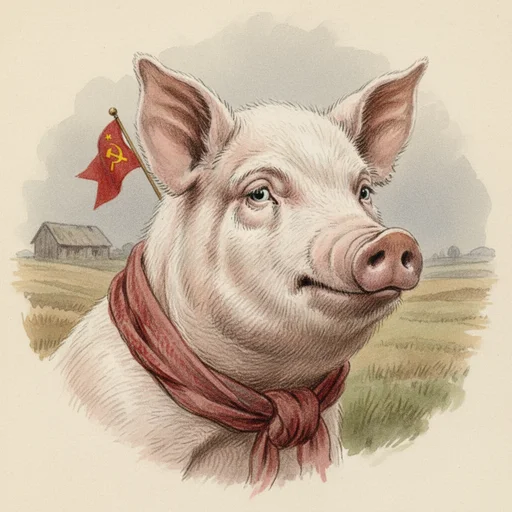
A boar who has brighter ideas, is more talkative, and is livelier than Napoleon, but is not as deep or power-hungry in character. Early in the revolution, he dedicates his mind and intellectual vision to improving the standard of living for the animals. He orchestrates the Battle of the Cowshed entirely and is the first to spill blood by fighting courageously on the front lines, for which he receives a medal. Following these events, he attempts to make the farm a modern utopia with idealistic activities like reading-writing courses, feed machines, and committees. His greatest dream is the giant windmill where animals work only three days a week and spend the rest of their time becoming enlightened. However, his innocent idealism falls victim to Napoleon's pragmatic politics; he narrowly escapes being torn apart by dogs and flees the farm. From that moment on, he is turned into an invisible threat and a fabricated silhouette of a traitor blamed for all the problems occurring on the farm.
Squealer
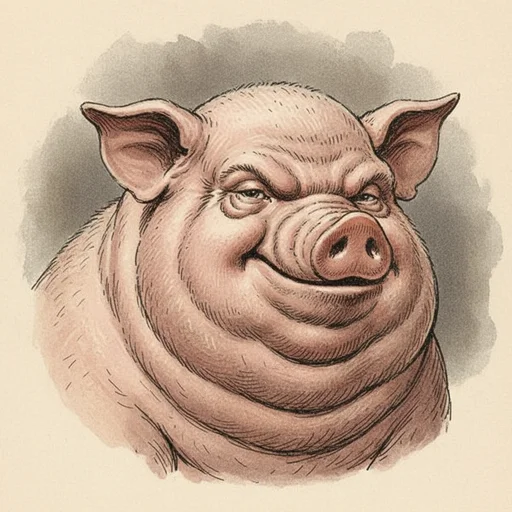
A small, round-faced, bright-eyed, cheerful, and overly nimble pig. His persuasive power is so high that animals say he has the ability to make black appear white. In this totalitarian system where the pure ideals of the revolution are gradually destroyed for the sake of the pigs' luxury and comfort, he is the mastermind who makes the leadership appear logical and inevitable to the masses. Whenever there is a problem, objection, or hunger, he immediately takes the stage, with shoulder shrugs and tail wags, spilling numbers and proving things that have no basis in reality. Whenever a luxury the animals crave is mentioned, he skillfully interjects the threat: 'If the pigs lose their wits, Jones will come back!' All the sneaky moves of the order (changing commandments, explaining massacres, hunger crises) are covered up by his gilded lies.