
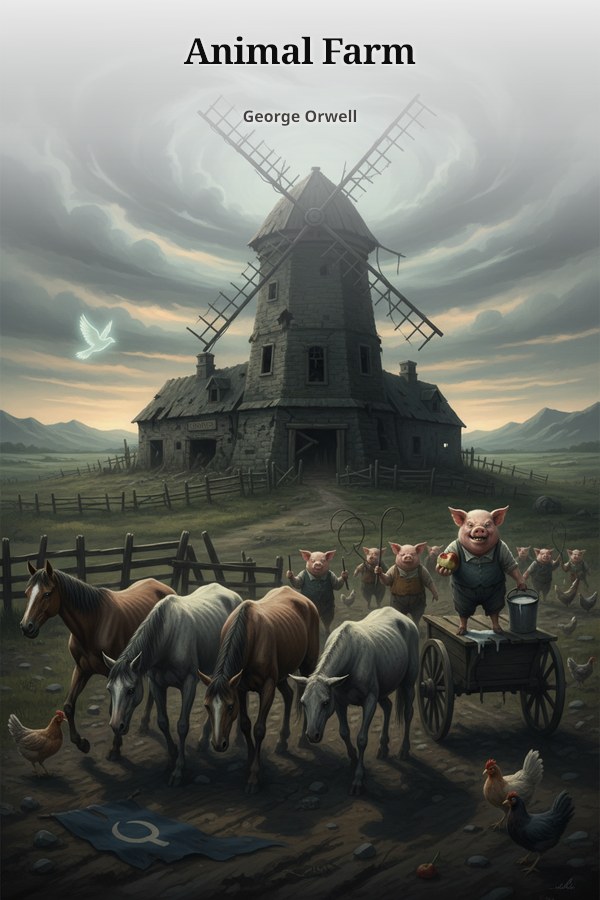
George Orwell
George Orwell's cult work Animal Farm is an allegorical political satire that tells the story of animals who unite against human exploitation to take control of the farm, aiming to establish a more equal order, only to transform over time into an authoritarian and corrupt dictatorship.
The efforts of common animals to escape oppression and exploitation to build an equal, free society, only to suffer internal and external betrayal as the very pigs leading the rebellion seize power and become corrupt. A tragic struggle between the pure ideals of revolution and the selfish, ruthless dictatorship of the leaders.
Manor Farm, owned by Mr. Jones, in the English countryside, which is renamed 'Animal Farm' during the independent intervening period.
Indefinite, the first half of the twentieth century (years that allegorically reflect the Russian Revolution and the subsequent Soviet Russia period).
A tense, initially hopeful and enthusiastic atmosphere that gradually turns dark, oppressive, mistrustful, ironic, and gloomy.
An omniscient, third-person god-like narrator; yet the style is a fable-like voice that relays events from the pure, gullible perspective of uneducated animals, thereby creating striking drama and sharp situational irony.
A free Animalism republic initially based on 'All animals are equal' and 'Four legs good, two legs bad,' where human behaviors (wearing clothes, sleeping in beds, trading) were strictly forbidden. However, the rules are secretly altered by the pigs—who hold a monopoly on power—under the cover of darkness with a paintbrush; an elitist, bloody, and punitive hierarchy exists that evolves into the point where 'All animals are equal, but some animals are more equal than others.'
An allegorical culture tightly woven into the historical context of Karl Marx's ideas, the Russian Revolution, Stalinist purges, and totalitarian regimes, beginning with the revolt of animals representing the oppressed working class in a human-centric world of domination.
Characters are arranged at equal intervals on a circle; you can read the relationship type and dynamics by clicking on the lines.
Bir çizgiye tıklayarak ilişki detayını açın.
Although they cooperate as the two main leaders of the revolution, they eventually clash on every issue. While Snowball pursues projects and social progress, Napoleon builds a military force (puppies) behind the scenes to solidify his dictatorship, permanently tipping the balance of power in his favor.
Napoleon unexpectedly letting out a shrill whinny during the vote on the windmill plans and unleashing his secretly trained dogs upon Snowball.
While Napoleon rules through fear and violence, Squealer represents the soft power that provides legitimacy to the oppressive regime. Squealer is entirely obedient to Napoleon, rationalizing his crimes and serving as the perfect demagogue for the maintenance of power.
Squealer being caught in the act with a paint brush when the Seven Commandments on the walls are crossed out or altered at night.
There is a deep, unspoken bond between the strongest, purest character of the farm and its oldest, most cynical one. Even though Benjamin values nothing, he agrees to graze alongside Boxer on his days off, and when he senses catastrophe, he breaks his indifference only for him.
The two of them sitting side-by-side in the small pasture beyond the orchard on Sundays without speaking a word, and Benjamin crying out and trying to stop the van when Boxer is taken to the knacker.
Both are the long-suffering and hardworking horses of the farm. Their shared fate brings them together. Clover constantly worries about Boxer's desire to overwork and tries to care for him in a motherly way as he ages, but she cannot prevent his blind loyalty.
Clover making poultices for Boxer after the Battle of the Cowshed and advising him to work less, warning him that 'a horse's lungs cannot last forever.'
Even though there is no direct physical confrontation between them face-to-face, Old Major's idea of rebellion is entirely against Jones's colonial order and tyranny. Major identifies Jones as the primary cause of animal misery.
Old Major's speech at the meeting where he recounted his dream: 'Remove Man from the scene, and the root cause of hunger and overwork is abolished for ever.'
While Boxer is Napoleon's greatest supporter and the backbone of the farm, Napoleon treats him like an object or cheap labor. Even as Boxer says 'Napoleon is always right' with his last breath, Napoleon coldly sells him to the knacker when he becomes exhausted and ill.
The fact that when Boxer fell ill, Napoleon claimed he had arranged for a hospital, while in reality, he secretly sent him to the knacker.
Clover is a dignified mother figure defending the morality of the revolution, while Mollie is entirely self-centered and obsessed with vanity. Clover sees Mollie's secret weakness for her former human owners and warns her sternly, but Mollie cannot withstand this pressure and runs away.
Clover sternly confronting and questioning Mollie when she catches her secretly talking to a man from a neighboring farm at the fence and allowing him to stroke her nose.
Snowball wants to instill the philosophy of the revolution, Animalism, into the animals, but struggles to tolerate Mollie's extremely superficial and selfish questions. He views her passion for luxury (ribbons) as a symbol of slavery.
When Mollie asks foolish questions such as 'Will there still be sugar after the Rebellion?' and 'Shall I still be allowed to wear ribbons?', Snowball retorts that 'those ribbons are the badge of slavery.'
Although Boxer is completely uneducated, he is honest and can sometimes sense the wrongness in the turn of events (especially when he opposes the claims that Snowball was a traitor). Squealer has to crush Boxer's strong but slow brain with complex, persuasive, and threatening rhetoric.
Boxer refusing to accept it when Squealer says Snowball is an agent, yet immediately giving in the moment Squealer says, 'Comrade Napoleon says so.'
They are old enemies but begin secret trade for the sake of profit. Napoleon, thinking himself very cunning, sells the timber to Frederick, but the even more cunning Frederick swindles Napoleon with forged money and then launches a bloody attack on the farm.
Napoleon's immediate issuance of a death warrant—that he would be 'boiled alive'—for Frederick, whom he had been fawning over, once the forged banknotes were discovered after the timber sale.