
Lev Tolstoy
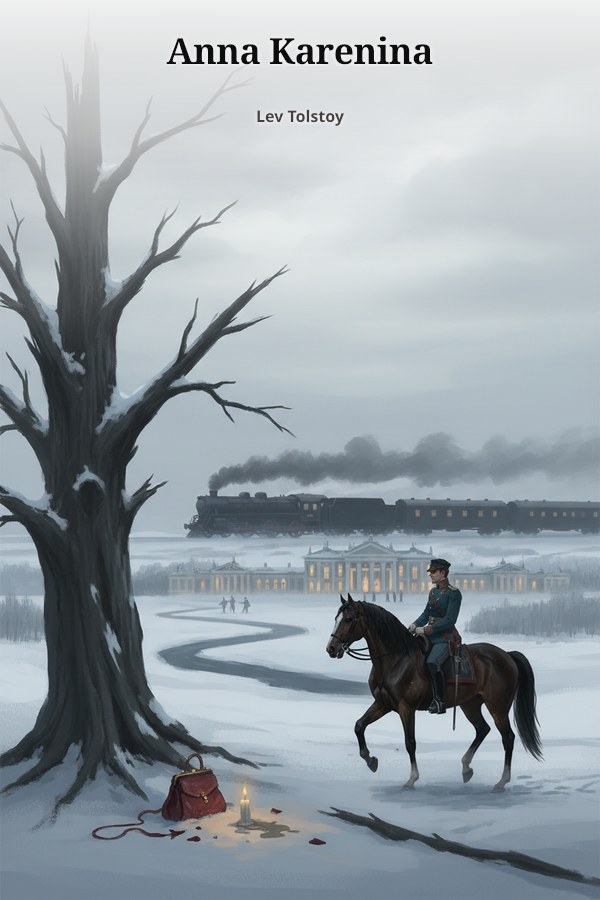
Leo Tolstoy's 1877 masterpiece Anna Karenina is a tragic novel set in 19th-century Russian aristocracy that deals with passion, loyalty, family, betrayal, and social pressures. The forbidden love between Anna, a married woman with a child, and Count Vronsky, and the destruction it brings, is presented in contrast to the peace of an honest marriage (Levin and Kitty).
The fatal clash between Anna's selfish yet irresistible love, which ignores social norms and moral values, and the uncompromisingly hypocritical mechanism of these very rules; and in parallel, Levin's internal struggle to find existential meaning between the logic-based modern age and simple human life grounded in faith.
Russia, spread across a vast geography (particularly St. Petersburg, the center of salon life, and the traditional city of Moscow, along with the countryside estates of Levin and Vronsky), and partly Europe (the Soden spas in Germany and Italy).
The 1870s (according to Nabokov's analyses, the novel begins in February 1872 and ends in the middle of 1876, based on the plot's calendar).
A heavy and melancholic atmosphere, laden with existential crises and passionate turmoil, shifting between the suffocating, hypocritical high society of the 19th-century Russian aristocracy—woven with false values—and the honest, clean rural life that follows the natural rhythm of existence.
A third-person omniscient narrator with a neutral yet powerful moral grasp, observing the characters' behaviors, passions, and internal monologues (streams of consciousness) with the depth and time-perception of a god.
In the high society of Tsarist Russia, while extramarital affairs by men are considered normal and tolerated, a woman experiencing a passionate love while married and honestly revealing it is considered unforgivable immorality, resulting in definitive ostracization. Social status and outward appearance are always prioritized over an individual's inner happiness or moral truths.
A transitional period caught between shifting socioeconomic relations between landowners and peasants following the abolition of serfdom, the Slavophile nationalism flaring up in the Russian intelligentsia, Western-imitating bureaucratic reforms, and the efforts of the enlightened segment to integrate with the people.
Characters are arranged at equal intervals on a circle; you can read the relationship type and dynamics by clicking on the lines.
Bir çizgiye tıklayarak ilişki detayını açın.
Initially, there is a passionate attraction that intoxicates both parties and makes them forget the rest of the world. However, over time, Vronsky's feeling that his freedom is being restricted, and Anna's obsessive insecurity born of jealousy and isolation, turn their love into a suffocating and destructive war. While Vronsky wants to maintain his power and social life, Anna prepares her own destruction by trying to possess him completely.
Vronsky looking fearlessly into Anna's eyes and saying, 'Our situation cannot remain as it is... For me, you and I are one person,' and the subsequent gradual replacement of the love between them with intolerance.
Anna, initially respectful toward her older husband, feels a deep disgust for Karenin's calculating, bureaucratic nature that cares only for outward appearances after she falls in love with Vronsky. Although Karenin suffers from Anna's infidelity, his primary concern is that his honor remains untarnished. Despite a temporary moment of spiritual forgiveness on her deathbed, the chasm between them is never truly closed.
The fact that even when Alexei Alexandrovich learns of his wife's betrayal, his only thought is to cover up the situation with the least amount of damage and without creating a scandal, demanding that the marriage continue.
Covers a process that begins with Levin seeing Kitty as an unattainable, almost divine angel and deepens with his rejection. They unite after Kitty matures following her disappointment by Vronsky and realizes Levin's true value. Although their marriage is shaken at times by Levin's internal turmoil and Kitty's worldly obsessions, it ultimately transforms into a spiritual home balanced by loyalty, trust, and mutual understanding.
The silent and profound spiritual communication established between Levin and Kitty by writing only the first letters of words on a chalkboard while Levin was in a state of emotional disarray.
Stiva is a selfish, hedonistic, cheerful, and habitually unfaithful character; Dolly is a weary mother who has lost her youth to her husband's infidelities, pregnancies, and child-rearing. Although Stiva suffers because of his wife, he apologizes easily and appeases his conscience. Dolly forgives her husband every time for the sake of the children, but the sense of hurt and worthlessness within her never fully fades.
Dolly's feeling of 'Everything is over, everything is destroyed' despair when her husband's correspondence with the governess falls into her hands, and her eventual submission to her fate through Anna's intervention.
Kitty, in her youth and innocence, is captivated by Vronsky's impressive charm at balls and gatherings and sincerely believes he will propose to her. However, for Vronsky, this is merely a superficial parlor game; when he falls in love with Anna, he discards Kitty without a second thought, leading to profound destruction and a nervous breakdown for her.
When Kitty sees Anna and Vronsky dancing at the ball and realizes with horror the strange and terrible connection in their gazes, sensing that her own love has been disregarded.
They are complete opposites, both in their love for Kitty and in their outlook on life. While Levin is a sincere, somewhat rugged man struggling with the land, spiritual values, and deep-rooted ideas, Vronsky represents the superficial, stylish, and selfish world of the elite society. Levin harbors secret resentment toward Vronsky's successes and ease, while Vronsky does not take Levin seriously.
Levin’s perception of Vronsky as a cynical, vacuous dandy when they meet at the Shcherbatskys' house and at later gatherings, and Vronsky’s condescending attitude.
This is the only, most innocent relationship in Anna's heart that can compete with Vronsky. Despite hating her husband, she adores her son. However, the relationship hits a painful obstacle when the mother commits adultery and leaves the home. The son is led to believe his mother is dead, even though both deeply yearn for each other. The longing for her child becomes Anna's greatest external and internal conflict.
Anna secretly sneaking into her son's room on his birthday to embrace and kiss him, and the child excitedly whispering that he knows she is not dead.
Although there is deep respect between Levin and his half-brother Sergei, they constantly clash ideologically. Sergei sees the people and the peasantry only as an abstract concept, a class to be saved; whereas Levin lives among them and knows who the peasants truly are. Levin often finds Sergei's superficial and theoretical approaches frustrating and devoid of action.
During a discussion at home on education and medical aid for the people, Levin suggests that the peasants do not understand these things, while Sergei accuses his brother of not caring for the welfare of the people.
Anna begins as an elder sister figure who saves Dolly's life by repairing her crumbling marriage, but the roles are later reversed. Amidst her own misery, Dolly both envies Anna's life of luxury and love, and judges her morally from afar. During Anna's decline, Dolly is her only genuine female friend; but as women from different worlds, this bond is also shaken to its core.
When Dolly visits Anna at her summer home, she senses that the luxury and superficial freedom she sees are merely lies Anna has invented to hide her suffering, wounded identity.
There is no open communication between them; their relationship is focused on socially and morally destroying one another. Karenin sees Vronsky as a foolish man who has violated his wife's chastity, destroyed the family, and insulted his honor. Vronsky, in turn, characterizes Karenin as a heartless, inanimate government machine. Except for the deathbed scene, they do not hold the slightest respect for each other.
The disgust and anger Karenin feels as he watches Vronsky after their encounter outside the theater, and his decisions to inflict ruthless punishment to put an end to the union of Vronsky and his wife.