
Sabahattin Ali
Sabahattin Ali’s first novel from 1937, Kuyucaklı Yusuf, is a realistic work that centers on a boy whose family is murdered by bandits, his adoption, the epic love he experiences with his stepsister Muazzez, and his tragic struggle for life against the corruption, injustice, and immorality of the town notables.
The tragic struggle of Yusuf—a character with a natural, pure, and honest disposition (the laws of nature)—against the spoiled, opportunistic, and unjust gentry and society of Edremit (the laws of a corrupt society).
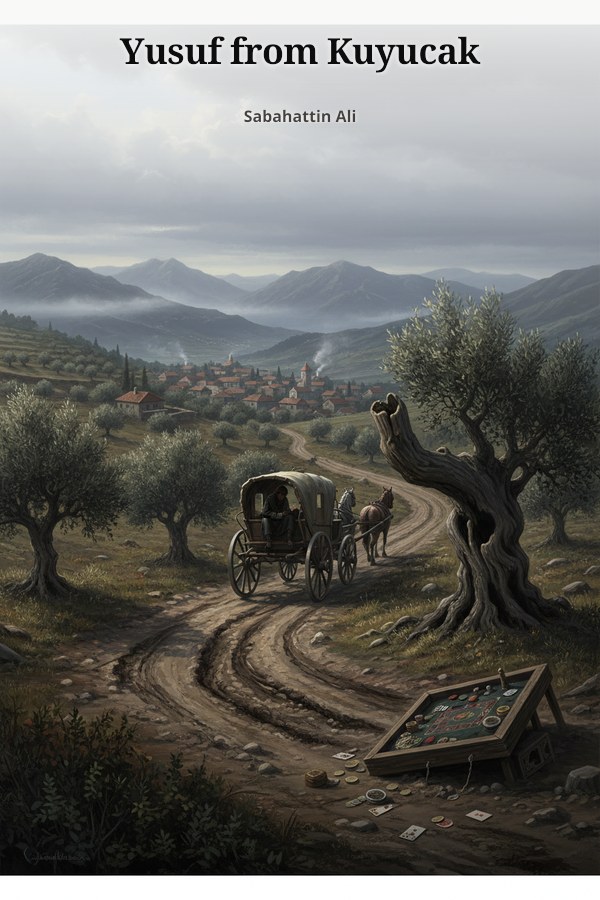
Kuyucak village in the Nazilli district of Aydın (initial short segment) and the township of Edremit, where the main events take place, including its olive groves and surrounding mountain paths.
The years starting in the autumn of 1903 and extending to the period of the mobilization declared before the First World War.
The gloomy, gossipy, and suffocating moral atmosphere of the Edremit countryside, where money and status dictate everything, breeding deep-seated corruption.
Third-person omniscient narrator.
Law and justice do not prevail in the town; rather, the word of the wealthy and influential gentry—such as Factory Owner Hilmi Bey and his son Şakir—rules. Bureaucrats are either corrupted by this dynamic or neutralized through a cycle of debt and blackmail. Social status is always valued above honesty.
Rigid class distinctions in the late Ottoman Western Anatolian countryside, the use of gossip as a tool of social pressure, and the ruthless dominance of the local gentry over the public and civil servants.
Characters are arranged at equal intervals on a circle; you can read the relationship type and dynamics by clicking on the lines.
Bir çizgiye tıklayarak ilişki detayını açın.
The brotherly affection formed by growing up together gradually evolves into a deep and reticent love. Yusuf is like a protective, strong, and silent wall; Muazzez is a character with a weak will who seeks refuge and comfort in him. Just as Yusuf's love is introverted and self-destructive, Muazzez's devotion is equally vulnerable.
Yusuf's entry into a fatal rivalry with Şakir to prevent Muazzez from being tarnished, and his act of whisking her away on horseback, oblivious to his own wounds.
Salâhattin Bey became a strong father figure by saving Yusuf's life and adopting him. Yusuf harbors infinite loyalty toward him, yet he feels deep pity and disappointment inside due to the Kaymakam's inability to intervene, his gambling debts, and his passive attitude. Despite all this, out of loyalty, Yusuf never openly confronts the Kaymakam.
Yusuf's attempt to support Salâhattin Bey, cradling him like a handkerchief in the face of his desperate destitution on his deathbed.
Şahinde views Yusuf as a dependent who covets the luxury of the house and feels disgusted by his presence. Yusuf, in turn, hates Şahinde's vanity, ignorance, and destructive nagging. As the two poles of the household, they can never tolerate one another.
Şahinde constantly refers to Yusuf as a 'peasant bastard' behind his back and conspires with the gentry circles against him.
Şahinde has established a tyrannical dominance in the house by crushing her husband's weary and mild-mannered temperament. Salâhattin Bey turns to gambling and drinking to escape this constant nagging and domestic tension, only returning home to sleep.
The Kaymakam pretending to be asleep to avoid his wife's shouting after spending late nights drinking at others' houses.
Yusuf represents the nature that refuses to bow to the gentry; Şakir represents the spoiled corruption. While Şakir sees Muazzez as his prey, Yusuf acts as her guardian. The power balance between the two constantly contains a crisis ready to explode, ultimately leading to a fatal confrontation.
Yusuf striking Şakir in the middle of the street after the Kübra incident and the inappropriate propositions made to Muazzez.
Şakir views Muazzez as a luxury object he desires. He recognizes no moral boundaries, acting solely out of pride and a possessive urge. Muazzez initially fears and is disgusted by him, but she is reduced to a vulnerable prey as her mother drags her into his social sphere.
Şakir swearing to the townspeople, 'I will have that girl, or may my mother be cursed.'
He is one of the few people in town whom Yusuf believes in and trusts. Their relationship is based on mutual sacrifice and sincerity. Yusuf trusts him enough to risk marrying off his most precious possession to his close friend in order to protect Muazzez and her family.
Yusuf asking Ali for a large sum of money to pay off the District Governor's gambling debt, and Ali providing it without questioning him at all.
Şakir views Ali, the legitimate and innocent obstacle to his obtaining Muazzez, as a disposable nothing. He possesses the audacity to treacherously destroy a rival by using his wealth and influence.
During the chaos of the wedding night's celebratory gunfire, Şakir aims directly at Ali and kills him in cold blood.
Muazzez is actually pure and innocent, but she cannot withstand her mother's endless psychological pressure. When left alone, she is captured by her mother's corrupted but opulent lifestyle, drifting toward her own ruin through disobedience.
After Yusuf becomes a tax collector and moves away, Şahinde forcibly gets Muazzez accustomed to the hedonistic and alcohol-fueled mansion of the Hilmi family.
Hilmi Bey turns the state representative into his puppet by getting him indebted through gambling. Salâhattin Bey is too weak to escape this web, and the great District Governor loses his honor by bowing to the blackmail of a wealthy local notable.
Hilmi Bey reminding Salâhattin Bey of his gambling debt promissory notes as a threat to ensure the cover-up of his son's murders and scandals.
Hacı Etem is Şakir's corrupted flatterer. While Şakir provides the brute force and money, Etem manages the dirty work, false testimonies, and the orchestration of murder cover-ups.
Immediately following Ali's murder, Hacı Etem steps in to switch the weapon and fix the witnesses' testimonies.