
Sabahattin Ali
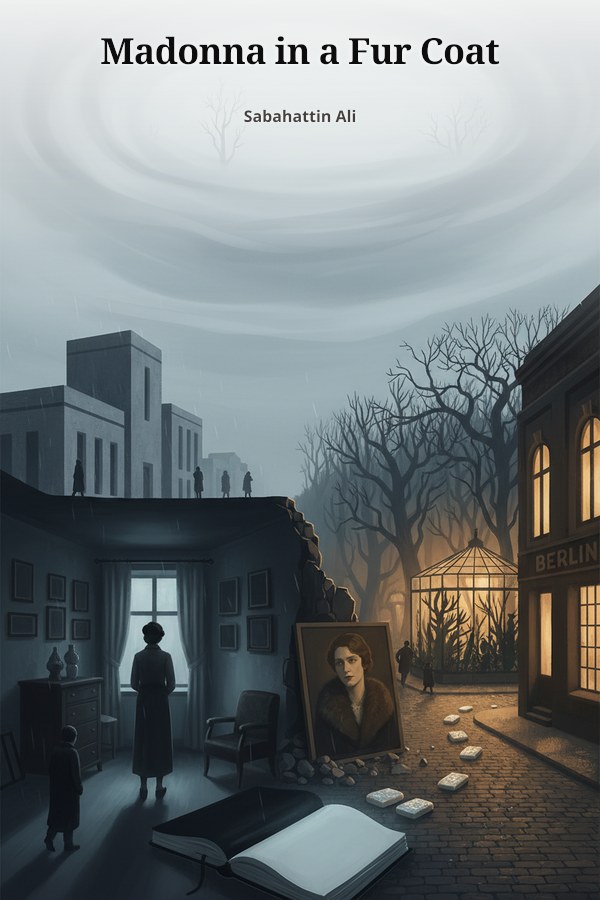
Sabahattin Ali's immortal 1943 work, Madonna in a Fur Coat, recounts the passionate, melancholy, and profound love that the introverted Raif Efendi experiences with Maria Puder, whom he fell in love with after seeing her portrait at an exhibition in Berlin. Exploring themes of loneliness, alienation, and the complexity of the human spirit, the novel chronicles the emotional journey of an individual with a rich inner world.
At its core, it is about the inability of an individual with a sensitive and rich inner world (Raif Efendi) to hold his ground against worldly and superficial social dynamics, leading him to withdraw. It depicts an internal destruction resulting from the loss of a soulmate, caused by external expectations and one's own inertia.
There are two main settings: Ankara in 1930s Türkiye, the city of bureaucracy and the formalist new middle class (ice-cold offices, a crowded and loveless home), and the turbulent Berlin of the 1920s (boarding houses, exhibitions, forests, and the Atlantic Cabaret).
The frame story takes place in the late 1930s and early 1940s (November 1940 - February 1941). The main story (the notebook) is set in Germany in the early 1920s (approximately 1923-1924), shortly after World War I.
A bleak, melancholic, and nostalgic mood prevails. In contrast to the stifling environment of societal masks and superficial relationships, a lyrical and romantic sadness permeates the novel. The coldness of Berlin's streets alongside a deep, heartwarming love creates an atmosphere that is both sorrowful and filled with secrets.
The novel employs a 'frame narrative' model. Initially, the observant and empathetic voice of an unnamed narrator is heard in the first person. Then, upon transitioning to the black-bound notebook, the first-person expressive, intimate, and regret-filled lyrical voice of Raif Efendi takes hold, characterized by internal oscillations.
Society judges individuals ruthlessly based solely on their outward appearance and social status. True emotions are destined to remain hidden because ordinary crowds lack the capacity to understand or appreciate such subtleties. Expressing one's soul carries the risk of exploitation and contempt; therefore, deep souls must live behind masks.
The economic collapse (inflation), the upheaval of values, and new artistic trends in post-war Europe provide the backdrop. Regarding the Turkish context, the civil service life of the Republic era, provincial commerce, and the new material-focused social relationships are criticized.
Characters are arranged at equal intervals on a circle; you can read the relationship type and dynamics by clicking on the lines.
Bir çizgiye tıklayarak ilişki detayını açın.
Initially shy but a tremendously profound spiritual connection. While Maria Puder is the one in control, Raif is in complete surrender. Over time, their souls open up to each other completely, but misfortunes tragically sever this bond.
"I am lonely enough to drown... lonely as a sick dog... We could be friends!"
Although the narrator initially tends to look down on Raif Efendi, thinking he is an ordinary person, he gradually begins to harbor a secret admiration for him. It is a master-apprentice and confidant dynamic built on trust, ending with the revelation of the most intimate secret on the deathbed.
"Could you not leave this notebook with me for one night, just this one night? You are the most precious person in the world to me..."
Hamdi is the superior who holds the power; he acts arrogantly and condescendingly. Raif Efendi does not react, showing passive resistance and appearing submissive from the outside, while inwardly considering how superficial he is.
"If Hamdi found a small typo in Raif Efendi's translations, he would immediately call the poor man, sometimes even coming into our room to lecture him."
Despite being former schoolmates, Hamdi looks down on the narrator with the power of his position, giving advice as if lecturing a child. Since the narrator is in need, he swallows this condescension, but is inwardly hurt.
"He talks as if he is lecturing a small child, never imagining that one could answer him or argue..."
There is no real connection or attempt at understanding between them. Mihriye is a spouse trapped in the hustle of daily life, full of simple complaints; Raif is a detached stranger in a state of calmness who views her presence and absence as the same.
"What is it to her? What am I to them?.. We have lived together in the same house for years... They never wondered who this man is..."
Raif Efendi sometimes looks at his eldest daughter, Necla, with hope, expecting some interest and seeking human sparks in her different from her aunts. However, Necla, under the influence of the outside world and the general atmosphere of the house, remains fake and distant toward her father.
"Sometimes he would stare at his eldest daughter, standing as if expecting something from her, something warm and sweet."
Nurettin Bey is an arrogant, pedantic man who apes European ways and sees himself as larger than life. Although Raif bears the burden of the household, Nurettin views him as a nobody. Raif, for his part, looks upon him with a quiet pity.
"Even though it was Raif Efendi who bore all these burdens... They were angry at him for not earning more money, for not providing a more luxurious life..."
The widowed Dutch woman, finding Raif naive and innocent, attempts to seduce him for her own amusement and gain. Due to his passivity, Raif initially struggles to resist her predatory behavior, merely attempting to flee.
"I felt the thirty-five-year-old woman's hungry lips upon my face... All I could do was flee, and even that I could not do now."
Despite being relatives, they do not care for one another. Frau Döppke's gossiping and judgmental bourgeois superficiality clashes violently with Maria's free and stubborn nature, which defies moral taboos.
"My mother does not want to see her; because of these ways of hers... She leads an 'unsuitable' life, in my mother's words..."