

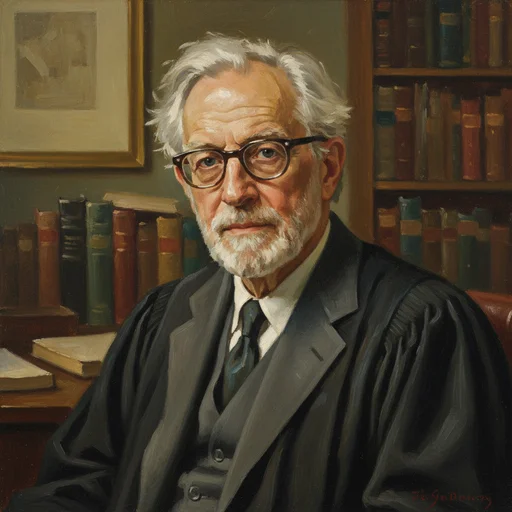
Arthur Coleman Danto was born on 1 January 1924 in Ann Arbor, Michigan, and grew up in Detroit. He was the son of Samuel Budd Danto, a dentist, and the household kept the measured tone of Reform Judaism. From 1943 to 1946 he served in the army during the Second World War, stationed in North Africa and Italy; he came home determined to be an artist. At Wayne University in Detroit he studied art and history, and from 1947 he was pulling Expressionist prints. He then went to Columbia for philosophy; a Fulbright took him to Paris in 1949-1950, where he attended Jean Wahl's lectures. In 1951 he returned to Columbia to teach. His woodcuts hung in the Art Institute of Chicago and the National Gallery of Art in the fifties, but after a solo show in 1960 he stopped making art. The turn came in 1964. He saw Andy Warhol's Brillo boxes at the Stable Gallery and wrote “The Artworld”: what makes an object a work is no visible quality but the theory and the history that surround it. The next year he published Nietzsche and Analytical Philosophy of History, reading Nietzsche not as a scattered aphorist but as a coherent thinker. From 1984 to 2009 he wrote art criticism for The Nation, in a voice that joined philosophical precision to everyday looking and never lost its humour. The idea of the “end of art”, developed in The Transfiguration of the Commonplace and After the End of Art, held that a single line of progress had closed and a plural age had begun, one in which anything can be art. In 1990 he received the National Book Critics Circle Award for criticism. He died of heart failure in Manhattan on 25 October 2013.
Mid-to-late 20th century, United States, academic attire, elderly intellectual with thoughtful expression.