
Arthur Danto
Friedrich Nietzsche (1844-1900) was a groundbreaking German philosopher, philologist, and cultural critic who harshly criticized Western metaphysics, religion, and traditional morality, profoundly influencing modern thought with concepts such as the "death of God," the "overman" (Übermensch), and the "will to power."
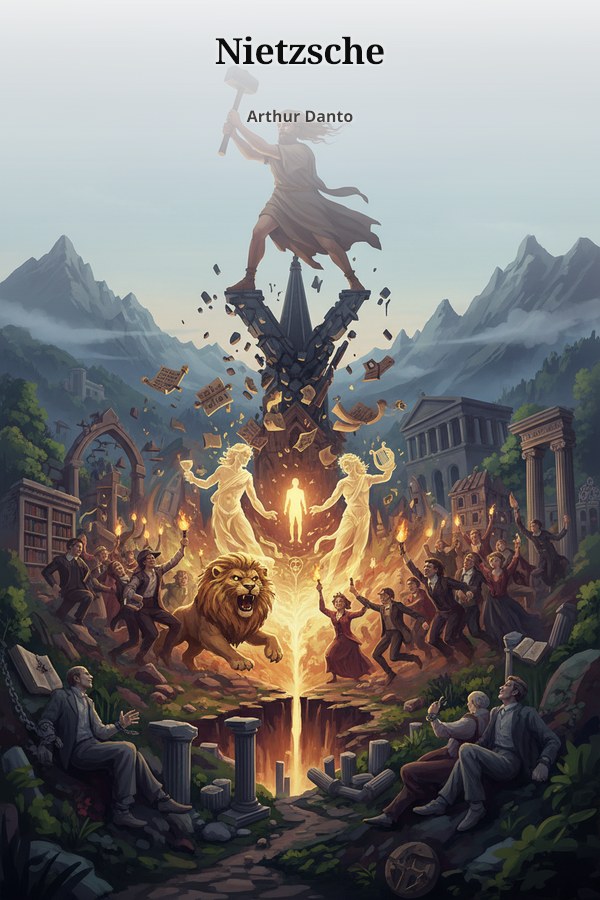
The existential and intellectual battle between the taming 'slave morality' (Western metaphysics and Christianity)—which weakens the individual and denies the body and this world—and a joyful, tragic, and creative philosophy of life ('master morality') that affirms life, danger, and power, aiming for the 'Overman' by embracing suffering and tragedy as part of existence.
The intellectual stage of Europe (Leipzig, Basel, Sils-Maria) and the philosophical depths of the human mind and culture.
Late 19th century (in a philosophical context, it covers the entire history of philosophy from Ancient Greece to Modernity).
Charged with crisis, awakening, and intellectual rebellion; an atmosphere of both a harsh and jarring criticality that smashes the established order with a hammer, and a Dionysian affirmation that celebrates life in all its exuberance.
An analytical, critical, and at times biographical academic voice that probes the origins of concepts (genealogical).
There is no 'objective' or 'in-itself' truth, moral world order, or universal laws in the universe; there are only interpretations and perspectives shaped around the 'Will to Power.' Existence is not a fixed being, but an endless state of 'becoming' and flux. Energy in the universe is finite, while time is infinite; therefore, every event that occurs will be relived countless times (Eternal Recurrence). Traditional good-evil distinctions are merely a reflection of power relations.
A period of cultural crisis formed by the rigid moralism of Victorian Europe, post-Enlightenment positivist/rationalist optimism, German nationalism, and the 2,500-year-old Platonic/Christian Western metaphysical tradition.
Characters are arranged at equal intervals on a circle; you can read the relationship type and dynamics by clicking on the lines.
Bir çizgiye tıklayarak ilişki detayını açın.
While there was initially a deep admiration and mentor-student relationship built on music, art, and Schopenhauer's philosophy, it eventually transformed into an ideological war. Wagner's antisemitism and his turn toward Christian mysticism with Parsifal led Nietzsche to break with him completely.
The friendship ended in 1878 when Nietzsche interpreted Wagner's opera Parsifal as a return to Christian values.
In his youth, Nietzsche was heavily influenced by Schopenhauer's pessimistic philosophy of 'blind will.' However, over time he rejected the idea of escape from this will (Nirvana/asceticism) and replaced it with the life-affirming 'Will to Power,' thereby transcending his master.
Having inherited the idea that a blind will lies at the foundation of the universe, Nietzsche later separated from Schopenhauer, labeling him the pessimist philosopher of the nihilistic age.
Zarathustra is Nietzsche's messenger and literary mask, used to convey his philosophical vision and deepest ideas (death of God, Overman, Eternal Recurrence) to the masses. Nietzsche speaks his own ideals through this character.
Nietzsche relays his thoughts, which he attained as if through an inner revelation, in the language of the Persian sage Zarathustra.
Nietzsche views Socrates as the founder of Western rationalism and the beginning of the theoretical man who denies becoming. Initially, he holds him responsible for the death of tragedy, though he develops a complex appreciation alongside intense criticism for this figure.
Nietzsche argues that since Socrates, the Western metaphysical tradition has been busy seeking an unchanging substance behind change, which has led to nihilism.
For Nietzsche, Plato is the architect of the metaphysical illness that devalues life by inventing the distinction between the 'true world' and the 'world of appearances.' Nietzsche builds his entire project on destroying Platonism and its popular form, Christianity.
Platonism and Christianity are fiercely rejected as forms that lead humanity toward nihilism.
In the world of the work, Zarathustra is the spokesman for life, the body, and the star (becoming) within chaos; Socrates is the symbol of pure reason, moral universalism, and a dogmatism that excludes tragedy.
Zarathustra aims to transform the passions withered by Socratic rationalism back into a creative power (the Overman).
Both have left deep marks on German culture and laid the foundations for Nietzsche's early-period idea of 'redemption from blind will through music/art.'
In his early period, Nietzsche attempts to establish a relationship between Schopenhauer's philosophy of will and Wagner's music.
Socrates' rationalism was systematized by Plato's theoretical metaphysics; in Nietzsche's words, they laid the roots for the West's life-denying 'ascetic ideal' and its nihilism.
The Western metaphysical tradition has progressed as periods, each being various forms or versions of Platonism.