

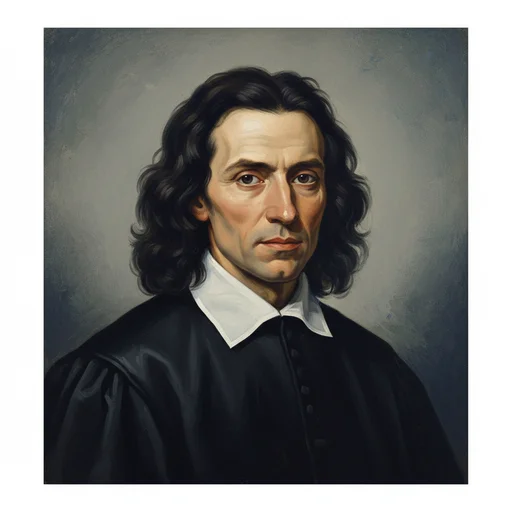
He was born in Amsterdam on 24 November 1632. His family were Portuguese Jews who had fled the Inquisition and taken refuge in the Netherlands; his father, Michael, was a merchant. His mother, Hanna Debora, died before he turned six. At the congregation's Talmud Torah school he studied Hebrew and the religious texts, and as a boy he worked in his father's trading house. After his father's death in 1654 he gave up commerce; at the Latin school of Franciscus van den Enden, a former Jesuit, he came to know Descartes, the new natural science and the dissenting circles of Amsterdam. His views unsettled the congregation: on 27 July 1656, aged only twenty-three, he was cast out with the harshest ban the Portuguese community of Amsterdam had ever pronounced. He took the name Benedictus; the Principles of Descartes' Philosophy, published in 1663, remained the only book to appear in his lifetime under his own name. He settled in Rijnsburg near Leiden, then in Voorburg, and finally in The Hague. He earned his living grinding lenses for microscopes and telescopes, and corresponded about that craft with the opticians of the day, Christiaan Huygens among them. In 1670 he published the Theological-Political Treatise without his name on it; the book was banned in 1674. In 1673 he declined the chair offered him from Heidelberg, on the grounds that it would restrict his freedom of thought. He built the Ethics out of definitions, axioms and propositions, in the order of a book of geometry, and treated the passions not with moral reproach but with the composure granted to natural events. He never risked publishing it while he lived. He died in The Hague on 21 February 1677, at forty-four, of a lung disease aggravated by years of breathing glass dust. His friends printed his manuscripts in secret that same year; his books reached readers only after he was gone.
He is the son of a Jewish merchant family that fled the Spanish Inquisition and settled in Amsterdam. After receiving a solid education in the Talmud and Jewish theology in his early years, he turned to New Scholasticism and modern philosophy (especially Descartes). Because his ideas were found dangerous and he refused either the bribes or the threats given to make him back down, he was definitively exiled and ostracized from the Jewish community. He even narrowly escaped an assassination attempt by sheer luck. These events did not make him vindictive; on the contrary, he used his solitude to produce more seamless and systematic works, to delve into the origins of universal truth, and to construct the purest ethical theory even amidst political instability.
Although an abstract philosophical narrator, consistent with the engravings and known historical depictions that adorn the scope of the text; he is a man with sharp features, a serious but very calm face, and dark, flowing, curly hair down to his shoulders, possessing dark, luminous eyes. He wears a dark, wide, simple robe (kaftan) that fits the Dutch fashion of the period but stands out for its simplicity, along with a wide, curved white collar. His demeanor carries a subtle fragility that seems like sadness but actually resembles a state of absolute tranquility.
Özgür İnsan
Representing the highest rational model humanity can achieve, this is the blessed and rare identity his philosophy aims to lead toward.
René Descartes
His philosophical predecessor, whose error in separating the mind from the body and positioning man outside of nature he frequently condemns, yet whom he takes seriously and answers.
Tanrı / Tabiat
His object of pure philosophical intellectual love, not by deifying Him, but by understanding Him entirely and placing His existence at the center as the absolute cause.