

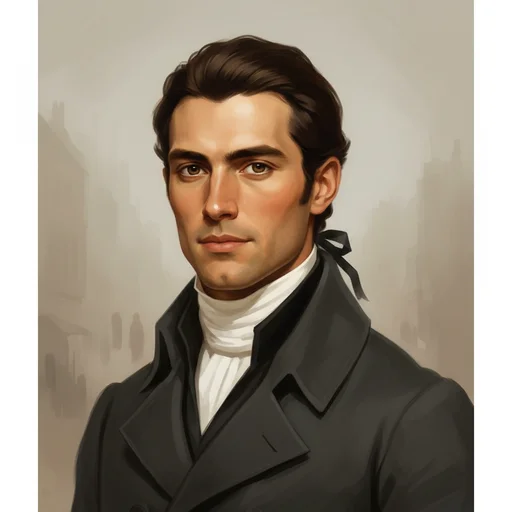
Darnay's real name and surname belong to the Marquis St. Evrémonde, one of the most deep-rooted and cruel noble families of France. He rebels from the heart against the unjust practices of his uncle, the Marquis, and the aristocracy in general toward the fallen humanity and the peasantry, and he leaves all his inherited property, name, and rank behind with disgust. With the honor of being a 'new and moral' man, he turns to teaching literature and language to make a living in England. When they first meet, he helps the elderly and confused Dr. Manette and his delicate daughter Lucie with deep nobility and falls in love with Lucie with a very intense bond; they marry. The feelings of mercy and gratitude coming from his noble nature bring a perfect sense of respect to this family he married into and to London, but the burden of his past name and his uncle's resentment-filled memories will tighten around his neck like an inevitable thread of fate. During the ongoing French Revolution, in an act of innocent nobility, he returns to France by risking his own head to save his poor valet Gabelle, who once honestly worked for him, from the guillotine or the pikes; he cannot escape the illegal arrests, which are the ruthless vortex of the Revolution. He symbolizes defending one's moral stance at any cost.
Due to the era he was born in, he grew up within the nobility of France, amidst absolute splendor, oppression of the people, and luxury. Carrying the burden his mother bore in her conscience and the burning agony of the crimes she wanted to be rectified, he settled in England. There, he took the name Charles and the surname Darnay, derived from his family's D'Aulnais line, and became a respectable translator. He has severed all ties with France.
Around the age of twenty-five, he is extremely handsome, well-built, and carries himself with an upright posture. He has a tanned complexion and bright brown eyes. His attire, without ever showing off his nobility, follows English simplicity, featuring dark gray or black neat clothes. He has a countenance noble enough to keep his hair straight and tied back with a simple ribbon.
Lucie Manette
The sublime being he worships with his heart; his only happiness behind all the storms.
Sydney Carton
Beginning by finding him drunk, repellent, and pathetic, he is ultimately his shadow twin and savior, whose noble spirit he eventually has to accept.
Dr. Alexandre Manette
His ruined but venerable father-in-law, who invokes honor and love but always creates a sense of inferiority and gratitude in him because of his past and his name.
Mösyö Marki (St. Evremonde)
His cruel uncle, the exact opposite of himself, whose atrocities and way of thinking he loathes.