
Charles Dickens
Charles Dickens's famous 1859 classic, A Tale of Two Cities, takes place in Paris and London before and during the French Revolution. The work is shaped around the oppression of the aristocracy, the destructive chaos of the revolution, and a striking story of love and sacrifice that unfolds during this process.
On the macro level, a life-and-death struggle between an oppressive aristocracy and the masses, who have been crushed for years and transformed into a bloody machine of revenge; on the micro level, the struggle of individuals to escape their dark pasts, traumas, and family legacies to build—or fail to build—a new life through love and compassion.
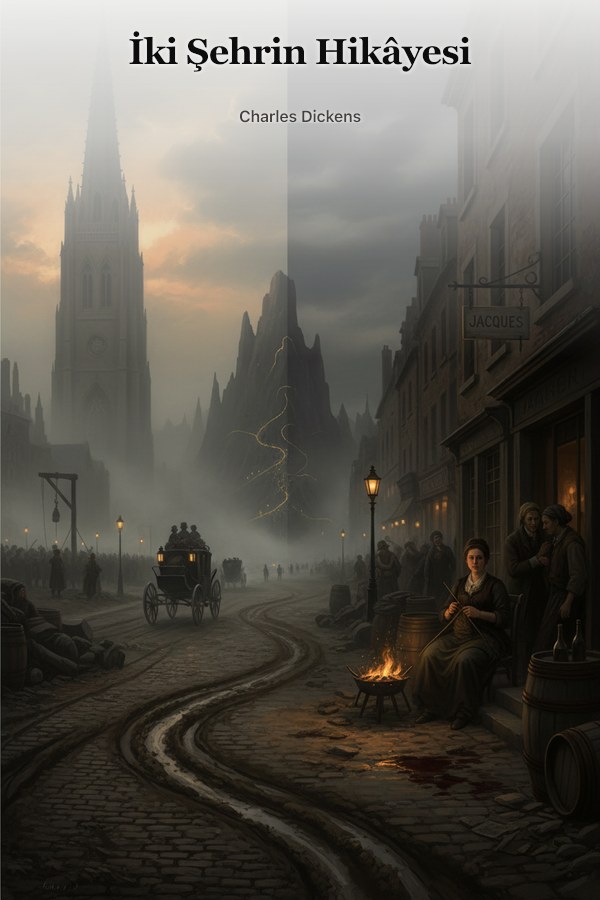
London, the capital of England, which is relatively protected but operates with a ruthless and formalist judicial system, and St. Antoine, Paris, a poor neighborhood in France containing roads that have turned into a bloodbath of hunger, misery, and rebellion, and the misty paths between them.
A period beginning in 1775 and spanning the terrifying early stages of the French Revolution after 1792, representing one of the darkest chapters in history.
A suffocating atmosphere woven with dark, gloomy, and lethal tension and despair; one where both the absolute and cruel tyranny of the aristocracy and the bloodthirsty rage accumulated by the people before and during the revolution are felt at every moment.
A third-person omniscient narrator who observes events from above, adding philosophical and often melancholic, cynical commentary that conveys the hypocrisy of human nature with both pity and judgment.
There is an unbridgeable abyss between the nobles and the people in society; the aristocrats have absolute dominion over the lives of commoners and view them as worthless, like animals. The belief that the world exists only for the masters is supreme. The price for these injustices is paid when the masses, having accumulated hunger and cruelty until they reach a breaking point, transform into an uncontrollable beast that no law or authority can stop, establishing their own unjust laws.
In France, there is a backdrop where the masses, suffering from poverty due to excessive taxation, the tax-farming system, and hunger, unite underground under the password 'Jacques,' preparing for one of the greatest social eruptions in history. In England, a conservative daily structure is seen where executions are watched as a public spectacle, driven by brute force and a pursuit of wealth, yet bounded by its own internal limitations.
Characters are arranged at equal intervals on a circle; you can read the relationship type and dynamics by clicking on the lines.
Bir çizgiye tıklayarak ilişki detayını açın.
The daughter's unconditional love is the greatest force tethering the father's traumatic mind to reality; they share an extremely sacred and healing bond.
When Lucie enters the dark room and her father looks up from his shoemaker's bench, his daughter feels no disgust for him; rather, she takes him by the neck and leans him against her chest.
A smooth relationship based on great respect, loyalty, and sacrifice; Darnay does his utmost to protect the peace of the Manette family.
Charles Darnay, while sitting under the plane tree in London, expressed that he loved Lucie with reverence, as one might love an angel who completes the Doctor's existence, more than his own life.
Although they look incredibly similar on the surface, they are opposites in structure; one is the representative of honorable living and virtue, the other of wasted potential and worthlessness.
Carton admits that when he looks in the mirror, he hates Darnay because he sees in him the bright and good version of his own life.
Carton views Lucie as a distant horizon, a sacred savior he can never touch, and he is ready at any moment to sacrifice his own wasted life for the woman he loves.
Carton tells Lucie, through tears, that she should keep his secret even in his worst state, and promises that he would sacrifice his life at any moment for the family she will build in the future.
Mr. Lorry, a trusted banker, shows both great patience in the face of Doctor Manette's traumas and acts as an unshakeable pillar that connects him to the outside world and practical life.
When the Doctor suffers his nine-day shoe-making crisis, Mr. Lorry never leaves his side, attempting to inquire about his mental health with great reverence and extreme gentleness.
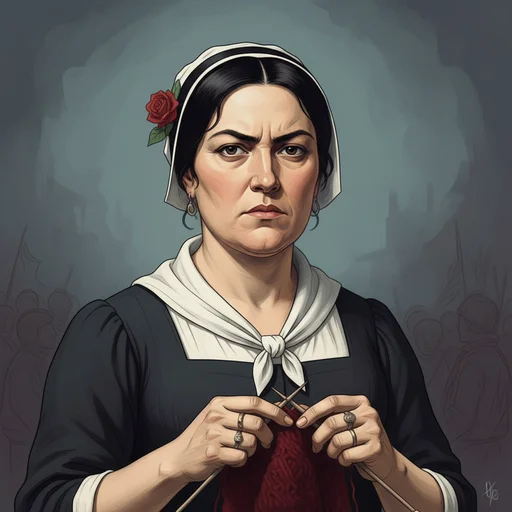
Both are forces fueling the revolution, but Madame Defarge's uncompromising, deadly determination woven with a thirst for vengeance constantly suppresses her husband's flickers of mercy and forces him into submission.
When Madame Defarge senses hesitation in her husband while knitting, she rebukes him, telling him he must always keep the tiger and the devil within him.
While Darnay detests and breaks away from the cruel and privileged aristocracy his uncle represents, the Marquis views his nephew as a traitor to the order and a fool; reconciliation between them is impossible.
When Charles Darnay renounces all his wealth at dinner at the château and declares he will toil in England, the Marquis dismisses him with secret mockery and disdain.
While Stryver makes a show of himself in the courts with his flamboyance and brute force, Carton prepares the actual intellectual work and the cases; though they tolerate each other, a mutual indifference prevails deep down.
While working by the fireplace at three in the morning, Stryver praises himself as the lion who gets things done, and Carton as the dull jackal who does all the work but remains unseen.
Defarge, having been the Doctor’s former servant, feels a respectful pity for him and protects him from danger in the attic when he is released, but he does not hesitate to use this situation as a 'spectacle' for the sake of the revolution.
Even while Defarge displays the Doctor in the attic like an animal to his chosen revolutionary friends to serve as a lesson, he shows great caution when approaching him.
Miss Pross is like an unwavering and jealous shield that perceives every suitor hovering around Lucie as an enemy, disregarding her own life for the sake of Lucie's well-being.
Miss Pross insists at every opportunity that only her brother is worthy of Lucie, whom she calls her 'bird', and that no one else, including Mr. Lorry, deserves her.