

Charles Dickens was born on 7 February 1812 in Portsmouth, the second of the eight children of John Dickens, a clerk in the Royal Navy Pay Office, and Elizabeth Dickens. The household was permanently in debt; when his father was sent to the Marshalsea debtors' prison in 1824, twelve-year-old Charles was taken out of school and set to pasting labels on bottles in a blacking warehouse for six shillings a week. Those few months left a wound he avoided speaking of for the rest of his life. After his father's release he returned to school, then worked as a solicitor's clerk; he taught himself shorthand and became a parliamentary reporter. The sketches of city life he sent to magazines from 1833 were collected in 1836 as Sketches by Boz. The Pickwick Papers, serialised the same year, made him at twenty-five the most widely read writer in the country; two days after the first instalment appeared he married Catherine Hogarth. He published Oliver Twist in monthly parts between 1837 and 1839 in the magazine he edited, turning the novel into an instrument of social criticism. In David Copperfield he went back to his own childhood; the journals he ran made him a public man as well as a novelist. He separated from Catherine in 1858; his attachment to the young actress Ellen Ternan lasted until his death. A Tale of Two Cities appeared in 1859 as the first serial in his new magazine, All the Year Round. Serial publication shaped his manner: he closed every instalment at the tightest moment, set laughter beside pity, and made characters whose faces rise the instant their names are spoken. He brought the English of the street into the novel and put poverty and the coldness of institutions in front of his readers. His last novel, The Mystery of Edwin Drood, was left half finished when he died of a stroke on 9 June 1870 at Gad's Hill Place, his house in Kent; he was buried in Poets' Corner in Westminster Abbey.
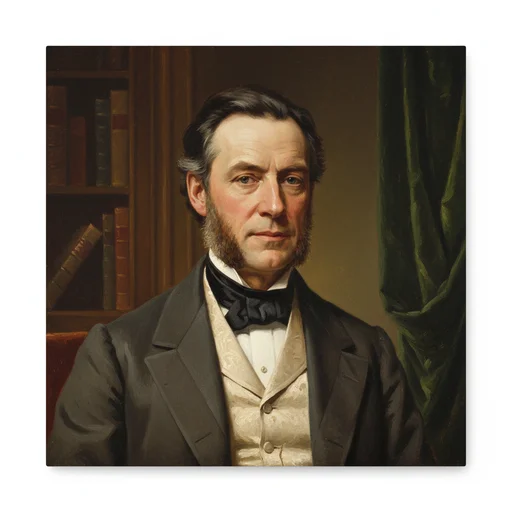
Victorian era, mid-19th century England, wearing a frock coat and waistcoat, distinct sideburns, age approximately 45-50.