

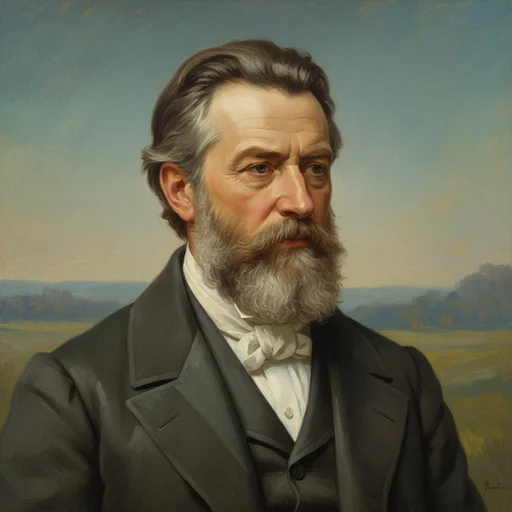
Ivan Sergeyevich Turgenev was born in 1818 in Oryol, the second son of a wealthy noble family. His father was a cavalry colonel; the land and the serfs belonged to his mother, Varvara Lutovinova, a woman known for her hard temper. He spent his childhood on the family estate at Spasskoye, in a household where only French was spoken; he learned Russian largely from the servants. He began his studies at Moscow University, continued them in Petersburg, and then went to Berlin to read philosophy. He came to writing through poetry; “Parasha”, published in 1843, was the work that first made his name. That same year he met the singer Pauline Viardot, who had come to Petersburg on tour; the bond that followed lasted the rest of his life and tied him to Europe. The village stories he published in magazines from 1847 onwards appeared in 1852 as A Sportsman's Sketches; these pieces, showing the everyday face of serfdom, were widely read. In 1852 an obituary he wrote for Gogol, refused by the censors, earned him a month in prison and then confinement under surveillance at Spasskoye; he wrote Mumu while detained. After Rudin, Home of the Gentry and On the Eve came Fathers and Sons in 1862. Bazarov's “nihilist” stance angered the young radicals and the older generation alike; the quarrel the book provoked drew Turgenev away from Russia. He lived in Baden-Baden, and later near Paris. His language was measured and trusted the detail; he wove descriptions of nature into his characters' states of mind and carried an argument without raising his voice. He became the writer who brought the Russian novel to Western Europe; he was a friend of Flaubert and Zola, and in 1879 received an honorary doctorate from Oxford. In 1877 he published his last novel, Virgin Soil. He died of cancer on 3 September 1883 at Bougival, near Paris; his body was taken back to Russia and buried in the Volkovo Cemetery in Petersburg.
Mid-19th century, well-groomed gray beard, high-collar frock coat, European-style intellectual attire, mature middle-aged man.