
İvan Turgenyev
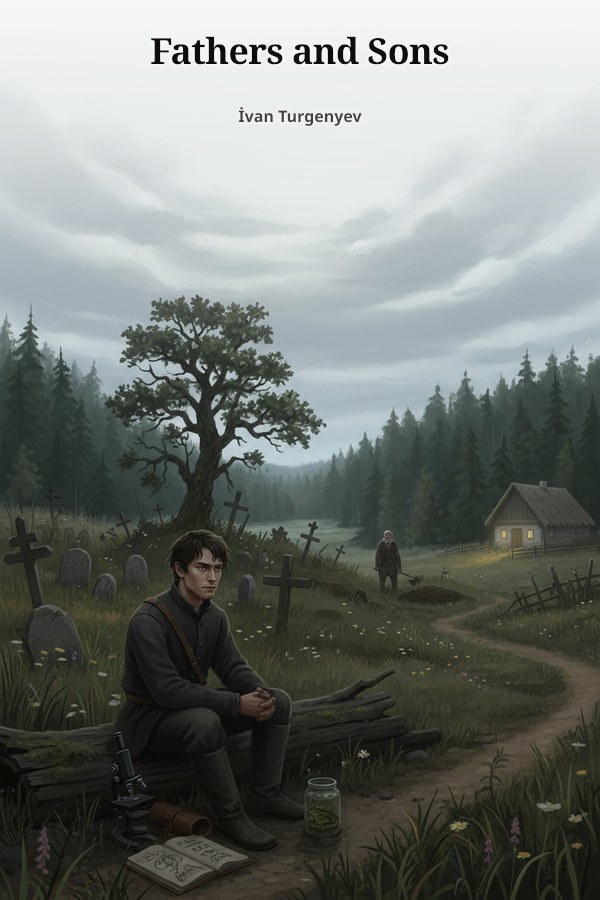
Ivan Turgenev’s 1862 masterpiece, Fathers and Sons, is a classic novel that explores the generational conflict in 19th-century Russia and the contrast between traditional values and the era's new radical philosophy, nihilism.
The irreconcilable intellectual and practical conflict between the nihilist philosophy, which rejects all authority and belief in favor of science and materialism, and the old romantic aristocratic values rooted in love, art, honor, and family ties.
The provincial regions of Russia: Nikolay Petrovich's farm 'Maryino', Anna Odintsova's estate 'Nikolskoye', the town of K..., and the desolate, humble village home of Yevgeny Bazarov's parents.
The months between May and late summer of 1859 (with the epilogue set six months later and the following years).
A sense of tense, sorrowful, and fragile silence on the brink of change. Gloom and nostalgia, the beauty of nature and the restlessness of the human spirit exist side by side.
An omniscient third-person narrator who occasionally makes observations about the characters and maintains an empathetic approach toward both the fathers and the sons.
A realistic world where rigid social boundaries are eroding and Western ideas are creating tremors in the Russian countryside; yet, it is a world where neither the old landowners can truly function nor the new nihilist intellectuals can truly connect with the people. Nature and biological laws are absolute.
Mid-19th-century Tsarist Russia, on the eve of the abolition of serfdom, where a deep chasm has formed between progressive youth (nihilists/radicals) and romantic, old-school aristocrats.
Characters are arranged at equal intervals on a circle; you can read the relationship type and dynamics by clicking on the lines.
Bir çizgiye tıklayarak ilişki detayını açın.
Initially, Bazarov is the dominant teacher and Arkady is the obedient student. Over time, Arkady’s romantic nature prevails, and they grow apart due to ideological differences.
While sleeping in the hayloft, Arkady and Bazarov argue, and Bazarov coldly says their paths are parting, asserting that Arkady belongs to the world of the 'fathers'.
Bazarov’s crude, practical, and iconoclastic attitude constantly clashes with Pavel’s refined, aristocratic, and principled ego. Their mutual hatred escalates to a duel.
After Pavel Petrovich sees Bazarov kissing Fenichka, he challenges him to a duel under the guise of ideological differences.
Although Bazarov does not believe in love or romanticism, he feels a violent and painful passion for Anna; Anna, though intrigued by him, rejects him to protect her peace.
In a hotel room, Bazarov tries to press Anna to his chest with fury and passion by the window, then leaves, declaring his feelings to be idiocy.
Initially, the new ideas Arkady adopts build a wall of shame and alienation between him and his father; however, when Arkady returns to his true identity, this loving relationship is strengthened once more.
At the beginning of the book, Arkady embraces his father to encourage him, helping to alleviate his father's embarrassment regarding Fenichka and their baby Mitya.
Arkady steps out of Odintsova’s shadow and discovers Katya’s quiet but intelligent nature. Katya gently guides him and frees him from Bazarov’s influence.
While sitting in the shade of a tree in the garden at Nikolskoye, Arkady declares his love to her, and Katya smiles and accepts his proposal.
Nikolai, due to the difference in social status and his fear of his older brother, cannot formalize this relationship; however, Fenechka feels endless love and respect for him. In the end, they reach an equal footing.
Following the advice Pavel gives after the duel, Nikolai finally gathers his courage and decides to marry Fenechka formally.
Pavel likens Fenechka to Princess R., to whom he was once bound by a destructive love and subsequently lost. He both keeps his distance from her and secretly harbors a respectful and protective love for her.
After being wounded in the duel, Pavel looks at Fenechka and says, 'How much she resembles Princess R...' and subsequently insists that his brother marry her.
The father virtually worships his son and believes he will become a great man, but he is forced to conceal his affection due to his son's coldness and detachment.
Vasily Ivanovich warns his wife, Arina, not to overwhelm their son and suppresses his terms of endearment so as not to annoy him and drive him away from home.
Anna exerts an invisible but heavy pressure on Katya. Katya remains timid in her sister's shadow but secretly looks for ways to break free from this dependency.
Katya expresses to Arkady that she feels very lonely because of her sister, and that if a dominant suitor were to come along to suppress her, she would reject him just to remain independent like her sister.
Bazarov views her as a pleasant, sweet object and approaches her with a nihilistic ease; although Fenechka is afraid, she feels comfortable in his presence.
One morning in the lilac arbor, Bazarov leans in under the pretext of smelling the roses and kisses the startled Fenechka on the lips.