

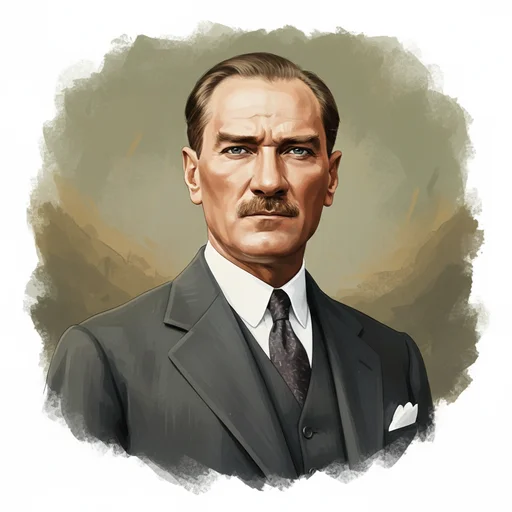
The commander-in-chief of the War of Independence, the first president of the Grand National Assembly of Türkiye, and the founder of the Republic of Türkiye. By landing in Samsun on May 19, 1919, he lit the fire of creating an independent nation-state from the wreckage of the collapsing empire. In addition to his military genius, he fought against both the occupation armies of the Allied Powers and the Sultan and Caliph who supported them with an immense political and diplomatic strategy. He implemented every stage of the revolution when the time came, and did not hesitate to part ways with even his closest friends for the sake of his principles. In the *Nutuk* (Speech), he explained to his nation how this unique homeland was founded, based on documents, with unshakeable logic and historical responsibility. He is a unique revolutionary who recognized no legitimacy other than the sovereignty of the people.
Born in Macedonia and a graduate of the Military Academy, he is an officer who personally fought on the Balkan Wars, Gallipoli, Caucasian, and Syrian fronts, closely observing the country's military and civil collapse. By seeing the moral and political bankruptcy of the Sultanate and the Ottoman administration directly from the mouths and attitudes of the Sultans themselves, he had believed in his heart even during the war years that the nation must determine its own destiny.
In the text of Nutuk, physical descriptions of himself are rarely provided; however, as 'Gazi' and 'Marshal,' he is envisioned as a respectable and charismatic leader with a proud posture, always carrying a military gravity even in civilian attire and commanding his surroundings with his presence. He possesses a physical fortitude strong enough to remain at the head of his army despite having broken ribs during the Battle of Sakarya.
Çerkez Ethem
The rebellious militia leader whom he crushed immediately the moment he disobeyed orders and whom he declared a traitor to the country.
Damat Ferit Paşa
The representative of treason against the nation and of sycophancy to the Sultan; his arch-enemy.
Kâzım Karabekir Paşa
A commander who, despite being his supporter since Erzurum, later fell out with him over his vision for the republic and was turned into an opponent.
İsmet Paşa (İnönü)
His only confidant and comrade-in-arms whom he trusted the most and endowed with full authority in the political and military arenas.
Rauf Bey (Hüseyin Rauf Orbay)
His ally at the beginning of the National Struggle, but a conservative-minded political rival from whom he parted ways during the reform process.