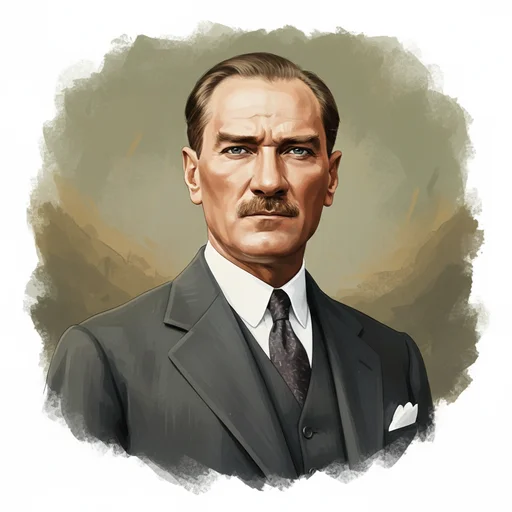

Mustafa Kemal Atatürk
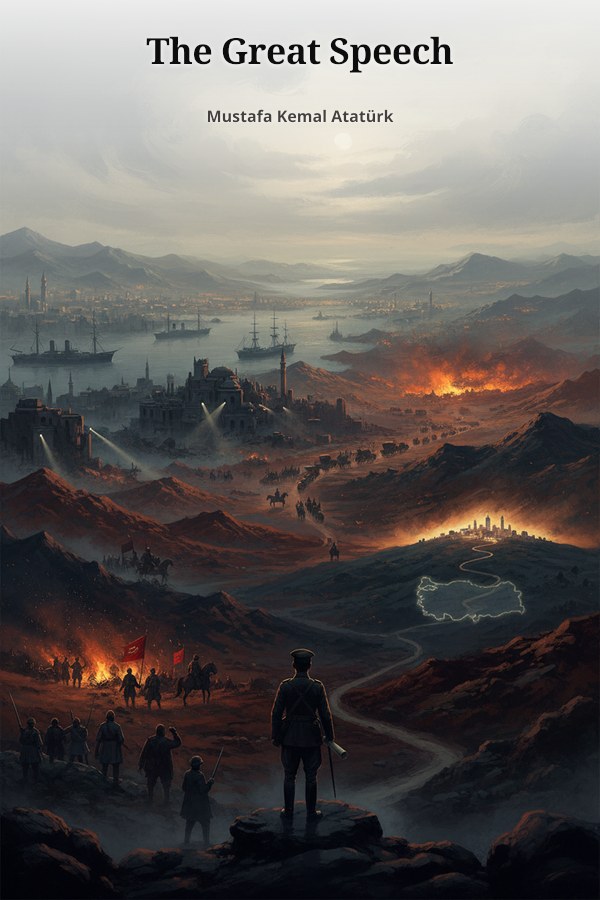
Nutuk is a 36-hour historical address delivered by Mustafa Kemal Atatürk at the CHP Congress between October 15-20, 1927, in which he recounts the historical process between 1919 and 1927, the National Struggle, and the founding of the Republic of Türkiye. It is the foundational document of the Turkish Revolution, a work of accountability, and a testament entrusting the newly founded state to the nation.
The life-or-death struggle between the great Turkish nation fighting for its survival (led by Mustafa Kemal and his companions) and the Allied Powers (and the Greeks they exploited) who wanted to partition historic Turkish lands among themselves. This is accompanied by the relentless struggle against the corrupt Ottoman Palace, which collaborated with the enemy for the sake of its own life and throne, and the internal rebellions it incited.
The remnants of the disintegrating Ottoman Empire, occupied by the Allied Powers; Istanbul under the Sultan's captivity, and Anatolia, where the resistance was ignited (Samsun, Amasya, Erzurum, Sivas, Ankara, and the Western Front).
1919 - 1927 (The collapse of the Ottoman Empire, the War of Independence, and the early years of the Republic)
A heavy, revolutionary, solemn, and epic atmosphere where the national existence faces the threat of extinction, and where betrayals, sacrifices, and heroism are intertwined; military and political strategies are executed with breathtaking tension.
First-person singular. An authoritative narrative in which Mustafa Kemal Atatürk recounts the process by verifying it with countless official telegrams, documents, and logical arguments—persuasive, stern, held to account, and embodying leadership qualities.
Sovereignty belongs unconditionally to the nation, and political power has been transferred from individuals to the Grand National Assembly of Turkey. Not a single inch of the homeland can be abandoned until it is soaked in the blood of its citizens. No foreign mandate, protection, or personal monarchical delusion can be held above national independence. State affairs cannot be conducted by begging for mercy and justice.
The transition from centuries of absolute monarchy and a dogma-centered (caliphate) structure to a secular, modern nation-state guided by reason and science. A society in a transitional period where ignorance and bigotry struggle in a life-or-death battle against patriotism and the belief in independence.
Characters are arranged at equal intervals on a circle; you can read the relationship type and dynamics by clicking on the lines.
Bir çizgiye tıklayarak ilişki detayını açın.
Mustafa Kemal has infinite trust in Ismet Pasha's military and diplomatic skills and his absolute loyalty. During the Lausanne negotiations, the unshakeable authority and support of Mustafa Kemal stand firmly behind Ismet Pasha, who had fallen out with the head of government, Rauf Bey. They share both a superior-subordinate relationship and a strong consensus of ideas and deep brotherhood.
Mustafa Kemal's response to Ismet Pasha—who said in a telegram, 'You arrive like Khidr in my every difficult moment'—with 'I kiss your eyes, my brother.'
Although they set out together for the liberation of the homeland, deep ideological rifts formed during the proclamation of the Republic and the implementation of the reforms. Rauf Bey's emotional attachment to the caliphate and sultanate clashes with Mustafa Kemal's radical enlightenment vision. Mustafa Kemal accuses him of misleading the nation and using religious dogmas as political weapons.
Mustafa Kemal accusing Rauf Bey of deceiving the public and being reactionary in response to Rauf Bey's insinuations in the Assembly that the proclamation of the Republic was a 'fait accompli by the irresponsible'.
The relationship between these two commanders, who shared a common fate starting from Erzurum, reaches a breaking point over political factionalism within the Assembly and the separation of military and politics. Kâzım Karabekir's desire for commanders to have a say in civil revolution decisions conflicts with Mustafa Kemal's ideal of a democratic and secular nation-state. Their respect-based relationship gives way to serious mistrust.
Kâzım Karabekir saying regarding the proclamation of the Republic, 'They did not ask us,' and Mustafa Kemal criticizing him for using the army as a tool for politics.
There is no point of reconciliation between Mustafa Kemal, who devoted himself to the liberation of the homeland, and Damat Ferit Pasha, who collaborated with British imperialism to protect his seat and stabbed the Turkish nation in the back. Mustafa Kemal sees this government as a focal point of treason and makes it his primary goal to overthrow it with the power of the nation.
Mustafa Kemal imposing the condition on newly formed governments after toppling the Damat Ferit cabinet to 'not drive the country into an abyss like Damat Ferit Pasha did.'
Ethem, initially a useful militia commander against the Greek occupation and internal uprisings, eventually transforms into a rogue warlord. He acts out of arrogance and insubordination by refusing to enter the administration of the regular army. Against this attitude, which does not recognize the regular army, he is ruthlessly crushed by Mustafa Kemal's orders and forced to take refuge with the enemy.
Cerkez Ethem sending arrogant telegrams directly to the Assembly by not recognizing Ismet Pasha's command, and Mustafa Kemal giving the order to the armies to crush him.
During the Lausanne Conference, the fact that İsmet Pasha was the chief representative while Rauf Bey held the position of Prime Minister created a diplomatic deadlock between the two. Rauf Bey was uncomfortable that İsmet Pasha did not consult him during decision-making processes and attempted to accuse him of incompetence; however, Mustafa Kemal threw his full weight behind İsmet Pasha in this conflict.
Rauf Bey's persistent veto regarding the acquisition of Karaağaç in exchange for Greek reparations during the Lausanne negotiations, and İsmet Pasha bypassing him to obtain direct approval from Mustafa Kemal.
Mustafa Kemal stood firmly against Tevfik Pasha's attempts to bring Anatolia back under the control of the Istanbul Government. Although respectful language was used, Mustafa Kemal repeatedly and bluntly reminded Tevfik Pasha that the sole representative of the Turkish nation was Ankara, and that the structure in Istanbul was nothing more than a 'puppet'.
Mustafa Kemal's firm rejection of Tevfik Pasha's proposal to attend the London Conference together, stating, 'Step aside; the only legitimate government is in Ankara.'
Ali Fuat Pasha, an important commander in the early stages of the War of Independence, lost his authority on the front following the failure at the Battle of Gediz. Mustafa Kemal persuaded him to accept an appointment as Ambassador to Moscow. In later years, he would join the opposition alongside Rauf Bey and Karabekir against the rapid declaration of the Republic.
Mustafa Kemal personally traveling to the front after the failure of the Gediz offensive to inspect the situation and subsequently appointing Ali Fuat Pasha as Ambassador to Moscow.
Mustafa Kemal was infuriated when Bekir Sami Bey, sent to Europe in his capacity as Minister of Foreign Affairs, made secret agreements with imperialist states independent of Ankara's principles of national independence. Refusing to compromise on the principle of independence in the slightest, Mustafa Kemal immediately canceled these agreements and forced Bekir Sami Bey to resign.
The process by which the economic concession and prisoner exchange agreements signed by Bekir Sami Bey in London were found to be contrary to the National Pact and rejected by the Parliament.
Mustafa Kemal found Refet Pasha's military capabilities to be insufficient or hesitant at certain stages. His inactivity during his time as a front commander in particular, and his later support for Rauf Bey's pro-caliphate policies, led Mustafa Kemal to regard him as a politically dangerous and weak figure.
During the Battle of Aslıhanlar, Refet Pasha's failure to mobilize his cavalry despite the expectation of commanders waiting for support, and Mustafa Kemal's subsequent outcry over this situation.