

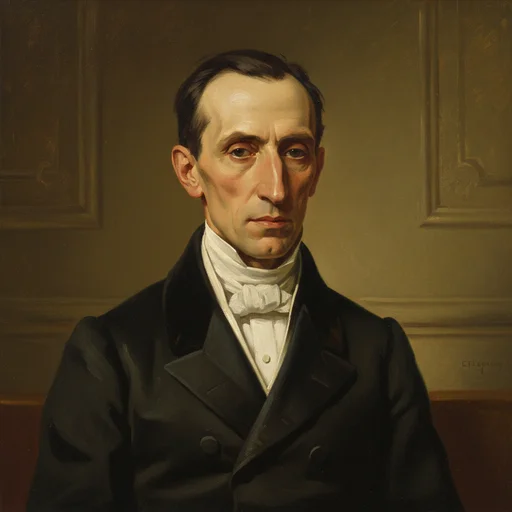
Nikolai Gogol was born in 1809 in Sorochintsy, a town in the Poltava region of Ukraine, into a family of minor landowners. His father, Vasily Gogol-Yanovsky, wrote amateur plays and staged them at home; he died when Gogol was fifteen. A sickly, withdrawn child, the future writer became known at the school in Nezhin for his sharp tongue and for the old men and women he played in school theatricals. In 1828 he went to Petersburg in search of fame; his attempt at acting came to nothing, and when the poem he had printed at his own expense, Hanz Küchelgarten, was savaged by reviewers, he gathered up every copy he could find and burned it. Written while he held a minor clerkship, Evenings on a Farm Near Dikanka (1831-32), a set of Ukrainian village tales, made him known overnight and won him Pushkin's friendship. In 1835 he published Mirgorod and Arabesques; the following year The Government Inspector reached the stage, and its mockery of provincial officials caused an uproar. Worn down by the reaction, Gogol left Russia and spent most of the next twelve years in Rome, where he wrote the first volume of Dead Souls. Selected Passages from Correspondence with Friends, published in 1847, turned against him the very critics who had defended him; Belinsky's furious letter shook him deeply. Gogol's pen holds the ridiculous and the frightening in a single sentence: the colourless copying clerk of The Overcoat and the provincial manor houses of Dead Souls make the reader laugh and grow uneasy at once. Much of the realist strain in Russian prose grew out of that way of looking. In 1848 he made a pilgrimage to Jerusalem; his last years were consumed by a religious crisis. In February 1852 he threw the manuscript of the second volume of Dead Souls into the fire, refused food, and died days later in Moscow, aged forty-two.
1840s, Russia, frock coat with high cravat, gaunt face with a prominent long nose and thin hair.