
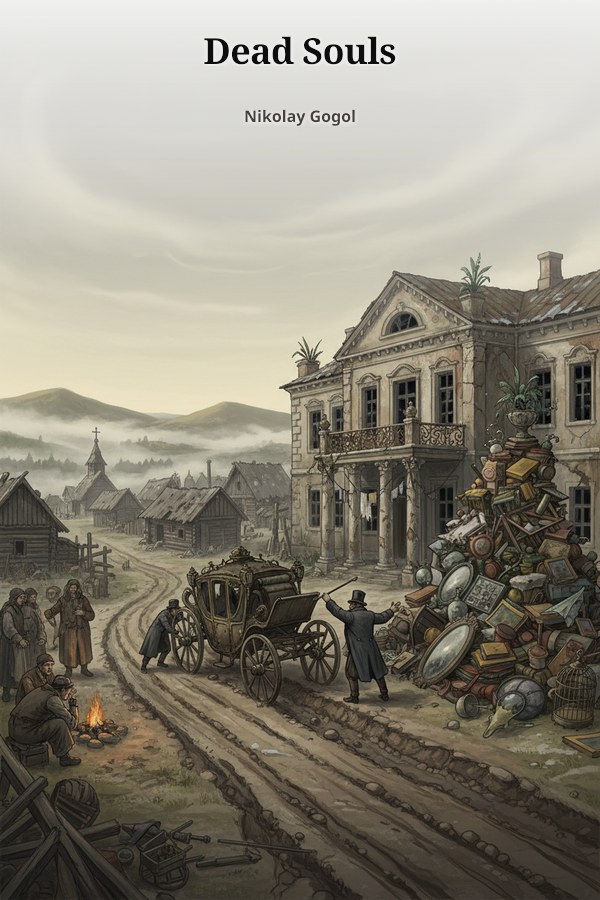
Nikolay Gogol
Nikolai Gogol's Dead Souls, published in 1842, is a masterpiece that critiques the bureaucracy, landlords, and corrupt system of Tsarist Russia. Chichikov, a cunning civil servant, attempts to defraud the state by purchasing dead serfs ("souls") on paper and mortgaging them, driven by the dream of becoming wealthy.
The conflict between the polite con man Chichikov, who takes advantage of a legal but absurd loophole to purchase dead serfs on paper, and the landowners—each possessing distinct psychological obsessions (miserliness, anger, extreme naivety, greed)—as they react to this bizarre trade.
The city of N..., an imaginary provincial center in the Russian Empire, and the various towns and manors, both poor and wealthy, scattered around it.
The first half of the 19th century (the era of Tsar Nicholas I and the years before the abolition of serfdom).
A gloomy, bureaucratic, absurd, and satirized atmosphere of a dismal Russian province, where a tedious provincial stagnation prevails and ostentation is intertwined with squalor.
An omniscient, intrusive third-person narrator who speaks directly to the reader, renders moral judgments, and is highly sarcastic and humorous.
Humans (serfs) are akin to property that can be bought, sold, mortgaged, or lost in gambling by landowners. By law, peasants who die between census intervals (revisions) are not removed from the legal register; they are considered 'alive,' and landowners must continue to pay taxes on them. Social status is strictly tied to the number of serfs owned, official ranks, and titles of nobility.
A social structure where sycophancy, ostentation, and bribery are considered commonplace in the bureaucracy, and elites mimic French/German customs (speaking French, using foreign goods) while the underlying infrastructure is rooted in a dilapidated and crude Russian provincial mentality.
Characters are arranged at equal intervals on a circle; you can read the relationship type and dynamics by clicking on the lines.
Bir çizgiye tıklayarak ilişki detayını açın.
Manilov glorifies Chichikov as a deep and spiritual friend, and out of excessive affection, agrees to give away the 'dead souls' for free. Chichikov masterfully exploits Manilov's sweet but overly naive passivity.
Upon seeing Chichikov at his home for the first time, Manilov laments the tragic misfortunes of his life as if he had found a soulmate, then gifts him the dead souls and even covers the sales costs.
An extremely frustrating relationship for Chichikov. While Chichikov presents logical (to him) arguments and threats, Korobochka constantly resists, driven by superstitions and the fear that they might become valuable later. Chichikov barely gains the upper hand.
Chichikov exclaims, 'Curse that stubborn old hag, she’s worn me out,' while trying to settle for fifteen rubles as she insists 'other buyers might come along' for the dead peasants.
Nozdryov is uninhibited and intrusive; he tries to force Chichikov into gambling and defraud him. When Chichikov realizes he is being cheated, he resists, leading to a complete breakdown in relations that turns into pure violence.
Nozdryov orders his servants, 'Beat him, give him a thrashing!' and Chichikov narrowly escapes the beating thanks to the sudden intervention of the police captain.
Both parties recognize each other as 'con men' or 'sly' in their hearts but do not attack openly. A cold, tough negotiation ensues. Sobakevich sets an absurdly high price for his dead souls as if they were alive, while Chichikov tries to beat the price down.
Sobakevich demands one hundred rubles for a dead carpenter, and Chichikov engages in a fierce bargain, insisting, 'I won't give a kopek more than two and a half rubles.'
Chichikov immediately grasps the miserable state and horrific miserliness of Plyushkin; he wins his trust with the lie of saving him from taxes and obtains the dead souls and runaways for free under similar conditions.
Hearing that Chichikov will pay for the deed expenses himself, Plyushkin showers him with compliments as a 'benevolent man.'
Chichikov gives orders, gets angry, and frequently insults his servant; Selifan, while appearing submissive on the surface, gets lost in his own world when drunk, messes things up, and engages in quiet passive resistance.
When the carriage turns over into the mud, Chichikov shouts, 'You wretch! What kind of road are you taking?' and threatens to beat him with a stick.
A partnership that appears happy from the outside, woven with a continuous display of affection, kisses, and a barrage of meaningless compliments, yet is highly inefficient and lacks proper household management.
Despite being married for eight years, they feed each other apple slices saying, 'My darling, open your mouth.'
Mizhuyev is a loyal, spineless sidekick who constantly confronts Nozdryov with his lies but can never leave his side. Nozdryov treats him rudely yet drags him along everywhere.
When Nozdryov lies, 'You are the one who lost my fifty rubles,' Mizhuyev weakly replies, 'You didn't wipe me out,' yet he still cannot disobey him.
The father is pathologically distrustful and miserly; his daughter has entered into a marriage he did not approve of. Despite the grandchildren and small gifts his daughter brings, Plyushkin punishes her by never offering her any financial support.
When his daughter Alexandra comes to visit him with her two children, Plyushkin gives them only a button to play with and refuses to give them a single penny.
Although Sobakevich conforms to them in public or official settings, he does not hesitate to declare behind their backs that they are all despicable swindlers, bribe-takers, and animals.
When Chichikov praises the governor, Sobakevich shouts, 'The governor is a total bandit; give him a knife and turn him loose in the street!'