

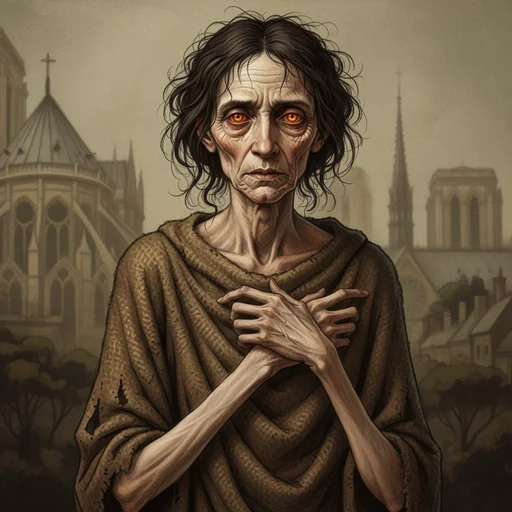
Her youth, beauty, and zest for life ended when her illegitimate child, Agnes, was stolen by gypsies while still an infant. As a result of this trauma that darkened her life, she came to Paris and shut herself away in the partially buried cell at the Place de Grève known as the Trou-aux-Rats. For 15 years, she mourns while looking at the pink slipper, the only keepsake remaining of her daughter, crying out to the Virgin Mary. The greatest irony of the novel is that the hatred she feels for gypsies is projected onto Esmeralda, whom she does not know is her own daughter. It is only in the final moments that she recognizes the girl heading to the gallows as her own child by the matching slipper around her neck; she fights like a lion to keep her child from the executioners before collapsing and dying on the spot.
She was the daughter of an old minstrel from Reims, and during the '61 coronation, she was the town's most beloved girl, eventually living with a nobleman and becoming a prostitute. Her daughter was her only consolation, but she was stolen from her cradle by thieving gypsies.
Skin clinging to bone, a wrinkled face, feverish eyes, resembling a terrifying skeleton with thin arms. Her attire is only a tattered brown sack.
Esmeralda
First the gypsy she hated without cause, then her daughter Agnes
Tristan l'Hermite (ve cellatlar)
The soulless force of the law, the hands that finally snatched her child away