
Victor Hugo
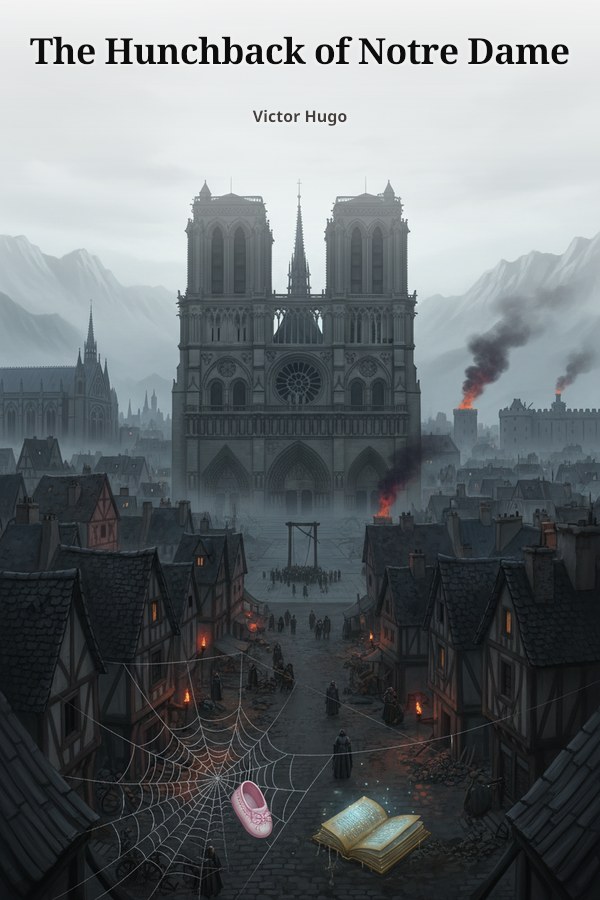
Victor Hugo's classic 1831 novel Notre-Dame de Paris recounts the tragic love, fate, and social corruption among the ugly bell-ringer Quasimodo, the beautiful gypsy Esmeralda, and the passionate Archdeacon Frollo in 15th-century Paris. Set in the heart of Notre-Dame Cathedral, the work aims to preserve Gothic architecture.
Centered on the conflict between pure beauty and deformity, and mercy and bigotry; Frollo's suppressed dark desires and the ruthless social judgments of the era drive Esmeralda, an innocent Gypsy girl, toward an inevitable catastrophe (the web of fate).
Paris. Locations typical of the medieval city such as Notre-Dame Cathedral, the Place de Grève, the Palais de Justice, the Bastille prisons, and the Court of Miracles.
The year 1482, late 15th century (reign of King Louis XI of France).
Dark, gothic, oppressive, and tragic. A melancholy atmosphere steeped in superstition, shaped by the gloom of the Middle Ages, the danger of streets controlled by vagabonds, and the stony weight of Notre-Dame.
An omniscient (divine/authoritative) narrator voice that occasionally addresses the reader directly and guides the events by interjecting philosophical and historical commentary (from a 19th-century perspective).
Society is divided into sharply defined classes. The Church and the monarchy hold absolute power, yet those who take refuge within churches are untouchable (the right of sanctuary). The justice system relies largely on forced confessions through torture and superstitions (witchcraft, sorcery). The night streets belong to the vagabonds and thieves (the community of the Court of Miracles), who have their own laws.
A culture in the throes of transitioning from the Middle Ages to the Renaissance, where the printing press is just beginning to spread and Gothic architecture stands in splendor, yet society remains profoundly bigoted, corrupt, and merciless. Witch hunts and public tortures are common.
Characters are arranged at equal intervals on a circle; you can read the relationship type and dynamics by clicking on the lines.
Bir çizgiye tıklayarak ilişki detayını açın.
Frollo's suppressed lust for Esmeralda gradually turns into a deadly obsession and hatred. Frollo holds the power, and he strives to either possess the girl or destroy her.
"You shall die, beautiful girl, or you shall be mine! You shall be my priestess! My apostate!"
In a world where Quasimodo believes he is loathed, Esmeralda offering him water ignites this love. Quasimodo protects the girl like a goddess; he cannot even bear to touch her.
"You, you are a ray of sunshine, a drop of dew, the singing of a bird! As for me, I am something horrible, neither human nor animal..."
Frollo has claimed and raised Quasimodo, acting as his master. Quasimodo is bound to him with the loyalty of a dog, but this loyalty reaches a breaking point once Esmeralda enters the picture.
Quasimodo loved his foster father as neither a dog, nor a horse, nor an elephant had ever loved their master before.
While Esmeralda sees Phoebus as the miracle of her life and her great love, Phoebus's intentions are based entirely on physical, fleeting pleasure and a deceitful aristocratic arrogance.
"To love you, angel of my life! My body, my blood, my life, my soul, everything is yours, everything is for you."
Esmeralda accepts Gringoire as her husband to save him from execution, but only a platonic and distant friendship develops between them. Gringoire is more concerned with his personal survival.
"This is a trouble, too... But what can I do, as it is my misfortune to have married a virgin, that is why it is so."
For years, Paquette hates her daughter, believing she was kidnapped and killed by Gypsies. When she realizes the girl is her own daughter, she fights to the death to save her.
"My daughter! My daughter! I have found my child again. But, is this story to be believed?"
While Claude tries to raise his brother like a son to satisfy his own unfulfilled affection, Jehan's mischief and alcoholism lead to Claude's disappointment.
"You behave so well toward me, you give me such fine advice, that I always return to you."
A relationship built on societal and familial expectations, characterized by jealousy and coldness. For Phoebus, it is a burden.
Fleur-de-Lys loved him, and she was his betrothed; the officer’s former desire for her had awakened, if not in all its freshness, then in all its intensity.
Clopin protects Esmeralda as a member of his gang and, according to his own rules, even risks attacking Notre-Dame Cathedral to save her.
"If you wish to save your church, we notify you that you must return the girl to us; otherwise, we shall take her and plunder the church."