

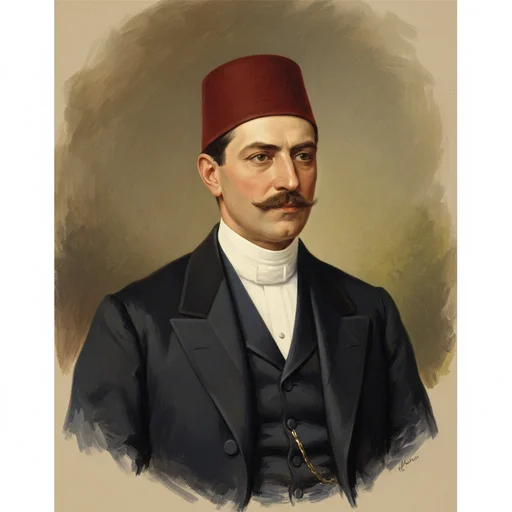
Mahmut Ekrem was born on 1 March 1847 in Vaniköy, on the Bosphorus shore of Istanbul. His father was Recai Mehmet Şakir Efendi, once head of the state almanac office and known as a poet and calligrapher; the family library was the boy's first school. He learned Arabic and Persian from him. After the secondary school at Beyazıt he attended the Mekteb-i İrfan, and entered the military preparatory academy but had to leave it because of illness. In 1862 he joined the correspondence bureau of the Foreign Ministry, where he met both the masters of the old poetry and Namık Kemal. Fleeing to Europe in 1867, Kemal left him the newspaper Tasvir-i Efkâr. His first book of verse, Nağme-i Seher, appeared in 1871, and its language was still the language of divan poetry. Between 1878 and 1887 he taught literature at the Mekteb-i Sultani and the School of Civil Service. Talim-i Edebiyat, which grew out of his lecture notes, was regarded as the book that carried Turkish letters from Eastern eloquence to Western rhetoric, and it earned him the name of “master”. Muallim Naci answered the innovations he defended in the prefaces to Zemzeme with Demdeme; the quarrel of old and new grew sharp enough to require the government's intervention. In 1896, shielding his own students, he helped open the magazine Servet-i Fünun to young writers. In poetry he took thought, feeling and imagination as his foundation; by saying that everything beautiful, from the mote to the sun, could be a subject for verse, he removed the limits of subject matter, and he argued that not every measured and rhyming phrase deserves the name of poem. The Carriage Affair, serialized that same year, is held to be the first realist Turkish novel for the ridiculous passion of Bihruz Bey, who mistakes Westernization for display. All three of his children died before him; what he wrote after the death of his son Nijad in 1900 makes up his most affecting pages. He died in Istanbul on 31 January 1914 and was buried beside his son in the Küçüksu cemetery.
Late 19th-century Istanbul, Ottoman intellectual, wearing a frock coat or dark suit with a fez, distinguished mustache, elegant gentleman appearance.