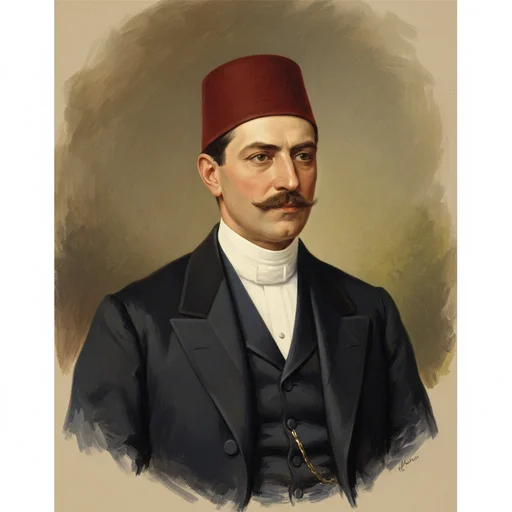

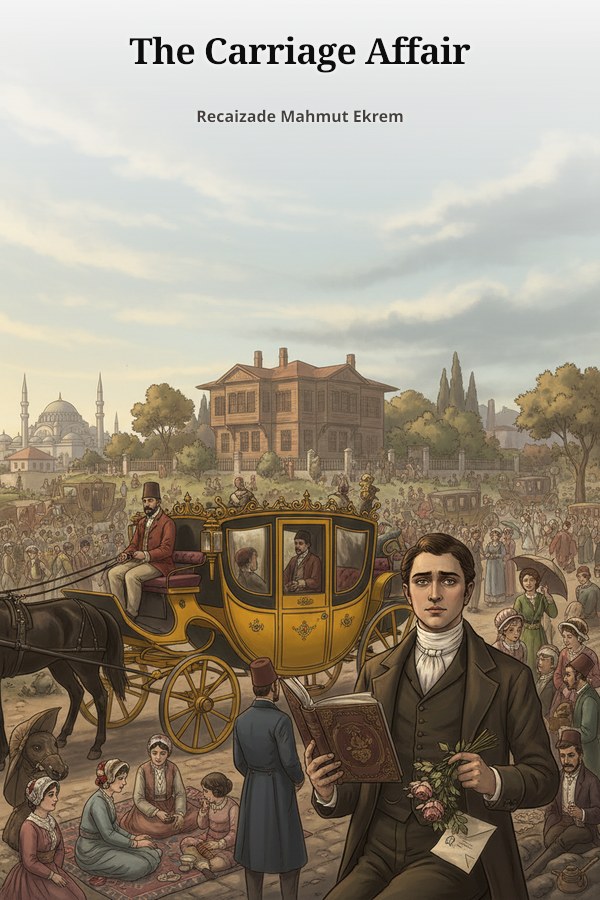
Recaizade Mahmut Ekrem
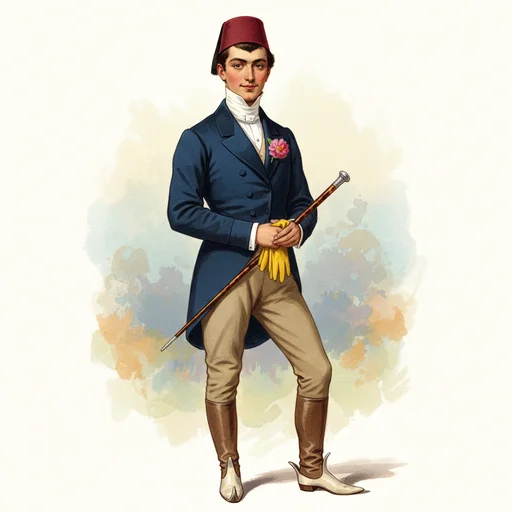
Araba Sevdası (1896), written by Recaizade Mahmut Ekrem, is considered the first realist novel of Turkish literature. The work critiques post-Tanzimat Westernization and a pretentious lifestyle with a tragicomic tone through the character of Bihruz Bey, who has become detached from his own values.
The clash between the sublime, tragic, and poetic world that Bihruz Bey has constructed in his mind from reading romantic French novels and the vulgar, self-serving, and realistic world of the people in Istanbul's promenades. Bihruz struggles with his own delusions until he realizes that the 'angel' of his dreams is actually a common streetwalker.
Istanbul, the capital of the Ottoman Empire. In particular, promenade and recreational spots such as Çamlıca Garden, Kısıklı, Beyoğlu, Kadıköy, Fenerbahçe, Göksu, Şehzadebaşı, and Direklerarası, as well as the mansion in Süleymaniye.
The last quarter of the 19th century, the post-Tanzimat era of the Ottoman Empire (the text explicitly mentions years around 1305 / 1889 and marks of the year '86 in the dates of the letters).
In contrast to the truly vibrant, lively, crowded, and entertaining atmosphere of Istanbul's promenades, it is laden with a false melancholy, an arabesque sorrow, and an exaggerated tragedy reflected by the inner world of the main character. It possesses an atmosphere where daily life and fictional daydreams are ironically and satirically intertwined.
Third-person omniscient narrator. The narrator generally relays events through Bihruz's eyes but frequently intervenes to show how blind and deluded he is, speaking directly to the reader (the 'connoisseur of reading') and employing a mocking, subtle irony.
In this world, value is based on outward appearance, dressing in fashion, owning an expensive carriage, and interspersing speech with French words (Westernization). Social status is measured by who strolls more stylishly in the promenades (Çamlıca, Fenerbahçe). Superficial and fake European mimicry has replaced genuine morality and intellect. Inheritors who think they are Westerners are exploited even by tradesmen and servants.
Society is caught between traditional Turkish/Ottoman values and superficial customs rapidly imported from the West (especially France). While the older generation (Valide Hanım, the veteran slaves) lives according to tradition, the new generation of wealthy children attempts to adapt Western literary lifestyles within a context of luxury and waste. Class classifications like 'civilized' and 'bourgeois' are just beginning to be invented among the people.
Characters are arranged at equal intervals on a circle; you can read the relationship type and dynamics by clicking on the lines.
Bir çizgiye tıklayarak ilişki detayını açın.
Bihruz worships her as a noble and innocent 'angel,' exalts her excessively in his mind, and experiences passive submission. Periveş, however, sees him only as an entertaining and ridiculous simpleton and places no value on him. The power balance between them is heavily in favor of reality and mockery, and against Bihruz, who is completely blind to Periveş's true nature.
As Bihruz runs after the carriage, Periveş Hanım and Çengi Hanım laugh at his state behind his back.
Keşfi is an opportunist who takes a sick pleasure in lying, while Bihruz is overly naive due to the books he reads. Keşfi shatters Bihruz's naive reality by fabricating the lie that Periveş has died, playing with him like a toy. Both are ostensibly 'Westernized' gentlemen, but in reality, they despise each other.
Keşfi Bey drags Bihruz into mourning with a completely fabricated story that the blonde woman died of illness.
Monsieur Pierre aims to fill his own pockets, comforts, and interests under the guise of teaching French to Bihruz. Although Bihruz shows him great respect (addressing him as 'Excellency' or 'Professor'), Pierre secretly considers him an uneducated fool whose money is easy to take. He protects his own interests by selling him books at high prices and instilling unfounded literary views in him.
Monsieur Pierre sells some of his old, decrepit books that should be thrown in the trash to Bihruz for forty or fifty francs by presenting them in luxury packaging.
Çengi Hanım is older, cruder, and more experienced. She directs Periveş, negotiates with carriage drivers, and holds the reins of situations according to how things develop. They have fun together, sell lies to nobles, and mock them.
Çengi Hanım mocks Bihruz's state by saying, 'Poor simpleton!', and catches up to the carriage with Periveş.
Bihruz views his mother not with love or respect, but only as part of a fortune or property from which money can be squeezed. His mother is aware of Bihruz's errant lifestyle but is weak toward her son; she constantly manages him by financing his desires and trying to prevent the mansion from being sold.
Bihruz manages to take one hundred and fifty liras from his mother, whom he sees in distress, to pay off his debts.
Bihruz has failed to establish real authority over his coachman. Andon is aware of the incompetence Bihruz exhibits for the sake of ostentation and pomp, and easily outmaneuvers and exploits him by inventing excuses to hide problems like carriage accidents from him.
Andon invents all sorts of lies about the broken carriage and intimidates Bihruz by telling him that the creditor has seized it.
Kondoraki, as an astute Beyoglu merchant, knows that Bihruz cannot pay the installments. He is ruthless and cold-blooded enough to seize the carriage immediately, using legal loopholes or sycophantic lies at the first opportunity. Bihruz can only threaten him with empty words, unable to take any action.
In a letter to Bihruz, Kondoraki cunningly informs him that, before the installment due date, he has seized the carriage and the horses at his own factory.
Bihruz constantly takes out his bad moods and frustrations on his servant, Michel. Although Michel fawns over him by calling him 'Excellency,' he is always the one to suffer from his master's unwarranted outbursts. Bihruz suppresses his own feelings of guilt by berating his subordinates.
Whenever Bihruz makes a mistake or receives bad news from Monsieur Kondoraki, he unjustly berates Michel and throws him out of the room.