

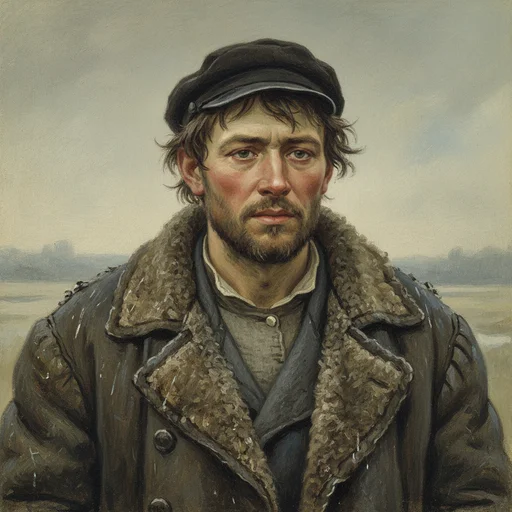
Chichikov's coachman. Throughout the novel, he drives Chichikov between towns and estates in a horse-drawn carriage. With his tough skin, simplicity, and extreme fondness for fun (alcohol), he is a representation of the typical old Russian 'muzhik' (peasant). During the journey, he stops at taverns whenever he finds the opportunity and, by getting drunk, both overturns the carriage, endangering his master, and gets lost. He oscillates between blind obedience and feigned cunning. When he hears rebukes and insults from Chichikov, he mutters to himself, thinking he can escape blame by always shifting it onto others or fate, especially onto the lazy horses hitched to the carriage (like the 'piebald nag').
A carrier who has submitted to the serfdom system, whose origins are not very clear but who has spent most of his life on saddles, harnesses, and muddy roads using his master Chichikov's personal carriage (troika).
He wears a thick, old sheepskin coat in which he seems to get lost (along with hats, hoods, etc., during rain and cold). He looks like an unshaven, ragged, typical, and neglected old-fashioned rural peasant.
Pavel İvanoviç Çiçikof
His master, whom he serves and cannot disobey, but behind whose back he can easily grumble.
Bakla kırı ve diğer Tembel Atlâr
His voiceless slaves, whom he treats both as companions and as culprits for his own shortcomings.