

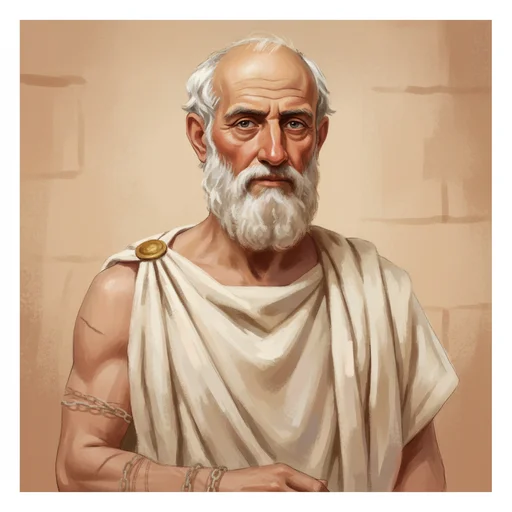
A legendary Athenian philosopher who lived in the 5th century BC and shifted philosophy from the heavens to the earth, focusing on morality and human behavior. He disregarded all his wealth, status, and physical comfort to invite people to think rightly and nurture their souls with virtue. He never considered himself a 'teacher'; he was merely an eternal student seeking the truth in the status of a 'gadfly.' He was sentenced to death in a court where he stood trial on charges of not believing in the gods of the city and corrupting the youth. Out of respect for the laws, he refused to escape.
In the past, he served as a soldier (hoplite) in the military at Potidaea, Amphipolis, and Delium, and was known for his courage. He never bowed to any order he believed to be unjust, including during the period of the oligarchic 'Thirty' in Athens. Declared the 'wisest of all who know' by the Oracle of Delphi, he pursued this prophecy and proved that he was wise only because he was aware of his own ignorance.
Throughout the text, he is depicted as poor and elderly (70 years old), completely devoid of any bodily ornamentation or ostentation; he is barefoot and bears scars on his legs from being shackled in prison, yet he interprets the pleasure behind this pain with a philosophical perspective.
Kriton
His oldest and most loyal friend, balancing the compassion he feels for him with logic.
Meletos
He humbles his accuser by reducing him to a philosophical nothingness.
Phaidon
The student who fostered his young mind with philosophy and for whom he felt a deep bond of affection.
Simmias
The discussion partner with whom he found intellectual satisfaction by welcoming his challenging questions.