
Platon
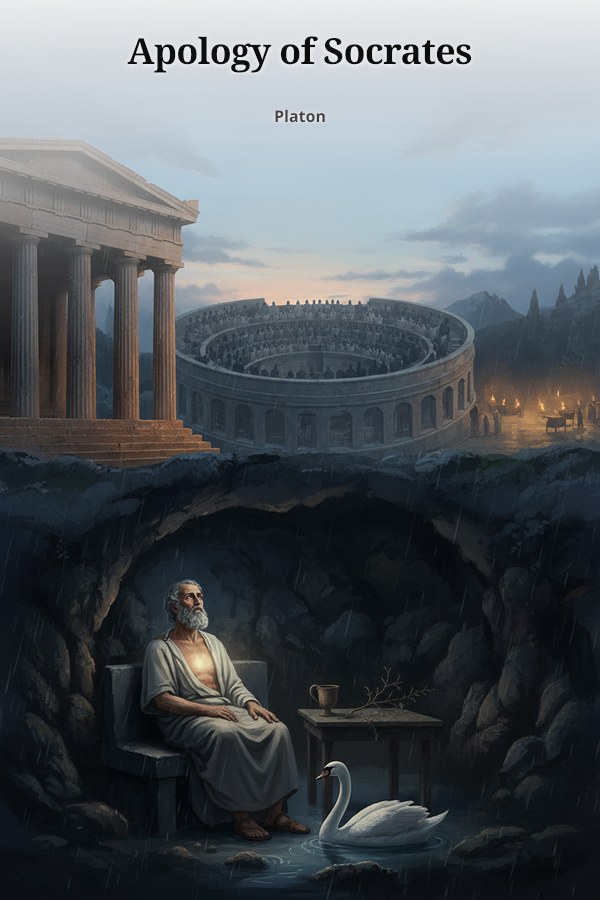
Plato's work titled Apology (Sokrates'in Savunması) concerns the trial of his mentor Socrates in 399 BC by the Athenian democracy on charges of corrupting the youth and introducing new gods to the city. It is a manifesto of honor where a defendant, rather than begging for mercy, defies death for the sake of his philosophical principles.
The clash between Socrates's unwavering search for truth, his logic, and moral rectitude versus the dogmatic beliefs, prejudices, and political arrogance of Athenian society. Central to this is the contrast between bodily existence and philosophical/spiritual ideals, culminating in Socrates's choice to obey the laws.
Ancient Athens (Stoa Basileios, the courtroom, and the prison where Socrates spent his final days).
399 BC (The year Socrates was tried and executed).
The dual atmosphere of a tense courtroom process and a dungeon on the brink of death, holding a mournful yet profoundly philosophical serenity. An intellectually weighted atmosphere where the fear of death gives way to rational acceptance and serene hope.
The works are in dialogue format. 'Apology' is a monologue and inquiry directly in Socrates's first-person voice. The 'Phaedo' dialogue is based on a frame story in which Phaedo narrates Socrates's final hours to Echecrates as a first-person outside observer.
The laws and democratic rules of ancient Athens apply. Courts consist of hundreds of members (a body of jurors) selected by lot, and charges are brought by individuals. Decisions are made by majority vote. In the Greek thought of that time, not believing in the gods (the gods the polis believes in) is a major crime. While philosophy and Sophistic debates guide the intellectual life of the city, they are met with suspicion by the populace.
The period of the restored Athenian democracy following the devastation of the Peloponnesian War and the tyrannical rule of the Thirty Tyrants. Society is in a moral crisis, with a prevailing tendency toward a return to old ways and traditional piety. It is a transitional age where the relativism of the Sophists clashes with Socrates's search for absolute truth.
Characters are arranged at equal intervals on a circle; you can read the relationship type and dynamics by clicking on the lines.
Bir çizgiye tıklayarak ilişki detayını açın.
Socrates gradually dismantles Euthyphro's arrogance and ignorance regarding piety through Socratic irony and cross-examination. The power balance between the two shifts from Euthyphro's self-confidence to Socrates gaining logical superiority.
Socrates asking Euthyphro, who is reporting his father, for a precise definition of 'piety' and refuting every response through dialectics.
Meletus is a shallow representative of the faction that harbors a grudge against Socrates and accuses him of undermining society. Socrates, in court, cross-examines Meletus, exposing the logical fallacies and philosophical ignorance in his accusations and belittling him.
Socrates asking Meletus in court who improves the youth, and Meletus contradicting himself by saying 'the laws and the judges'.
Crito is deeply attached to Socrates with love and practical loyalty. He offers to bribe guards and help him escape to save his life. While Socrates appreciates his affectionate approach, he overcomes Crito's reasoning with moral and legal arguments, eventually convincing him.
Crito's emotional speech where he recounts not having the heart to wake the sleeping Socrates in the prison before explaining the escape plan.
Phaedo feels infinite respect and admiration for his mentor. He feels both deep grief at the death of Socrates and an indescribable awe due to his philosophical steadfastness. There is a tender master-disciple relationship between them.
Phaedo describing how he played with Socrates's hair on his shoulders during his final day and struggled to keep himself from crying in the face of his death.
Simmias is a philosopher who raises clever objections to Socrates's arguments on the immortality of the soul, appearing respectful but difficult to convince. Socrates happily welcomes Simmias's strong objection that 'the soul is a harmony' and deepens the discussion.
Simmias comparing the soul to the harmony of a lyre, claiming the soul cannot survive the death of the body, and Socrates refuting this.
Cebes, along with Simmias, is Socrates' most challenging and critical interlocutor. He constantly demands definitive proof and expresses the doubt that while the soul may outwear many bodies, it may eventually perish. To persuade him, Socrates delves into the nature of concepts.
Cebes challenging Socrates' thesis on immortality by presenting the metaphor of a weaver and the cloaks he wears out.
Echecrates is an eager listener curious about Socrates' final hours, while Phaedo is the reliable source recounting the events in detail. They meet on a shared emotional ground.
Echecrates' request: 'Those of us who are to hear you share these same feelings, Phaedo; tell us everything in detail.'
Xanthippe, a traditional, highly emotional, and ordinary woman, is in complete contrast to her husband Socrates, who has embraced philosophical equanimity. Socrates finds her lamentations in the face of death excessive and has her removed.
Socrates asking Crito to have Xanthippe taken home after she tears at her hair and wails in the prison.