

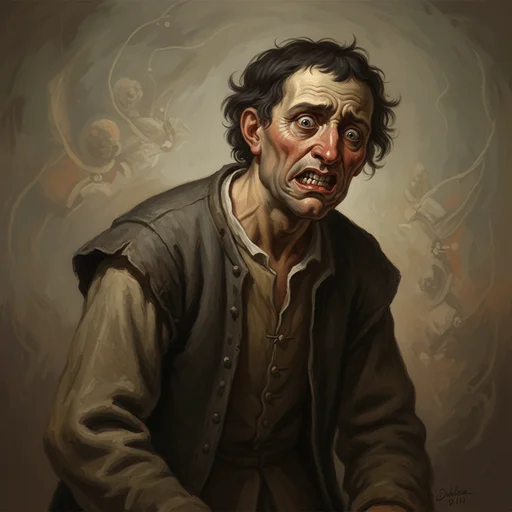
The Slaved Human represents the masses who, deprived of the light of reason, have completely surrendered the control of their existence to external world perceptions and fleeting, distorted emotions. This is precisely the tragedy at the core of the work: while the human being desires to exist and preserve themselves, they drown in the process among sycophants, tyrants, superstitions, or excessive passions that end in sorrow. Even if they grasp the good, they suffer for succumbing to evil. They feel an endless fear of death and shape all their actions with merchant-like beliefs, such as avoiding burning in eternal fire or extracting favor from God. By assuming their delusions, jealousy, and anger to be the world's greatest truths, they voluntarily imprison themselves in the darkest dungeons of ignorance. They do not hesitate to drag social life into chaos for the sake of their momentary interests and delusions.
Born among the vacuous masses of human societies. Their mind, blended with the superstitions of traditional culture, has been further narrowed by the distortions of scholastic education. They have never deeply pondered the laws of nature or explored cause-and-effect relationships, allowing their traumas to bathe them in anger, fear, and a misplaced sense of pity. Although they have lived their entire life imprisoned within the borders of their own mind, they have never realized they were in a cage, mistaking their delusions for 'free will'.
There is always either the twitching of a mindless panic or the distortion of a terrible fury on their face. Because they lack stability, their face rapidly turns from sorrow to delirium, from joy to melancholy. They can be envisioned as a wretched, hunchbacked, tired shadow pushed here and there by the whip of ghosts or invisible chains.
Baruch Spinoza
Symbolizes the masses who loathe Baruch's rational arguments, labeling his thoughts as heresy (atheism) and fleeing from him as if he were the devil.
Özgür İnsan
Cannot comprehend their insurmountable serenity; they envy it, but because they cannot attain that will, they find them strange and emotionless, distancing themselves accordingly.
Tanrı / Tabiat
For them, He is an irrational and dogmatic despot who sits in the heavens, demands offerings, and punishes people in anger.