

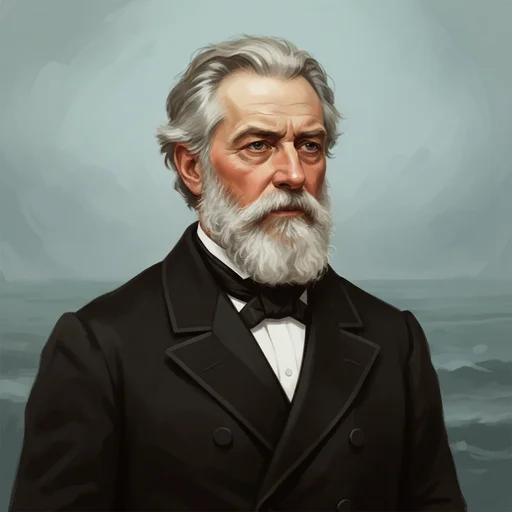
Victor Hugo was born in Besançon on 26 February 1802. His father, Léopold Hugo, was an officer in Napoleon's army; his mother, Sophie Trébuchet, held firm royalist convictions, so two opposing worlds met under one roof. His father's postings kept the family constantly on the road, and his childhood reached as far as Italy and Spain. He eventually settled in Paris with his mother, where reading became his refuge early on. At twenty he published his first collection of poems, and that same year he married his childhood friend Adèle Foucher. His 1827 preface to Cromwell was an open challenge to the rules of classical theatre and was read as a manifesto by the young Romantics. In 1830 the premiere of Hernani turned the auditorium into a brawl; that night, remembered as the “Battle of Hernani”, put him at the head of his generation. A year later came The Hunchback of Notre-Dame. He was elected to the Académie française in 1841, but the real rupture came in 1843: his daughter Léopoldine drowned in a boating accident on the Seine, shortly after her wedding. Hugo learned of her death from a newspaper and spent years tracing her in his poetry. When he opposed Louis-Napoléon's coup of 1851 he was forced to leave France; after Brussels came a long exile on the islands of Jersey and Guernsey. He wrote most of Les Misérables there and dedicated Toilers of the Sea to the island. His language was broad and loud-voiced: he carried the speech of the street into poetry, history and poverty into the novel, and he wrote against the death penalty all his life. He returned to France in 1870 and was elected senator in 1876. He died in Paris on 22 May 1885; he was given a state funeral and buried in the Panthéon.
19th-century France, distinguished elderly man with a full beard, formal 1870s attire, intense and melancholic gaze.