
Victor Hugo
"Toilers of the Sea" (Deniz İşçileri) refers to Victor Hugo's classic novel about the struggle between nature and man, or to trade union platform structures defending the rights of seafarers. While the novel covers a sailor named Gilliatt's struggle with nature for the sake of his love, in the current context, it defines laborers working as ship crew under the Maritime Labor Law No. 854 or rights-seeking formations such as the Maritime Workers' Platform.
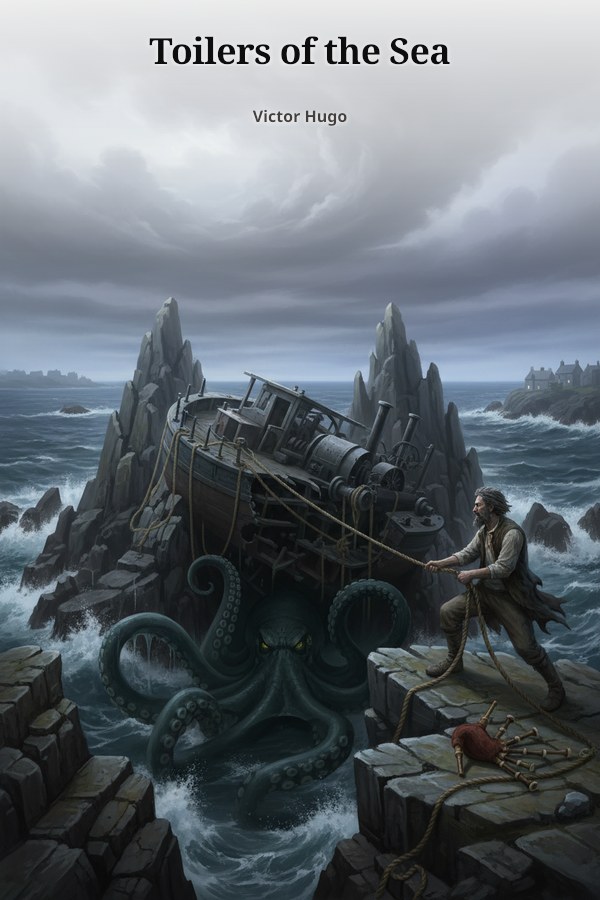
Gilliatt, an outcast and misunderstood man, takes on the mission of salvaging the engine of his uncle's steamboat (La Durande), which was deliberately wrecked in a storm, with the hope of marrying the woman he loves, Déruchette; in doing so, he fights a legendary life-or-death struggle against hunger, cold, the ocean, and a giant octopus. However, after this absolute victory against nature, upon learning that his beloved loves another man (Ebenezer), he must fight the greatest battle against his own heart and perform a sublime act of sacrifice.
The waters of the English Channel, the Channel Islands (particularly Guernsey, the port of Saint-Sampson, and the surroundings of Bû de la Rue), and the treacherous, deadly Douvres rocks.
Early 19th century, roughly the 1820s (the post-Napoleonic era and the time when steamships were first emerging and met with suspicion).
Romantic, epic, eerie, and laden with an overwhelming sense of solitude; a gloomy and majestic atmosphere where the unshakable, wild power of nature and the dark secrets of the sea are felt at every moment.
An omniscient, philosophical, didactic, and epic narrator. The narrative examines the dynamics of the human soul and the universe through deep analysis, engaging in what feels like a dialogue with the reader.
Nature and the ocean operate by their own rules as a merciless and colossal force; a human can only survive this overwhelming power with an unshakable will, perseverance, physical endurance, and intelligence. Society is in the grip of superstition; it ostracizes the true hero and honors the impostor. Ultimately, despite all physical victories, the human heart and emotions harbor the greatest devastations that even the sea cannot overcome.
A cloistered island culture where seafaring is at the center of life. An Anglo-French structure where Protestant-Catholic theological debates persist, but the population is primarily influenced by deep provincial superstitions regarding ghosts, witches, and sea monsters, and where progress is slow and met with resistance.
Characters are arranged at equal intervals on a circle; you can read the relationship type and dynamics by clicking on the lines.
Bir çizgiye tıklayarak ilişki detayını açın.
Gilliatt worships Déruchette from afar with a silent and almost divine passion. Déruchette lives innocently, unaware of Gilliatt's efforts and sacrifices; Gilliatt conquers nature to possess her, but upon seeing the truth in her heart, he submits to it and destroys himself.
Déruchette writing the name 'Gilliatt' in the snow ignites an eternal fire in the man's heart, leading Gilliatt to embark on that rescue mission that pushes the limits of human reason to attain her.
Although Lethierry is initially as distant toward Gilliatt as the other islanders, he pledges his gratitude and his niece on the condition that Gilliatt retrieves the engine of La Durande. When Gilliatt returns having succeeded, Lethierry's gratitude turns into a despotic joy and absolute acceptance.
Lethierry's exclamation when Gilliatt brings the machine, praising him: 'You are my man... You have performed a miracle!'
Lethierry is attached to his orphaned niece Déruchette not just like his own daughter, but with a sense of adoration. His two passions in life are his ship, Durande, and his niece; he has raised her like a queen to ensure she leads a comfortable, gentle, and effortless life.
Lethierry not wanting Déruchette to touch any manual labor and ensuring her hands, which he calls 'four fly legs,' remain white and elegant.
Lethierry blindly trusts the superior honesty and ability of his captain, Clubin. Clubin, however, uses this blindness and trust from within to plot a major theft, dismantling the ship that is Lethierry's greatest pride for his own gain.
Clubin's attempt to cover up his flight with the 75,000 francs stolen from Rantaine by sinking the ship on a stormy night and offering to stay behind like a hero.
Two criminals. While Rantaine represents brute force and open trickery, Clubin represents calculated, seemingly respectable hypocrisy. Clubin corners Rantaine and extorts the money he had stolen years prior.
Clubin confronting Rantaine on the dark cliffs with a revolver and forcing him to surrender the 75,000 francs.
Both are young, pure, and beautiful. They share a spiritual and innocent closeness. As the devout priest Ebenezer yields himself to this love, Déruchette forgets the world in his presence. The obstacles they face (Lethierry's pledge) are resolved when Gilliatt steps aside.
Under the church bell in the moonlight, they disregard the world and become engaged while making confessions to one another in the secret garden.
Gilliatt realizes that Ebenezer, whom he had initially saved from drowning, has stolen the heart of the woman he loves. Instead of fighting, he legitimizes his rival's victory with his own hands through an eternal act of renunciation.
After secretly listening to Ebenezer and Déruchette, Gilliatt, instead of interfering, gives them the gold ring he found and ensures they are married in the church.
The two are opposites throughout the story; one is a hidden evil posing as good, while the other is a hidden goodness perceived as evil. Gilliatt defeats the octopus that killed Clubin and returns the stolen wealth found in the belt to Lethierry.
Gilliatt finding Clubin's skeleton and the leather belt full of money in the depths of the rocks after killing the octopus.