

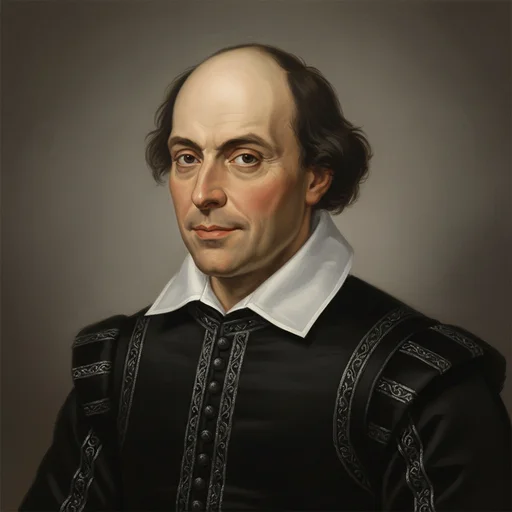
William Shakespeare was born in Stratford-upon-Avon in 1564; his baptismal record is dated 26 April. His father, John Shakespeare, a glover and leather worker, rose through the town's government and in 1568 was elected bailiff, its highest office; his mother, Mary Arden, came from a landowning family. He is thought to have studied Latin and rhetoric and read Ovid and Virgil at the town's King's New School. At eighteen he married Anne Hathaway, eight years his senior; Susanna was born first, then the twins Hamnet and Judith. No documents survive from the years between 1585 and 1592; by the end of that gap he was spoken of on the London stage as both actor and writer. In 1592 Robert Greene dismissed him as “an upstart crow, beautified with our feathers” — a barb now taken as proof that his name already carried. In the years when plague closed the playhouses he published Venus and Adonis and dedicated it to the Earl of Southampton. In 1594 he became a sharer in the Lord Chamberlain's Men; in 1599 he was among the founders of the Globe, and in 1603, when James I came to the throne, the company took the name King's Men. Romeo and Juliet belongs to these years of ascent. In 1596 he lost his eleven-year-old son Hamnet; the following year he bought New Place, the largest house in Stratford. He drew blank verse close to ordinary speech and let a king and a gravedigger speak on the same stage with equal weight. He loosened the borders of the inherited genres, folding comedy into tragedy. He died in Stratford in 1616, aged fifty-two, and was buried in Holy Trinity Church. Most of his plays reached us through the First Folio, compiled in 1623 by his fellow actors Heminges and Condell.
Early 17th century England, refined Jacobean attire, balding forehead with thin hair, ruff collar, portrait of a mature man.