
William Shakespeare
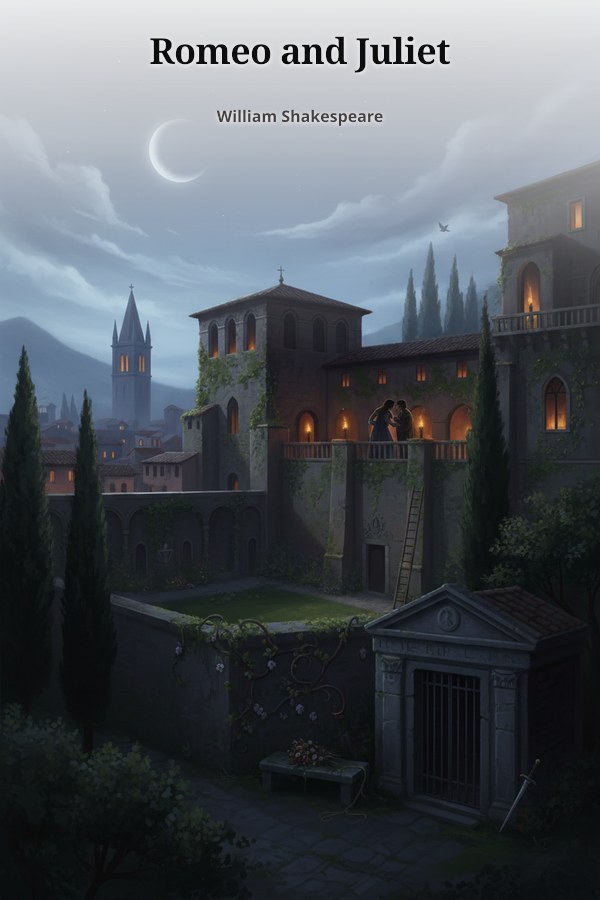
Romeo and Juliet is a world-famous play written by William Shakespeare that tells the story of the impossible love between Romeo and Juliet, the children of two feuding families, and its tragic end. Set in Verona during the Italian Renaissance, the work has become a symbol of universal love and fate.
The struggle of Romeo and Juliet—children of two noble families (the Montagues and Capulets) locked in a deep, centuries-old blood feud—to experience a passionate love and unite, despite their families' stubbornness, social norms, and belligerent relatives.
Verona, Italy (public squares, the Capulet house, the Capulet orchard, Friar Laurence's cell, and the ancient family tomb) and the streets of Mantua, the place of exile.
Late 14th century or early 15th century, the Renaissance period; events take place over a short, intense, and fast-moving period of approximately forty-two hours.
A somber atmosphere, semi-dark, passionate, intertwined with danger, tense, glowing with lyrical romance while burdened by a sense of inevitable, fatal tragedy.
Presented in a dramatic text format, primarily through objective theatrical dialogue. It also features a 'Chorus' role that provides an omniscient perspective to the audience, foreshadowing the direction of events.
Daily life in Verona is squeezed between the feudal blood feud of the Montague and Capulet leaders and the absolute laws of Prince Escalus, who attempts to curb the violence. In a patriarchal order where women cannot defy their fathers' word, love must be lived in secret and by crossing dangerous boundaries. Drawing swords in the streets is a common occurrence but is a crime punishable by death or exile by the Prince.
Set in Renaissance Italy, the story reflects the social status that powerful families define through nobility, honor, and masculinity. A Catholic social structure prevails, where arranged marriage is an absolute rule, and friars serve as key advisors and confessors.
Characters are arranged at equal intervals on a circle; you can read the relationship type and dynamics by clicking on the lines.
Bir çizgiye tıklayarak ilişki detayını açın.
They are bound together by immense passion, sacrifice, and mutual admiration. In their relationship, the decision-making mechanism often shifts to Juliet, who takes more practical and courageous steps, while Romeo follows this love with his more poetic, idealistic, and destructive tendencies. They are committed to a degree of perfection that leads them to sacrifice their lives.
My words would bandy her to my sweet love, / And his to me.
There is a deep, joyful friendship between Mercutio and Romeo, where they take pleasure in teasing each other. Mercutio openly mocks love while Romeo is constantly melancholic. The death of Mercutio leads Romeo to abandon his peaceful stance and be dragged into dark actions fueled by revenge, tragically proving the balance of the duo.
O Romeo, Romeo, brave Mercutio is dead! That gallant spirit hath aspired the clouds, which too untimely here did scorn the earth.
In the first half of the play, the Nurse is Juliet's most trusted confidante and a protector who essentially takes the place of her real mother. She builds the bridge between her and Romeo. However, when things go awry and the Nurse praises marriage to Paris as a practical necessity, the trust between them is destroyed, marking a threshold where Juliet is left entirely alone.
Ancient damnation! O most wicked fiend! / ... I'll to the friar, to know his remedy.
Friar Laurence is more than just a religious guide for Romeo; he is a confidant to whom Romeo turns for comfort. In his presence, Romeo complains like a teenager, while the Friar offers warnings and tries to calm him. Conversely, Romeo's uncontrolled fervor constantly exceeds the Friar's moderate philosophy.
Thy tears are womanish; thy wild acts denote / The unreasonable fury of a beast.
Capulet initially approaches his daughter with tenderness due to her age; however, the moment Juliet refuses to marry Paris, Capulet's oppressive, controlling, and threatening tyrant figure is revealed. He perceives his daughter's free will entirely as an insult, petulance, and rebellion against his authority.
Look to 't, think on 't, I do not use to jest. / ... if you be mine, I'll give you to my friend; / And you be not, hang, beg, starve, die in the streets.
Tybalt is a hate-filled enemy who incessantly instigates trouble under the guise of protecting his family name. Because of his love for Juliet, Romeo shows a peaceful and submissive reaction to Tybalt—because they are kin, even if Tybalt is unaware. However, the death of Mercutio shatters this passive attitude, and their relationship descends into purely fatal violence from which there is no turning back.
Romeo, the love I bear thee can afford / No better term than this: thou art a villain.
Paris is an ideal candidate for Juliet, a handsome and noble figure, yet he lacks a romantic connection. While Juliet resorts to wordplay to distance herself from him, Paris attributes this coldness to her mourning. On Juliet's side, there is forced and dangerous endurance, while on Paris's side, there is a superficial sense of ownership.
The face is mine, and thou hast slandered it. / (Juliet:) It may be so, for it is not mine own.
Although both are noble, brave, and stubborn characters, they stand at opposite poles; Tybalt is a fight-obsessed machine of rules, while Mercutio is a free-spirited and cynical fighter. The duel of honor between them is rooted in a personal ego so intense it disregards even the Prince's orders.
Tybalt, you rat-catcher, will you walk? / Good king of cats, nothing but one of your nine lives; that I mean to make bold withal.