
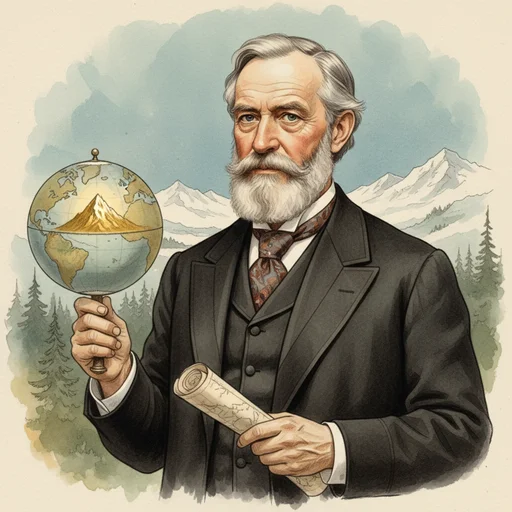
Author · 5 works
Jules Verne was born on 8 February 1828 in Nantes, the port city where the Loire meets the sea. His father, Pierre Verne, was a lawyer; his mother, Sophie Allotte de la Fuÿe, came from a family of shipowners and seafarers. He was the eldest of five children. He grew up on the quaysides, among ships unloading their cargo, and in 1847 his father sent him to Paris to study law.
He took his law degree in 1851, but the theatre held his real interest; his first play was staged in 1850. For a time he worked as secretary of the Théâtre Lyrique and spent his free hours reading science at the National Library. In 1857 he married Honorine Morel, a widow; he earned his living as a broker on the stock exchange and gave the early morning hours to writing. His first stories, among them Master Zacharius, appeared in those years.
Meeting the publisher Pierre-Jules Hetzel in 1862 changed everything. Five Weeks in a Balloon drew wide attention in 1863, and the contract that followed launched the Extraordinary Voyages, a series that lasted the rest of his life. From the Earth to the Moon, Around the Moon and Doctor Ox's Experiment belong to that arrangement. In 1886 a shot fired by his nephew Gaston wounded him in the leg, and that same month he lost Hetzel; the books that followed grew markedly darker.
He builds his narratives out of maps, calculations and technical detail; it is this exactness that makes the extraordinary believable. He counts among the founders of science fiction. He spent his last years in Amiens, serving long on the town council, and died on 24 March 1905 of complications from diabetes. Some texts, among them The Golden Volcano, were published after his death by his son Michel.
Verne wrote in the years running from the Second Empire into the Third Republic, an age of railways, steam and the telegraph, when geographical discoveries, colonial expeditions and world's fairs were everyday talk. Romanticism was in retreat and a positivist temper, trusting fact and measurement, was gaining ground. Hetzel's Magazine of Education and Recreation set out to bring knowledge to families and the young; Verne's books grew inside that publishing project, in the middle of the argument over where progress was taking humankind.