

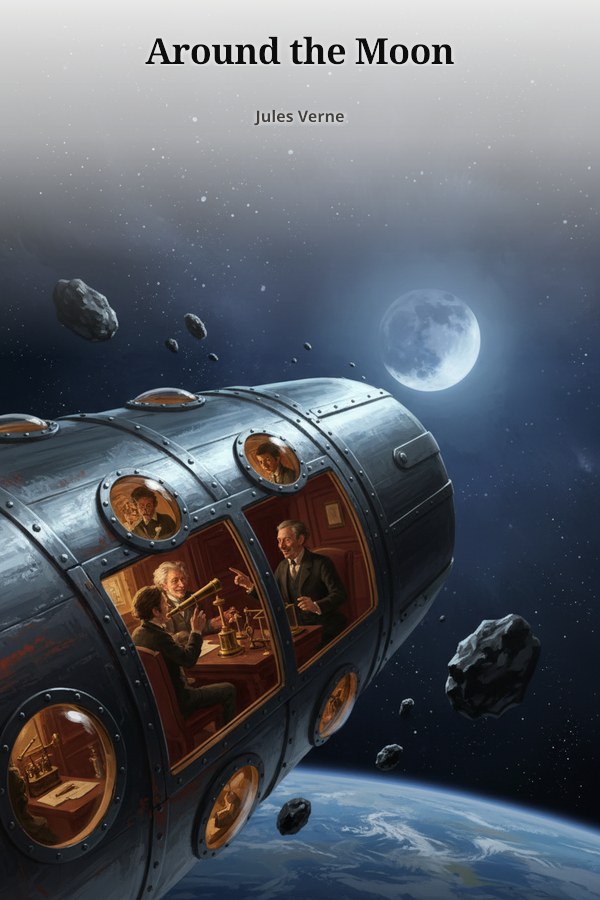
Jules Verne
Around the Moon is a classic science fiction novel by Jules Verne, published in 1870. It serves as a direct sequel to the author's book From the Earth to the Moon (De la Terre à la Lune). The work tells the story of three explorers who, after being launched into space in a massive cannon shell, fail to land on the Moon and are left stranded in orbit around the satellite, followed by their adventures in returning to Earth.
The struggle of three travelers inside a giant man-made shell who, due to a deviation during launch, fail to land on the Moon and enter orbit in the cruel void of space; a battle for survival against depleting oxygen, freezing space temperatures, and the laws of gravity, while attempting to regain control of their trajectory.
Inside a massive cylindrical aluminum projectile launched from Florida, traveling through the space between Earth and the Moon, and subsequently orbiting the Moon. At the end of the story, at the bottom of the Pacific Ocean off the American coast.
Late 1860s (The journey takes place between December 1st and December 29th). The period following the American Civil War.
The sharp contrast between the friendly, witty, and warm dialogues inside a narrow, enclosed shell and the cold, silent, lethal, and infinite darkness of the space surrounding it. A tense yet awe-inspiring environment where human intellect confronts the ruthless laws of nature.
An omniscient, third-person external narrator who occasionally intervenes to explain scientific data directly to the reader. The tone is as academic as it is exciting, and at times, satirical.
Newton's laws of universal gravitation prevail. Gravity, the lack of friction, centrifugal force, atmospheric refraction, and the near-absolute zero temperature of space are the fundamental physical rules of the story. Sound cannot be heard in a vacuum, and objects ejected travel alongside the shell at the same speed.
The Industrial Revolution and the 19th-century era of scientific enlightenment, a time of great technological breakthroughs and enthusiasm. A cultural infrastructure where American society was defined by boldness, entrepreneurship, and practicality, and where the idea of achieving the impossible captivated the masses.
Characters are arranged at equal intervals on a circle; you can read the relationship type and dynamics by clicking on the lines.
Bir çizgiye tıklayarak ilişki detayını açın.
Barbicane's ultra-logical, serious, and cool-headed reliance on scientific calculations is balanced by Michel Ardan's cheerfulness, artistic imagination, and witty nature. They hold deep respect and affection for one another.
"- You described that beautifully! shouted Barbicane. Do you know, Michel, as an artist, you are quite clever!"
Having been great rivals and enemies in the past, this pair achieves complete team harmony inside the shell once they honestly resolve their disputes. Both are rational and math-focused; there is an equal intellectual weight and a perfect partnership between them.
"- Meanwhile, Barbicane was suggesting that if he gave it some thought, Nicholl could have found that formula too."
Nicholl's rigid realism and silence create a constant, lighthearted friction with Ardan's chatter and impulsiveness. Although Nicholl cannot always tolerate Ardan's nonsense, he harbors a sincere affection for him.
"- That's impossible! shouted Michel... Nicholl and Barbicane paid no mind to Michel Ardan's jokes."
Maston holds almost worshipful respect and admiration for the club president. In his eyes, there is no chance that Barbicane's plans could go wrong; Barbicane provides him with the confidence of a leader, and he is ready to die following Barbicane.
"- J.-T. Maston didn't even want to hear the word 'return.' At the very least, he was unwilling to leave there without seeing his friends' graves."
Although both are scientists or fervent observers, they argue and wager incessantly at the telescope due to their beliefs regarding the state of the shell.
"- That's the shell you see right there! J.-T. Maston kept saying. - No, it's not! replied Belfast."
Ardan attributes a human character to his pet dog, constantly speaks to it, and finds comfort in it as a source of joy and a companion during the dangerous journey.
"- Come, Diana, come my girl! he said, my girl whose name shall be mentioned in the hunting chronicles..."
In deep-sea ocean soundings and the operation to locate the projectile, there is a professional chain of command, yet one marked by mutual respect and courtesy.
"- Lie down, sir, lie down! replied Lieutenant Bronsfield with the utmost politeness."
Ardan feels a deep sense of conscience and responsibility for Satellite, the dog severely injured during the projectile's launch, and releases him into space with great sorrow following his death.
"I would sooner give an arm than one of my poor Satellite's paws!"