
Author · 2 works
He was born around 427 BCE in Athens, into one of the city's oldest families. On his father Ariston's side the line was traced, in legend, back to Poseidon; on his mother Perictione's side, to the lawgiver Solon. His real name is said to have been Aristocles, and to have been called Plato for his broad shoulders. He lost his father early; when his mother married her uncle Pyrilampes, his childhood was spent in that household. He received in full the education in poetry, rhetoric and gymnastics expected of an Athenian nobleman.
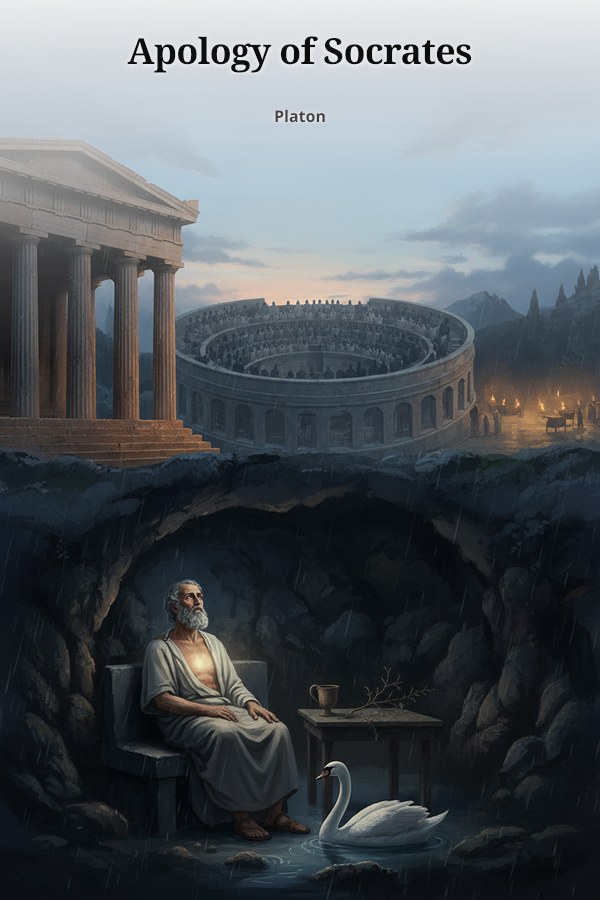
The passion of his youth was politics. What his relatives Critias and Charmides did under the rule of the Thirty, and then the restored democracy's condemnation of Socrates to death in 399 BCE, turned him from that road for good. He set down the trial of the teacher he had followed for years in The Apology of Socrates; the text is at once a piece of testimony and a reckoning served on the city.
After Socrates' death he stayed away from Athens for a long time; he went to Megara, to southern Italy, to Sicily and, by some accounts, to Egypt, and came to know the Pythagoreans and Archytas of Tarentum. In his forties he returned and founded his own school, the Academy, in the grove of Academus outside the city. Believing that philosophy could set government right, he travelled three times to Syracuse; his attempt to educate the young tyrant Dionysius II ended in mistrust and house arrest.
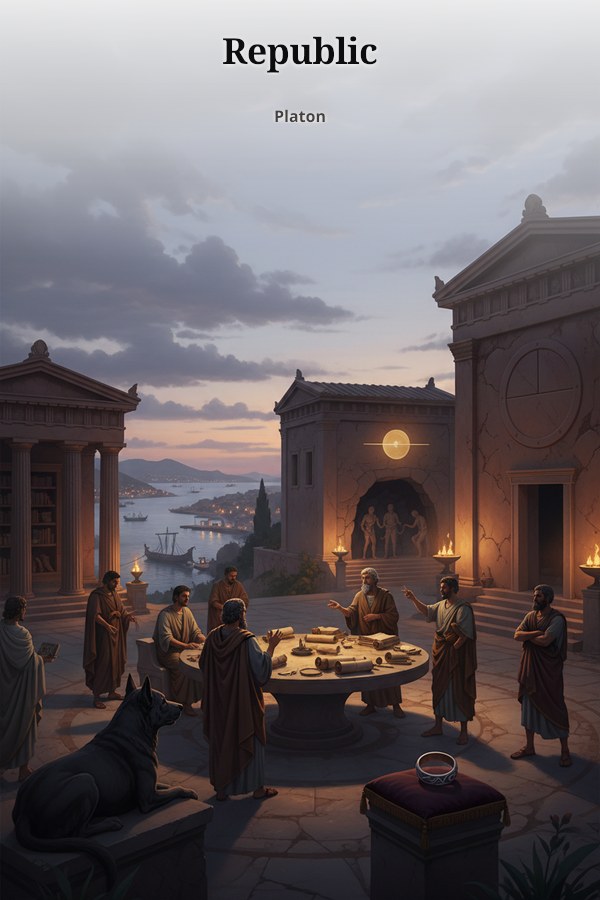
He built his thought not as treatises but through people who speak. In The Republic, what justice is is never settled by a ready-made definition; it is sought inside an argument that advances by questions, and the reader follows not the conclusion but thinking itself. He died in Athens in 348/347 BCE; the Academy he founded stayed open for centuries.
Plato wrote in a turbulent Athens where the Peloponnesian War had ended in defeat and democracy, cut short by an oligarchic coup, had been rebuilt. In a city that measured virtue by the power to persuade, the sophists taught the art of speaking for a fee, and skilful talk was taking the place of truth. His dialogues answer that climate: they defend the difference between rhetoric and truth, between a majority verdict and knowledge, and argue that good government springs from knowledge rather than skill. The same quarrel was the reason the Academy was founded.