
Platon
Plato's work titled Republic is a philosophical utopia that examines the concept of "justice" through the mouth of Socrates and constructs a perfect (ideal) social order. At the center of the work lies the idea that the structure of the state shows a resemblance to the structure of the human soul.
The struggle to prove the unwavering truth of justice against the assertion that injustice provides superior bodily and worldly advantages through cunning and impunity; the challenge of building an ideal state and model of the soul from scratch to prove that justice is an inherently good, lasting, and profitable virtue.
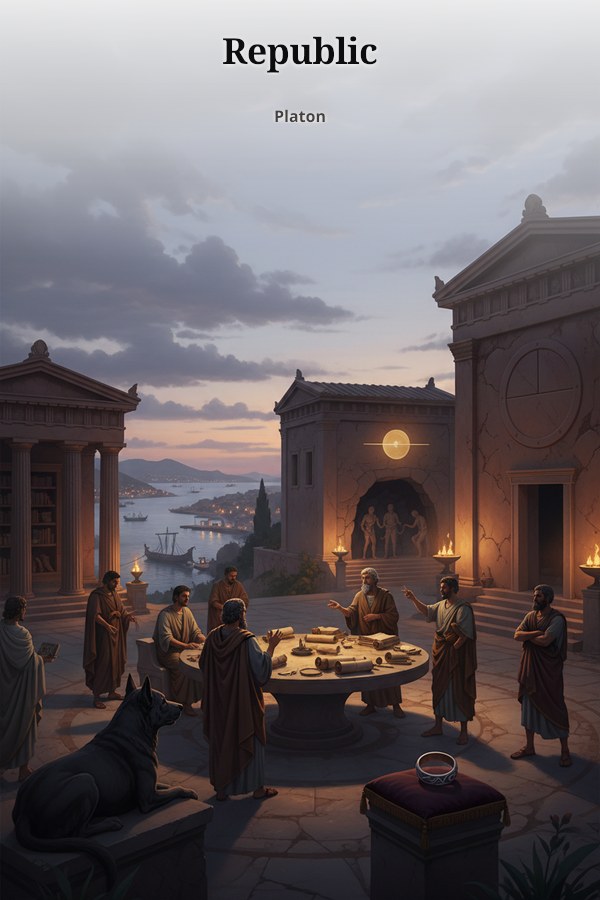
The house of Polemarchus, a wealthy immigrant, in Piraeus, the port city of Athens.
Early 4th century BC (Ancient Greek Classical Period / The Age of Socrates).
Dialectical Inquiry, Intellectual Depth, Ancient Wisdom, Serious and Political Tension, Philosophical Enlightenment.
First-person singular (Socrates recounting a discussion that took place one evening).
The world is in a state of coming-to-be and passing-away, filled with illusions. True existence belongs only to the realm of unchanging Forms that can be grasped by the intellect. The unwavering rule in the state and the soul is balance: each social layer or part of the soul must perform only the one task specific to its nature and not interfere with the tasks of others. Superior intelligence and virtue require the pursuit of pure truth, not power and material pleasures. There is no well-being for humanity unless philosophy and power unite in one person (the Philosopher King).
An era defined by the political crises, wars, and clashes between oligarchy and democracy of the ancient world. An intellectual atmosphere where the traditional understanding of God and mythology (Homer and Hesiod) is morally questioned, and the relativistic values of the Sophists, which advocate for the interests of the powerful, are on the rise.
Characters are arranged at equal intervals on a circle; you can read the relationship type and dynamics by clicking on the lines.
Bir çizgiye tıklayarak ilişki detayını açın.
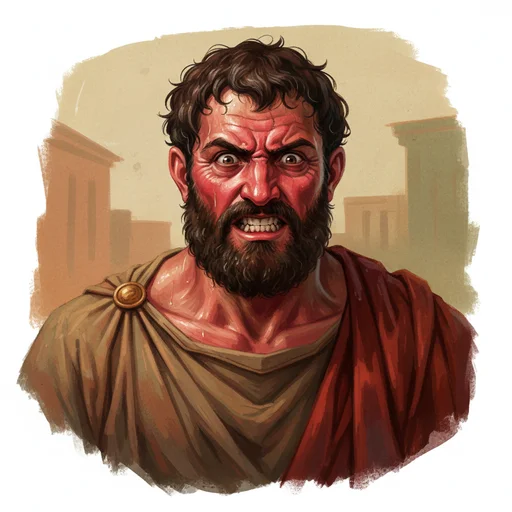
While Thrasymachus attempts to dominate the discussion in a predatory, coarse, and arrogant manner, Socrates dismantles his hubris with calm, ironic, and logical inquiries. It is a struggle of reason, which defends virtue, against the sophist mindset that defends the rights of the powerful. Although Thrasymachus grows tired and cornered, Socrates essentially neutralizes him rather than fully convincing him.
While Thrasymachus pounces on the discussion like a wild animal, Socrates's sarcastic questions make him sweat and blush.
Glaucon is Socrates's closest rational follower, yet he pushes the most rigorous arguments to their limits to challenge Socrates. Socrates appreciates his fiery desire for truth and constructs the theory of the Ideal State side-by-side with him.
Glaucon tests Socrates's belief in justice with the story of the Ring of Gyges and commands him to defend justice as completely stripped of self-interest.
While Glaucon dives into theoretical depths, Adeimantus focuses on practical and social issues. He forces Socrates to constantly face reality by offering constructive opposition regarding how education, rules, and practices will be implemented. Socrates elevates him as a reasonable and respectful listener.
Adeimantus stops Socrates to demand an explanation, arguing that the absence of women, children, and private property will make the guardians unhappy.
They are the noble sons of the same father (Ariston). Throughout the discussion, they take turns speaking so as not to leave Socrates alone, and by filling the gaps in each other's arguments, they continue the objection initiated by Thrasymachus on a much more qualified foundation.
Adeimantus intervenes, saying, 'Let brother help brother,' and takes over the critical defense left by Glaucon.
He is the host who first captures Socrates and brings him into the discussion setting. Although he defends the traditional poetic view of doing good to friends and harm to enemies, he cannot resist Socrates's logic and easily shifts to his side.
When Socrates explains that doing harm even to an enemy is not befitting of good men, Polemarchus agrees with him and proposes an alliance against Thrasymachus.
Socrates respectfully questions Cephalus regarding his experiences with old age, wealth, and the afterlife. After describing traditional morality, Cephalus leaves the discussion to the youth and departs to attend to the sacrificial rituals, thus signaling the transition from religion to rational philosophy.
Socrates gently corners Cephalus, asking whether he owes his ability to endure the hardships of old age to his character or his wealth.
While Thrasymachus defends selfish power, Polemarchus tends to defend friendship and social justice. Throughout the debate, Polemarchus often plays the role of an arbiter or supporter, frequently siding with Socrates against Thrasymachus.
During the debate, Polemarchus notices that Thrasymachus has reached a dead end and openly declares that he finds Socrates to be in the right.
Glaucon finds Thrasymachus's power-centric immorality dangerous, yet he insists on hearing and refuting this thesis in its entirety. Even after Thrasymachus gives up, he criticizes Socrates for failing to silence him in a sufficiently convincing manner.
Glaucon finds Socrates's responses to Thrasymachus inadequate and takes up the true philosophical battle by moving to a position that once again praises injustice.