
Ahmet Mithat Efendi
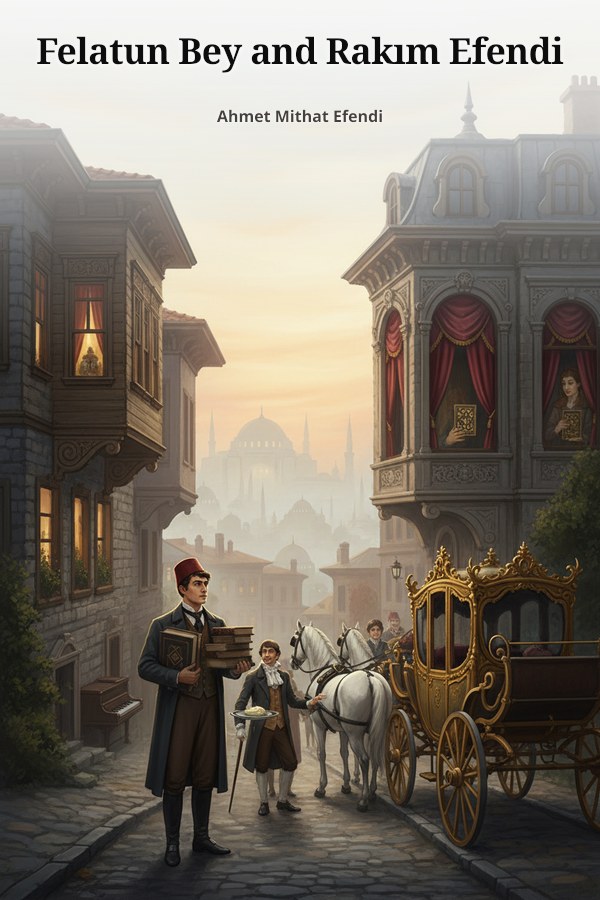
Felatun Bey ile Rakım Efendi is a classic Tanzimat-era novel of Turkish literature, written by Ahmet Mithat Efendi in 1875. The work satirizes misguided Westernization (alafranga manners), ignorance, and the East-West cultural clash through two contrasting characters.
A clash of lifestyles and mindsets between Rakım Efendi, who remains committed to his own values while synthesizing the productivity, languages, and science of the West, and Felâtun Bey, who consumes his own heritage by adopting only the luxury, decadence, and superficial arrogance of the West.
Istanbul (Beyoğlu, Tophane, Salıpazarı, Kumbaracı Yokuşu, Kâğıthane, Çamlıca, Asmalımescit)
Second half of the 19th Century (Tanzimat Period, estimated 1870s)
The work possesses an intimate atmosphere dominated by an author-narrator style that engages directly with the reader, offering moral advice with a warmth and occasional light humor. Accompanied by vivid depictions of daily life, a subtle satire regarding the characters' flaws is felt throughout.
A didactic and omniscient third-person narrator (resembling a traditional meddah storyteller) who continuously addresses the reader, intervening in events to advocate for their own moral ideas.
True respect in society is not earned through inherited wealth or the imitation of the West, but through one's own labor, knowledge, and moral virtues. Lives built on ostentation and laziness are ultimately doomed to material and spiritual exhaustion and disgrace.
The encounter of the Tanzimat-era Ottoman intellectual with European culture. It depicts the civil life of Istanbul during a transitional period where a generation that mastered both Eastern sciences and Western knowledge, adopting diligence as a principle, coexisted with a mentality that equated civilization solely with speaking French and participating in shallow amusements.
Characters are arranged at equal intervals on a circle; you can read the relationship type and dynamics by clicking on the lines.
Bir çizgiye tıklayarak ilişki detayını açın.
They form the novel's main dichotomy. While Rakım is a humble and diligent genius, Felâtun is an arrogant and ignorant heir. Felâtun secretly envies Rakım and tries to belittle him, while Rakım mostly feels pity for him and takes lessons from his errors with kind words.
During a debate at an English family's home regarding the letters of the Turkish alphabet, Rakım politely exposes Felâtun's ignorance to his face.
Initially a compassionate master-student and protector-protégé relationship. As Rakım educates and raises her, Canan becomes deeply attached with love; Rakım also admires her development, and the distance between them evolves into a profound, mutual love.
When Rakım is offered fifteen hundred gold coins to sell Canan, they both weep bitterly and confess their love for one another.
Fedai is the person who raised Rakım through all hardships since his orphanhood. Rakım respects her like a true mother, gives her his first earnings, and does everything he can for her comfort.
Rakım gives half of the first substantial sum he earns to his nanny to free her from having to serve in other households.
Fedai is initially instrumental in Canan's arrival to help around the house, but she soon grows to love her like her own daughter. Canan also attaches herself to her like a mother, and a great solidarity begins between them.
Canan presents the clothes she sews from fashionable fabrics to Fedai first for her approval and feels shy about keeping secrets from her.
A relationship that begins with a romantic attraction evolves into a deep friendship thanks to Rakım's maturity and his commitment to Canan. Josephino transforms into an elder sister who champions the happiness of Rakım and Canan.
During a trip to Kağıthane, Josephino encourages Canan and sets up a ruse for her to confess her love to Rakım.
Josephino becomes both a piano and French teacher to Canan. Seeing Canan's incredible intelligence and naivety, she sincerely embraces her and serves Canan's happiness.
Josephino teaches Canan for free and with extraordinary enthusiasm to help accelerate the lessons Canan is to provide to English girls.
Mr. Ziklas views Rakım as a highly talented and moral Eastern scholar, holding him in high regard. He loves Rakım like a son and provides him with significant opportunities.
When his daughter Can falls ill with tuberculosis and lies on her deathbed, Mr. Ziklas disregards his entire fortune and offers Rakım his hand in marriage without even requiring him to change his faith.
During lessons, Can becomes deeply infatuated with Rakım’s intelligence, appearance, and gentleness. Rakım, however, treats her only with the affection of a respectful teacher and never oversteps his boundaries.
Can falling into her deathbed from tuberculosis after being unable to express her feelings to Rakım, and her belief that the poems Rakım reads from the Divan of Hafez are intended to mirror his own hidden feelings for her.
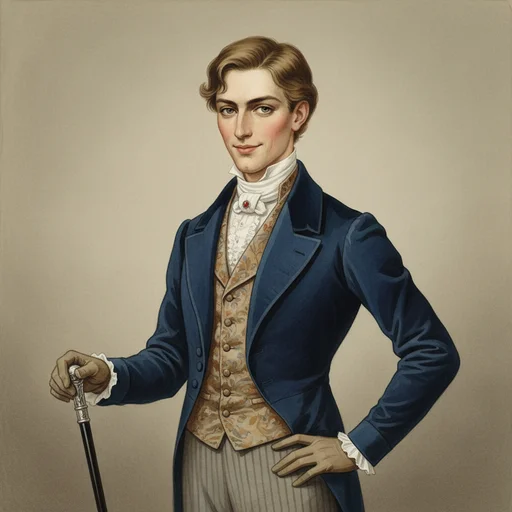
His father considers his son's Westernized, superficial persona a virtue and dotes on him. The father does not exert control over his son; on the contrary, he finances his wasteful lifestyle.
During a debate between his father and Felâtun about clouds blocking sunlight in winter, the father praises Felâtun by comparing him to the philosophers of Ancient Greece.
In order to appear 'alafranga' (Westernized), Felâtun pursues Polini as a wealthy suitor. Polini sees him only as a source of income, a 'fool,' and exploits him until he has exhausted his entire fortune at the gambling tables.
Polini humiliating Felâtun in front of other men at the casino by calling him a 'dull turkey' and a 'monkey,' and subsequently taking all his money.