
Gustave Flaubert
Madame Bovary, written by Gustave Flaubert in 1856, is one of the masterpieces of world literature, depicting the tragedy of a woman trapped between the romantic life she imagines and the mundane reality of her existence. The work is considered one of the most important examples of the Realism movement in literature.
The fatal and insurmountable chasm between Emma Bovary's boundless imagination—nurtured by romantic literature and a desire for luxury, passion, and grand adventure—and the restrictive, shallow, and uncomprehending provincial reality and marriage in which she is trapped.
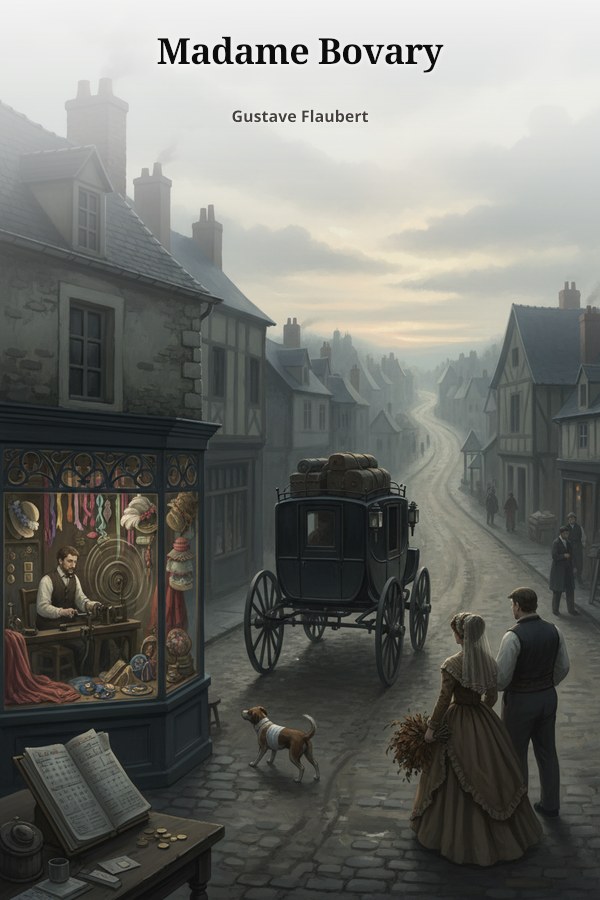
Provincial towns in the Normandy region of France (mainly Tostes and Yonville-l'Abbaye) and the nearby city of Rouen.
The first half of the 19th century (1830s, the era of the July Monarchy, years characterized by rising progressive and bourgeois tendencies).
A stifling and melancholic atmosphere born from a sharp contrast between the suffocating, tedious, and monotonous air of a provincial town and the passionate, colorful, and unreachable romantic dreams of Emma's inner world.
Third-person, omniscient, yet frequently employing free indirect discourse to present the characters' (especially Emma's) inner world, delusions, and emotions from their own perspective, delivered in a sarcastic and ironic authorial voice.
It portrays a rigid and narrow-minded bourgeois order where individuals are evaluated according to their status, profession (apothecary, physician, priest, clerk), and wealth; and where gossip, social pressure, and debates over religion and science (between Homais and the priest) shape daily life.
The culture of early capitalist provincial France, where science and religion, innovative vanity (Homais) and conservatism (Father Bournisien and Monsieur Binet) clash, the public wallows in ignorance and superstition, and flamboyant merchants (Lheureux) exploit peasants and naive bourgeoisie.
Characters are arranged at equal intervals on a circle; you can read the relationship type and dynamics by clicking on the lines.
Bir çizgiye tıklayarak ilişki detayını açın.
Charles loves Emma with a blind devotion and gratitude, practically worshipping her; yet he is completely oblivious to his wife's spiritual needs. Emma, in turn, feels increasing disgust for Charles's timidity, simplicity, and crudeness, viewing him as the cause of all her life's disappointments. Communication between them is superficial; power and emotional superiority rest entirely in Emma's hands.
While watching Charles sleep, Emma finds his fingernails, his eating, and his drinking repulsive, muttering to herself, 'Poor man!... Poor man!'
Rodolphe is a predator who skillfully exploits Emma's pure and passionate love for him. While he initially uses sweet words and romantic lies to seduce her, he begins to grow bored with the relationship as Emma fully surrenders to him and hopes for an escape. While Emma is madly attached to him and begs him to run away, Rodolphe is a selfish man who seeks excuses to push her away.
During the agricultural festival, while Rodolphe cunningly charms Emma with romantic words, he thinks to himself that 'she is merely a beautiful mistress' and calculates how to sever the ties.
Both feel bored with provincial life and bond like soulmates dreaming of art, music, and a life in Paris. Initially, Léon acts shy and cannot confess his feelings; Emma plays the role of a chaste woman, deriving a secret, melancholic pleasure from this unrequited love. Although Léon's departure to Paris and later Rouen separates them physically, it causes them to idealize one another in their minds.
As Léon and Emma dream of novels, music, and Paris by the fireplace in the evenings, they silently connect in their shared emotional world.
Homais uses Charles by flattering him professionally to achieve his own goals (such as covering up his unauthorized medical practices and sending promotional articles to the newspaper). Although the idea for Hippolyte's surgery came entirely from Homais's ambition, he is cunning and slippery enough to leave the entire burden on Charles should it fail.
While Homais praises Charles endlessly for the clubfoot surgery, he immediately shirks responsibility once gangrene sets in after the operation.
Lheureux is a devious predator who understands Emma's weakness for luxury consumption and her search for false happiness through material goods. Every time she falls into a depression, Lheureux markets new items to her. As Emma signs promissory notes for short-term pleasures, Lheureux coldly drags her into a massive quagmire of debt and an irreparable addiction.
Even during the period of Emma's illness, the merchant inflates the bill and exploits Emma's helplessness by selling items like whips and having her sign new promissory notes.
Both are authority figures in the town, yet they represent different worlds. Homais symbolizes a Voltairean pseudo-enlightened, progressive, and (shallowly) science-worshipping bourgeoisie; Bournisien represents a dogmatic, comfort-seeking, and spiritually hollow church. They are constantly engaged in biting debates, yet both are actually arrogant and lack vision.
At the Golden Lion hotel, the pharmacist Homais and the priest engage in endless, shallow, and biting polemics regarding the nature of theater and morality.
Charles's mother is a frugal, hardworking, overbearing, and religious woman; she despises Emma's ostentatious spending and her tendency to neglect housework to read novels. Emma, for her part, scorns the woman's rustic and bigoted attitudes. Charles struggles helplessly between the two. Eventually, the mother-in-law realizes she cannot control Emma and withdraws, while Emma harbors a desire for secret revenge against her.
When Madame Bovary senior arrives at the house and begins to interfere with Emma's expenditures and her treatment of the servant, a violent argument ensues between them that is severe enough to bring Charles to tears.
Emma cannot maintain a consistent love for her daughter, Berthe. Having hoped that if she had a son, she could take revenge by birthing a free male child who would be liberated from the yoke of women, she suffers a great disappointment when she gives birth to a girl. Depending on her emotional volatility, she sometimes hugs the child and showers her with fake affection, while at other times she angrily pushes the girl away when she approaches, making it clear that she finds her repulsive.
Emma violently pushes away Berthe, who approaches her with affection, shouting 'Leave me alone!' and causing her to fall and cut her cheek; she then reflects on how ugly the girl is.