
Marc J. Seifer
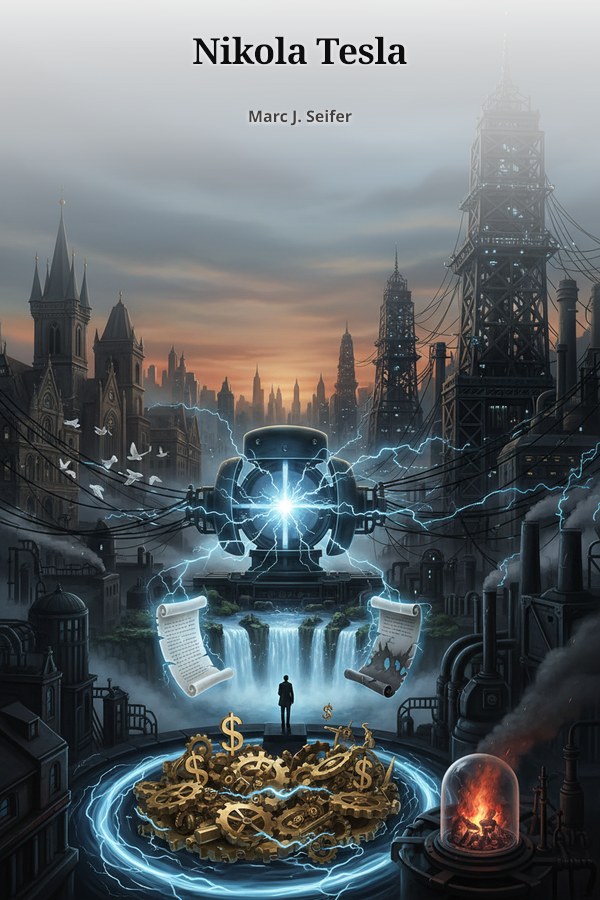
The most important work that deeply examines the life and secrets of Nikola Tesla, serving as both an explanation and a biography, is the book 'Nikola Tesla: Prophet of Silence' (My Inventions) by Marc J. Seifer, titled 'Wizard: The Life and Times of Nikola Tesla'. For Tesla's own account, you can refer to the work 'My Inventions: The Autobiography of Nikola Tesla'.
The unending life struggle between Nikola Tesla's pure passion for unlocking the secrets of nature and building massive systems for the universal benefit of humanity, and the ruthless world of his rivals and financiers, which is filled with intrigue, profit-seeking, patent monopolization, and pragmatism.
Initially Croatia, Austria, Prague, and Paris; but the main focus of the story is the United States (New York, Pittsburgh, Chicago, Niagara, and Colorado).
The last quarter of the 19th century and the first half of the 20th century (predominantly the Gilded Age period between 1856 - 1943).
A tense, academic, and at times dark atmosphere defined by the excitement of scientific discovery, the grandeur of the technological revolution, and the brutal commercial competition that accompanied it.
A third-person academic narrative, undertaken by author Marc J. Seifer, offering a research-based, objective, biographical, historical, and at times psycho-historical perspective.
For inventions to gain value and come to fruition, they must be patented, adopted by massive corporations, and backed by powerful financiers. Genius alone is insufficient to survive; ruthless capitalist maneuvers, courtroom battles, and public opinion manipulation drive the direction of science.
Set on the threshold of the Electrical Age, the final phase of the Industrial Revolution. It depicts the Gilded Age capitalism in America, where titans like Edison, Westinghouse, and J.P. Morgan monopolized the industry. The background is colored by the struggles of immigrants to establish themselves in America and the clash between the European aristocratic academic tradition and American pragmatism.
Characters are arranged at equal intervals on a circle; you can read the relationship type and dynamics by clicking on the lines.
Bir çizgiye tıklayarak ilişki detayını açın.
Begins as a master (Edison) and apprentice (Tesla) relationship. However, it breaks down due to a clash of visions and Edison's failure to keep his financial promises. Subsequently, it turns into a relentless rivalry (the War of Currents - AC vs DC) that pushes moral boundaries (black propaganda, gallows).
Edison's refusal to pay the 50,000 dollars promised to Tesla, brushing it off by saying, 'You don't understand our American humor,' and later initiating an electric execution campaign to discredit AC.
Westinghouse is a visionary capitalist who understood the commercial value and importance of Tesla's inventions, providing him with funding and respect. While the power balance was financially with Westinghouse, they were dependent on one another due to the respect he held for Tesla's technological genius. Tesla made sacrifices when the company faced difficulties.
The historical moment when Tesla, while Westinghouse's company was on the verge of bankruptcy, tore up his contract with his own hands, allegedly relinquishing millions of dollars in royalties.
Strict, devoutly religious, and intellectual, Milutin wanted his son to become a priest. The power balance rested with the authoritarian father, but Tesla stubbornly chose engineering. His near-fatal illness became the greatest moral leverage in Tesla's hands, eventually convincing his father.
When Tesla was severely ill, he told his father that he would recover if allowed to study engineering, leading his father to accept this condition in tears.
The War of Currents erupts between Edison's companies and Westinghouse's. While Westinghouse offered innovative (AC) technology at a cheap price, Edison developed government-supported fear tactics to protect his market share. The tension is at its peak.
Edison, through Harold Brown, using AC to execute animals and subsequently humans in the electric chair to smear Westinghouse's alternating current.
Batchelor is the main bridge who discovered Tesla in Europe and sent him to America to work for Edison. The relationship is based on appreciation for a talented employee, but Batchelor remains ultimately a loyal corporate man to Edison.
The legendary recommendation letter Batchelor wrote to Edison: 'I know of two great men. One is you, and the other is this young man.'
Martin is an important figure who introduced Tesla's inventions to the public, published his books, served as his editor, and introduced Tesla to high society. However, over time, Tesla's paranoia and financial tensions would drive them apart.
Numerous editorials prepared by Martin in prestigious magazines he edited, highlighting and defending Tesla's inventions in alternating current and wireless transmission.
Morgan holds absolute financial power. He maintains a pragmatic and profit-oriented stance in the face of Tesla's visionary (but highly expensive) projects. There is a terrifyingly asymmetric power balance and a communication breakdown in the relationship.
Morgan's decision to stop funding the Wardenclyffe Tower and his abandonment of Tesla after finding his vision of free global energy uncommercializable.
Both are of Serbian descent. Although they initially moved in the same academic and social circles, Pupin eventually sided with Marconi and Edison, attempting to debunk or ignore Tesla's theses. There is an undercurrent of envy and a competition for prestige.
Pupin's advocacy for Marconi's radio patents, rather than Tesla's, at the American Patent Office and in court.