
Jane Austen
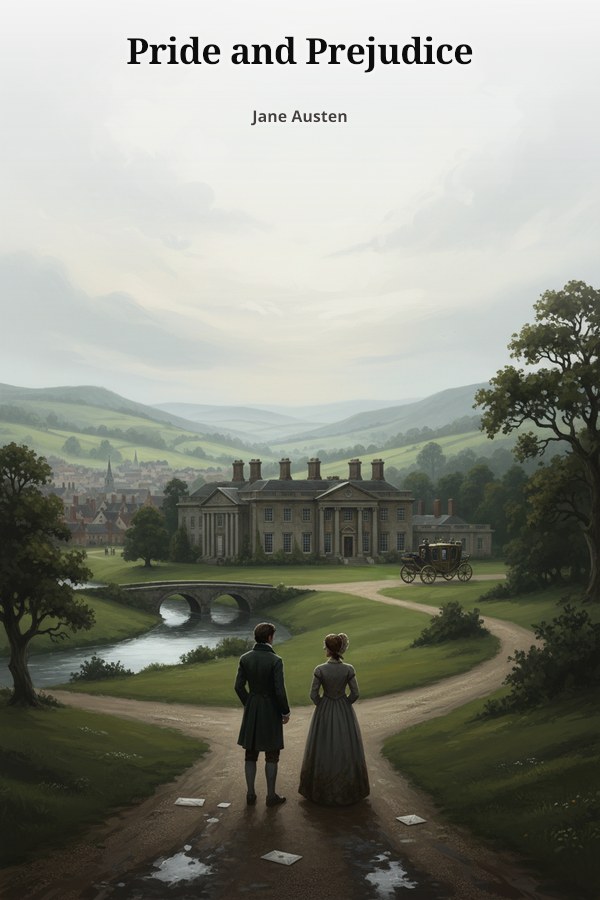
Jane Austen's immortal work "Pride and Prejudice" is a classic romance novel set in 19th-century England, exploring the marital pursuits of the five Bennet sisters, social class disparities, and how pride and prejudice affect human relationships. It focuses on the contentious relationship between the witty Elizabeth Bennet and the wealthy Mr. Darcy.
The conflict arising from Elizabeth's propensity for hasty judgment and prejudice clashing with Mr. Darcy's class-based arrogance, escalating into a crisis that must be resolved despite the interference of those around them (family, false friends, scheming adversaries).
The English countryside and cities; Hertfordshire (Longbourn, Netherfield, Meryton), Kent (Rosings, Hunsford), Derbyshire (Pemberley), and London.
Early 19th century (the 1800s).
An ironic, highly etiquette-bound, and vibrant atmosphere that characterizes early nineteenth-century English provincial and high-society life, simultaneously tense and judgmental due to rigid class distinctions.
Third-person omniscient narrator, ironic and witty, yet predominantly focused on the inner world and perspective of the protagonist, Elizabeth Bennet.
Social reputation and class belonging are paramount; because women's financial security is limited by inheritance laws, a good marriage is the only guarantee of a future. Once the reputation of a woman or her family is tarnished (as in the Lydia incident), it cannot be recovered.
A patriarchal rural English bourgeois and aristocratic society where a woman's primary duty is to acquire aesthetic accomplishments, manage a household, and marry a wealthy gentleman. A legal system characterized by entailment, where estates were bequeathed only to male heirs.
Characters are arranged at equal intervals on a circle; you can read the relationship type and dynamics by clicking on the lines.
Bir çizgiye tıklayarak ilişki detayını açın.
Initially, they experience an intense clash of prejudice and pride. Darcy's social arrogance meets Elizabeth's intellectual obstinacy. The power balance shifts to deep mutual respect and love as Darcy falls for Elizabeth's keen wit and vitality, and Elizabeth undergoes an inner transformation upon learning the truth (Wickham's lies and Darcy's secret kindnesses).
The letter scenes where Darcy reveals the truth to Elizabeth after she tells him, 'Had you behaved in a more gentlemanlike manner,' and 'You were the last man in the world whom I could ever be prevailed on to marry.'
An unwavering, pure, and gentle attraction. Because both are overly good-natured, they are susceptible to external influences (Darcy and the Bingley sisters) and remain apart; the tension in their relationship stems from this quietude and their reluctance to express their feelings outwardly. They always maintain a deep trust and love for one another.
Bingley's return and silent affirmation after Jane suffers in quiet sorrow for days because she had not been sought out by him in London.
An unbreakable bond of sisterhood rooted in complete trust and honesty. Elizabeth fears for her sister Jane, whose overly naive and forgiving nature makes her vulnerable, and she is always ready to fight on her behalf; Jane tries to soften her sister's sharpness and encourages her to see the best in situations.
Elizabeth walking three miles through mud, without a second thought, to reach Netherfield when her sister falls ill.
An incompatible and disrespectful marriage. Mr. Bennet, a clever but indolent man, finds amusement in his wife's shallowness and does not take her seriously, while Mrs. Bennet constantly complains about her husband's indifference within her narrow world focused solely on finding husbands for their daughters.
Mr. Bennet driving his wife to desperation with sarcastic comments such as, 'You mistake me, my dear. I have a high respect for your nerves. They are my old friends.'
Initially, a friendship quite appealing to Elizabeth due to Wickham's smooth charm and his claims about Darcy's wickedness. However, once Wickham's lies are exposed by Darcy's letter and subsequent evidence, this bond is severed completely, turning into sharp hatred and disappointment.
Elizabeth exclaiming upon learning of Lydia's elopement, 'We know him [Wickham] to be a profligate; he has no honesty, no honor.'
A very deep-seated enmity and resentment stemming from the past. Wickham, disloyal and exploitative, took advantage of Darcy's father's affection, pursued wealth, and attempted to elope with Darcy's fifteen-year-old sister, Georgiana. There is a complete moral opposition between them.
Darcy stating in his detailed letter to Elizabeth, 'His chief object was the thirty thousand pounds, and he was determined to be revenged on me.'
Bingley is compliant, while Darcy is authoritative and resolute. Bingley holds his closest friend in infinite respect, allowing his decisions to be guided directly by Darcy's advice. The balance of power rests with Darcy, though his sole intention is to protect his friend from potential trouble.
Darcy's ability to persuade Bingley to withdraw from Hertfordshire by lying that Jane was indifferent to him.
Elizabeth's intellectual rebellion, refusing to bow to the noble and tyrannical character of the Lady. While Lady Catherine views her as an inferior country girl to be crushed, Elizabeth defends her own worth and overcomes her with her logic.
Elizabeth's noble refusal when Lady Catherine arrives at Longbourn to demand she stay away from Darcy: 'You have not made me your confidante, and I do not mean to be so.'
A purely pragmatic, soulless, and calculating union. Charlotte is well aware that her husband is foolish, sycophantic, and tedious, yet she skillfully manages him to avoid financial hardship, creating her own space by keeping him at a distance.
When Elizabeth visits, Charlotte's cold yet managerial demeanor, evidenced by keeping her husband's room separate to avoid being face-to-face with Mr. Collins.
There is a profound lack of understanding and conflict. While Mrs. Bennet wants to marry off her daughter at any cost, Elizabeth absolutely rejects a loveless relationship she would not choose with her own mind. While her mother treats her as foolish or impolite, Elizabeth watches her with inward shame.
When Elizabeth rejects Mr. Collins's marriage proposal, her mother's outburst: 'If you will not marry Mr. Collins, I will never speak to you again.'