
Fyodor Dostoyevski
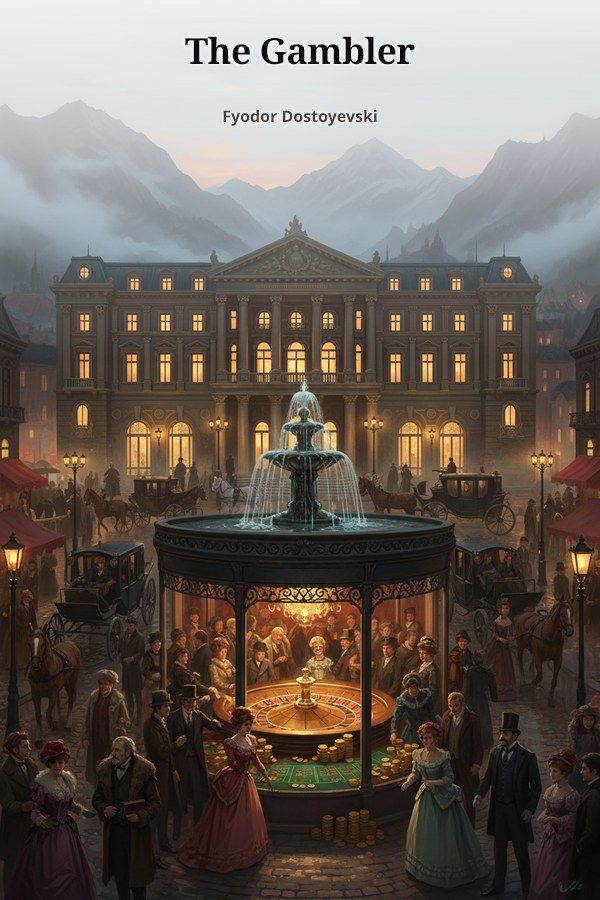
The Gambler, which Dostoevsky wrote in 29 days inspired by his own gambling addiction, is a classic novel based on passion, money, and human psychology. Set in Roulettenburg, the story deals with the life of Alexei Ivanovich, squandered by his love for Polina and his destructive obsession with the roulette table, his cycle of debt, and the Russian-European conflict.
The internal battle between Alexei Ivanovich's masochistic and destructive love for Polina, who tramples his honor, and his addiction to the roulette table, which suddenly offers him power, wealth, and the opportunity for revenge. Concurrently, the external conflict is shaped by the desperate need of the General's family for the inheritance they await in fear of losing their fortune.
A fictional German spa and gambling town called Roulettenbourg. In the latter parts of the novel, Paris and partly Homburg and Baden.
Mid-19th century. (Supported by the use of telegrams, train travel, German-Prussian cultural references, and mentions of General Perovski's memoirs in the text).
Tense, feverish, melancholic, and chaotic. The stifling, hypnotic, and destructive atmosphere of luxury hotels and gambling halls, where people succumb to their passions and greed for money, is reflected in every line of the novel.
First-person limited narrator (Alexei Ivanovich). The narration is highly subjective, passionate, feverish, at times bordering on insanity, and unreliable. It possesses a philosophical tone that simultaneously criticizes his own weaknesses and indulges in them.
Social respectability, morality, and relationships are shaped entirely around money and material power. Appearing to have status ('comme il faut') is more important than actual morality. The casino is a merciless arena where all social classes are leveled but also where weaknesses are brutally punished. Keeping secrets and debts hidden is of vital importance.
The infrastructure of the work is built on the cultural contrasts in a cosmopolitan European spa town: the undisciplined, passionate, uncontrolled, and extravagant nature of the Russians; the formal, arrogant, and calculating temperament of the French; the orderly and thrifty ('vater') structure of the Germans; and the cool-headed, honorable, and logical stance of the English.
Characters are arranged at equal intervals on a circle; you can read the relationship type and dynamics by clicking on the lines.
Bir çizgiye tıklayarak ilişki detayını açın.
Alexei is obsessively and slavishly attached to Polina. Polina scorns his feelings, degrades him, and uses him; yet deep down, she feels a complex mix of trust and hatred toward him. The power balance, initially in Polina's favor, is suddenly broken and shattered when Alexei wins the jackpot.
Polina cruelly plays with Alexei's fate by telling him to jump at the Schlangenberg; Alexei, in turn, is shaken when she throws the one hundred thousand florins in his face.
Astley is the opposite of Alexei; quiet, honorable, and balanced. Both love Polina. While watching Alexei's moral decline, Astley gives him honest advice; he respects him but judges his hopeless situation clearly at the end of the novel.
When Astley finds Alexei in Homburg, he gives him money to save him but tells him to his face that he is a man ruined by roulette and the Russian nature.
Alexei is disgusted by Des Grieux's superficial, calculating French politeness and his influence over Polina. Des Grieux, in turn, looks down on Alexei as an ordinary, insignificant tutor ('outchitel'), but begins to fear him when events spiral out of control.
Alexei openly provokes Des Grieux at the dinner table by mocking the false honor and manners of the French.
Both are passionate, stubborn, and have a typical Russian temperament. The Grandmother initially takes Alexei under her command and uses him to place bets at the table. While watching the woman's uncontrolled downfall, Alexei is both horrified and derives a dark pleasure from her rebellious attitude.
When the Grandmother bets all her money on zero at the roulette table, Alexei cannot oppose her madness and gets swept away by the flow of fate.
Polina had previously loved and surrendered to Des Grieux. Des Grieux manipulates her with the family's debts. When the Grandmother's inheritance vanishes, Des Grieux abandons Polina. Polina's love for him turns into deep hatred and disgust.
Polina shows Alexei the farewell letter written by Des Grieux, spewing out her rage and the humiliation she feels.
Astley is attached to Polina with great respect and silent love. In a moment of crisis, when everyone else abandons her, Polina takes refuge in Astley as the most reliable harbor. The power balance is based on the moral and physical protection provided by Astley.
After Aleksey's crisis and the General's collapse, Polina flees the hotel and takes refuge directly at Mr. Astley's hotel.
The General is obsessed with Grandmother's death and her inheritance. When Grandmother suddenly appears, the General is struck by terror and becomes paralyzed. With every gold piece she loses, the General's hopes and sanity shatter.
In his study, the General sobs and crawls on the floor when his hopes that Grandmother would die are dashed.
The General is blindly in love with Blanche, to the point of forsaking his honor. Blanche, however, is a pure opportunist; she keeps the General close while there is a prospect of inheritance, and discards him like a rag once the inheritance is gone.
Once Blanche realizes that Grandmother has lost everything, she kicks the General out of her room; the General chases after her, suffering humiliation.
After Aleksey wins a great fortune, Blanche pursues him and takes him to Paris. Both are aware that this relationship is purely one of financial exploitation. Aleksey deliberately allows her to spend his money, mocking the absurdity and repulsiveness of the situation.
Blanche spends most of the two hundred thousand francs Aleksey won on her own luxury and tells him, with candid sarcasm, that he is a fool.